Saturday, 21 June 2014

Quick update June 26:

Thanks for your response regarding our requests, etc.  It helps take some of the guesswork and memory work out of the workload.

It often happens that some crops force a change in the menu - as I started harvesting the Cress, I realised that their was more than enough for everyone.  As Cress is a once a season crop (does well only in the spring in this territory), I thought it best to give everyone some of it.  Let me know what you think of it...if we are lucky, we may get some more in two weeks.

Looks like the turnips and and Zuchini are getting ready - maybe some next week.  Lots of crops look like they are coming in earlier than expected.  One grower I was taking to said the fluctuations between hot and cool were "confusing the plants".

I wish that Zuchini ((3 weeks early?)  would get a little more confused and slow down.

Even some tomatoes are starting to flower, this could be bad news or great.  We'll have to wait and see...

Hey Folks:

Time for a quick post before some much needed RnR.

This is turning out to be a challenging season.  Computer issues (hopefully resolved), a difficult nursery (lost most of our bulb onions for a variety of reasons to it - I tried three times), one intern (three positions were advertised for), and early pigs (they were to have shown up in the mid season planting lull between early and mid July).  Even the priorities have had to be prioritized.

It is times like this that my back ground in other careers keeps me managing.  Competitive distance running (physical endurance and mental stamina), front line health care (working miracles in impossible situations), community radio and festivals (the show must go on), and playing in an independent rock and roll band in a small town where the scene numbers 3 1/2 musicians and as many appreciative fans (It's not going to happen if I don't make it happen).  All of the above, like farming, are not for the faint at heart.

I'll focus on the successes, read between the lines for the failures.

Peas and Beans:

The Peas are loving this cool-ish weather.  I am learning that 2-3 beds of picking are my limit for a harvest.  Many growers consider these crops a loss leader, due to the fact that picking time by most of us is not quick enough to make the value of the crop.  $4.00 a Lb for beans, and slightly more for peas), is about what the market will bear.  Professional pickers are difficult to come by (they are paid by the pound, and are accustomed to 40 degree heat), and machine picked beans are varieties that can withstand rough treatment - if they have any flavor, I haven't noticed.


Our snow peas, a variety called Norli, are not the greatest tasting variety either.  They are the only snow pea variety available as certified organic seed that I can find, and they are dependable and trouble free.  We do the snap peas later in the fall.


The first variety of beans that we should experience this season are called Provider.  (Should be on your table in about three weeks).  It has two characteristics that I require for our early beans.  First, they germinate in relatively cold soil, unlike most beans.  Second, most bush beans will produce for two or three weeks and then finish.  Provider continues to set beans as long as they are being picked.  However, they do shut down when the temperature gets too hot for them.  They do not taste quite as good as our french bean Maxibel, or our favorite, Slenderette.

Our greens have had mixed results so far.  Generally, the cool weather has been good for them.  However, 48 hours in the life of a 40 day Spinach is a long time.  Two or three days of 28 degree plus weather can be too much, particularly when they are germinating or just sprouting.


Aside from some poorly timed heat-waves, most of the greens are doing well.  The Kale and Chard look phenomenal, the lettuces are small (nursery issues again) but healthy, and the Cress has stood up to the heat with some of our shaded tunnels.  The mustard greens have suffered somewhat, I suspect that the bed they are in requires more compost.  They are following a root crop (last year's beets), and as beets are heavy feeders, this may also be the reason why our first round has not fared quite as well as expected.  Not to worry, they are still in good enough shape for this week and hopefully the next two.  One note, they have been bitten up a bit by the Flea Beetles.  Not much can be done about this except watering the heck out of these plants.  The damage only affects appearance.  There is some evidence that produce that has experienced insect damage is higher in building blocks for the immune system.


One other note on the leaves.  Our New Zealand Spinach is settling into its first bed and getting ready to climb onto the trellis.  We have another three heat tolerant leaves on the way for later in the summer - Red Callaloo, Gold Purslane, and Purple Orach.


The roots are looking good - potatoes, carrots, turnips and beets.  But they are growing SO SLOW!  Only the turnips look like they are approaching harvest.  More radishes on they way.


By chance, I made a preemptive strike on the Potato Beatles.  I was checking the plants progress under the row covers, and just happened to notice a cluster of yellow eggs on the underside of one of the pants leaves.  How DO they get under my row covers?  They even skipped the "canary" plants that I leave uncovered.  So, I checked every single plant and disposed of a dozen adults and hundreds of eggs.  There's more on the way I'm sure...


Mibuna (left) and Tokyo Bekana
Asian Greens (Pac Choi and Tatsoi) are also on the way.  Last year was our first attempt at these crops.  I made the mistake of waiting for them to size up, but later learned that they are at their best when small.  So, we planted 10 times as much in the nursery, transplanted them much closer together, and will start harvesting them three weeks after transplant.  Quite a turnaround time.  These crops are taking up a lot of space, but well worth the effort.  The biggest challenge for delivering these crops is their fragility.  Some growers let them wilt before packaging so that they are more flexible.  I can't bring myself to do this, though if broken Chois are in your deliveries, let me know and I will give it a try.

Tip - most vegetables that are a bit wilted can be brought back by a few hours of being immersed in water.


The Garlic is doing great.  The scapes are in various stages of forming.  My one worry is how early some of the crop is maturing - I hope this does not mean that the bulbs are not sizing up to expectation.  We may be pulling some of these bulbs by early July, which means they will be delivered by late July (after curing for two weeks in the rafters of the barn).  You may notice that the garlic shoots have slightly different colors on the bulb and lowest portion of the stalk.  This hints at some of the variation you can expect...


Green Onions are coming along slowly after a dismal start.  I was in a bit of a panic 4 weeks ago when it seemed that the nursery was going to do every round of seeding in.  I seem to have started to catch up.  Green Onions are fairly easy, but they are very susceptible to drying out due to their shallow roots.  I've been using a light straw mulch around the base of the plants to alleviate this somewhat.  This poses another challenge - how to cultivate with the hoe with all that straw around?  Even at the best of times, weeding by hand takes too much time.  And being shallow rooted, green onions simply can't compete for water with other crops.

The Tomatoes are slow but coming along according to plan, I am eager to try the earliest of these - the Lime Green Cherry tomatoes.  We tried a Cherry Tomato a couple of years back.  It was called "Matina" and advertised as easy to grow, juicy and sweet.  Well, it was easy (didn't crack, resistant to hornworms, uniform appearance).  All of my customers whom I spoke with about them seemed to agree that they were watery and bland.  So I am hoping that the Lime Green Cherry's from Sunshine Farm in BC (advertised as tart flavored - whatever that means) are a big improvement.  Our other Toms, Moskvich, Great White, and Sorrento are also doing well, but we could only about 6 Sorrento plants out of the nursery, and something with buck teeth got two of the Moskvich.  I made a temporary improvement to the fence where it had been breached (animal tracking is another essential skill for harried growers).  It looks ugly but it works until a permanent solution can be found.

We have successfully transplanted six Asian Eggplant seedlings.  An improvement over last year.  I originally intended to do four plants each, but assuming that we may loose a couple, I made room for two more.  I hope the trellis stands up to this crop.  Each plant has the potential to produce 20 fruits.  The only worry is that this crop is very susceptible to Potato Beetles.  As they are trellised, I can't cover them with row covers.

We were able to find more space this season for extra Cucumber plants by trellising these as well.  Another experiment that could easily end in tears (and a lot of extra work).  Angela and I drove the stakes in a foot just to be sure.

The acorn squash is already flowering.  That damn squirrel better stay well in the hedgerow (or in the Zuchini plants).  I love animals, but as any grower will know, animals - even the two legged ones - can be quite fierce when defending food territory.  And I (unlike squirrels) have opposable thumbs and a fore brain. Squash flowers make a tasty side dish when stir fried.  Less refined creatures will eat them raw.  Please excuse my rodent fury.

Winter Squashes mulched with straw
The other winter squash, Delicata Honeyboat, should be the one to wait for.  Those of you who tried it last year will know why I have concentrated on this one this season.

Well, it's much too late to continue.  I have an early day tomorrow (another 21 day work-week in store), and I still want to catch a film tonight.

I'll speak more about our long season produce in our next post, and our vegetables with a beating heart as well.  By then, the camera battery should be re-charged, and I can get the picks I shot today up on the site.

See you soon,

Bob

"Will plow for Oats..."


Oppopeos and Nicotania


Wednesday, 28 May 2014


Update June 21:

New post up shortly, with pix.  Just have to give it a once over (besides supper is ready and I can't write about food on an empty stomach).

"This Weeks Harvest" page is updated...

Bob


Update June 4th:

Able to access the net again - go figure, it was unavailable to me last night.  My digital box is heading back to the shop for another round of cleaning and reinstalling.  If that doesn't work, I guess it will be time to give up on the world wide sieve and go back to bush telegraph, or smoke signals, or carrier pidgeon...

Food continues to be planted and or transplanted.  A veritable parade of plants and seeds - more potatoes, more lettuce, more fennel and cress.  Makes my mouth water just thinking about it.

Those of you who were with us last year may recall the ongoing wrestling match with the monster Zuchini plants.  I have co-opted the same variety this year, and turned it to my advantage.

First off, some back ground.  I tried a new variety last year - Dunja Zuchini.  It was described by the seed house as a "compact plant with vigorous fruit set".  Having been disappointed with the yield of the previous two varieties, I gave it a try.  Wanting to ensure that I had enough fruits, I optimistically transplanted 8 plants into a bed in the field, figuring that Dunja being a compact plant, it would have plenty of space.  This was not to be.

First off, by the time it was apparent that these compact plants were not, they were spreading out over the adjacent beds, covering  the beets on the south side of the bed, and shading the lettuces on the north side.  Second, the seed house failed to mention the sheer pricklyness of this variety, making work on the lettuce and beets somewhat painful, not to mention awkward.  The Zuke plants were so big that they covered the path - work was impossible without stepping on their spreading leaves and stems.  This made little difference to the plants, they just kept growing.

As for the vigorous fruit set, it was a daily task to pick the fruits before they were buried in the foliage and or became too big for anything other than Zuchini bread*.  And the fruits kept coming.  And coming.  There was a box of fruits every harvest day for a couple of weeks, I was handing them out to each customer who wanted extra - fortunately, some of you were happy to oblige.  We ate as much as we could.  (Every sandwich and stew I made included a few slices.  There was still some to return to return to the compost for "next years food".

I'm not sure if these Zukes were to blame, but they were the first squash I have ever grown that attracted squash beetles.  We've had cucumber beetles before, these were a new insect for me.  Pick and squash sweeps were successful, at least when the bugs were on the perimeter of the plants.  More of these insects could be seen in the heart of the squash jungle, but these were almost arms length from what was left of the path. As well, the spiny stems put one at risk from lacerations when reaching into these thickets.

So the bugs multiplied and only seemed to encourage the Zukes to out-grow the damage, setting more fruit and spreading more leaves.  A few discouraging words were heard on the range.  (Squirrels love to eat squash flowers, I wanted to start throwing them into the plants in order to keep their little paws out of the nursery and reduce the number of fruits setting).   One of my customers "helped out" by taking a bag full of flowers to cook.

Finally, enough was enough, and Randy and I took the machetes to the plants, slashing one of my irrigation hoses and scratching our arms and hands in the process.  The plants were carefully carried out, buried in the compost, and forgotten until the squash beetles appeared in the pumpkins. 

This spring, I found a few stunted adult squash beetles in the undergrowth, they appeared to be subsisting on whatever they could consume.  Knowing that they would go to the first squash plants to be transplanted this season, I started my zukes using the leftover seeds from last year.  I planted them as far away as possible from everything (site of an old compost bed where I intend to build another flower garden next year).  

They will be out of the way,  have plenty of space to grow, and hopefully attract these beetles to an isolated corner of the  field (not far from last year's pumpkins).  They might even compete successfully with the cows parsley/wild celery (a rash causing  plant that also grows vigorously in that area).  Being near the road fence, they will augment the electric and barb-wire defences of the farm.  And they are close enough to the hedgerow to hopefully trap some squirrels.

I planted half as many this year, and used the last of that seed.  Please enjoy our Zuchini this year...

*(We discovered that large Zuchini sliced in half, stuffed with minced lamb and and seasoning's makes for a great meal).  

Later...  

First harvest in two weeks!

Update June 2nd:

We are still having intermittent internet issues, so please contact me by phone (at the bottom of the page) if you need to contact me.  I was able to access this thing late last week, but not at all on the weekend.

Still looking for 2 interns....

One last share left!  If interested, order soon.  Please contact us by phone - I am USUALLY home after 7 pm, though the fact is this has been a bit of a awkward and unexpected week  - see below...

Another milestone reached at Whitsend.  Our two little pigs have arrived, and seem to be settling in.

It's a long story (worthy of another post), but we had to advance this project quite unexpectedly.  First, the piglets pictured in a previous post last fall were the sows that were supposed to breed my piglets (a bit of a misinterpretation on my part with Flycreek Farm).

My pigs were to be born about a month ago.  However, I received a note from Brandy that the sows had miscarried.  

I scrambled!  Everything that I had done with the east field for the past year was with the plan to have pigs clearing it.  In other words, I had been dumping dandelion roots and clumps of quack grass turf into this area.  If pigs were not introduced to eat these quick rooting plants, I would have been facing a veritable tidal wave of grass and flowers.  Not good.

As well, I had already purchased the feed, purchased and planted forage crop, and collected numerous items required.  

I was able to find two male Berkshire piglets through Brandy.   So now they are at the farm, doing what contented pigs do.  Such as try to wallow in the water dishes, test the taste and thickness (with their teeth) of my boots, and grunt thanks when I bring their feed ration.

Late in the afternoon and early evening, they start playing (which seems to involve chasing each other like crazy around their enclosure).

Within two days, they were trained to the electric fence.  It took several tries with handfuls of oat grass to coax them into a new area of the field.   They did not want to pass the point where the electric line had previously been.  

Photos of pigs and farm up soon...interesting creatures.

Hey Folks:

Just a quick update on the state of the farm and your food.  

Our computer troubles persist, but I am finding a way around them. It’s awkward and time consuming, and not at all convienient.  I need to get this cleared up very soon.  If any of you are tech savvy (and can translate computerese into plain English), I would gladly take some advice.

As for the food, most of the growth is going well.  Other than onions, Parsley, and some Pepper/Tomato transplants, everything is growing according to plan, and exceeding expectaions in many cases. 

We lost a good intern!  Angela is doing great, but Scott had to leave for reasons beyond both of our control.  I need at least one or two more.  If you know of anyone interested in this opportunity, PLEASE direct them to Whitsend.  I’m almost in a panic on this point. 

Our two little helpers are scheduled to arrive later this week.  If you come out, be sure to say hello to them.  They’ll be eating from my trough and changing the constitution of my land…

Now for the food.

The early peas were very slow, and will probably catch up to the second round of peas.  Hope for some cool weather so we can actually have a decent harvest of them.

In the event that the peas shut down due to the heat, the green beans may well catch up in time to replace them.  They germinated in three days (5-8 days being the normal in previous years for me.  Your best case scenario is a week or two of 20 – 22 degree days (meaning lots of peas and beans all at once).  In other words, a lot of time consuming picking on my part.  I’m hoping for cooler weather to spread out the bean/pea harvest.  This is farming…probably wishful thinking.

The leaf crops are doing well.  I’m anticipating some small lettuces to start the season, but for the second and third week, there should be two small heads per basket.  We’ll be seeing a lot of green leaf initially.  I have found a red leaf that looks promising, an heirloom called “Les Orielles du Diables”.  The green and rose leaf lettuce we had last year should be due in about the third or fourth week of harvests.

The Spinach, Mustard greens (Arugula, Tokyo Bekana, and Mibuna) and Pak Choi are off to a good start as well.  These should be ready for the first harvest.  We have planted a lot of Spinach.  Again, hope for some cooler temperatures so I can get two harvests from each bed.  The Coriander has also germinated well and should be ready for its first harvest in early July, with a second, larger harvest to follow shortly thereafter.

The Kale is doing particularly well, and the Chard is not looking too bad either.  We should see these fairly early in the season (late June and early July respectively).

The New Zealand Spinach is straining at the leash to get out to the field, all I need to do is get the trellis up.  It’s a new crop for us.   I have been told not to be too expectant on the anmount of yield.   With that in mind, I have already started the other heat loving crops –  Gold Purslane (high in omega 3’s) and some red Amaranth for those of you who like veg Jamaican patties.

Speaking of Amaranth that reminds me of the flowers that have been transplanted into the new rock garden.  We have Oppopeos, jasmine scented Nicotania, and Leopard Flowers coming up.  The Zinnias and Safflowers are trying to grow their way out of the  nursery, a little more bed cleaning is required to get their space ready.  The evening Primrose will be a two year project, it is unlikely that they will flower this season.

Our Thyme did exceptionally well in the nursery, we transplanted almost a dozen seedlings two weeks ago.  We aslo got the Oregano out this year.  The Rosemary is coming along.  The planter for it still needs to be cleaned out, thankfully, Rosemary is a very slow grower.  We started the season with one Lemon Balm, which died when the nursery froze in late February (What happened to my my first round of Bulb Onions and Tomatoes!)  We have since manged to get a second plant started.  As it is a mint family crop, that shoud be more than enough to fill the field in a year or two, as the catnip we started two years ago has taken a very similar path.  One plant in the old rock garden has propogated so well that it is now found in the furthest reaches of the field.  

Speaking of extraordinary growth, almost every garlic clove I planted last fall has emerged.

I tried every trick I know of to get the first round of carrots to germinate sooner, but they appear to have waited again.  Infra-red plastic mulch, extra water, full sun for the afternoons.  They are up and are growing according to an early to mid July harvest schedule.  Now that the second round of carrots are starting to appear, the quantity for the late July carrots should be substantial. As well, the beds were prepped and amended with compost late last season, so they are very weed free and thus will be easy to thin out for some good sized roots.  

It may have been too hot too soon for the Parsnips, I have only seen a couple of sprouts so far.  This crop is tricky as it requires cool soil to germinate, and the germination period is almost three weeks under ordinary circumstances.  Not ideal for typical Eastern Ontario spring weather.  If they appear to fail, then the bed will be cleaned and the Parsnips replaced with more fall carrots.

Still in the carrot family, the coriander is growing well (though i made the mistake of planting it for whole plant harvesting as opposed to the cut and come again method).  I started a second round a bit early to make up for this.

Speaking of late, I was so afraid of loosing my Basil seeds due to nursery issues that I held off on starting it two weeks ago (it’s another slow grower, and very sensitive to temperature fluctuations).   It’s now about two weeks from transplant, another 6 to 8 weeks from harvest.  

By the way, I have figured out something on Basil that has given me difficulties the past few years.  Those of you who were with us last season may recall the “messy” leaves.  The challenge is that cleaning the leaves after harvest with cold well water often ruins the leaves (cold turns the harvested Basil leaves black).  So I ceased cleaning them (leaving them covered in soil, certainly an inconvience for the customers).  This year, I will be gently spraying the plants down before harvest this year.  I think this will make a big improvement.

The seed potatoes have started going into the ground, with more to be planted over the next couple of weeks.  The seed potatoes for those of you interested in planting some in your own containers are ready.  I’ll deliver these with the first harvest.

The Eggplants are doing as well as I can tell in the nursery.  We lost these at transplant last year, probably due to transplant shock. 

I am taking some better care of them this time around, with some good advice from a couple of growers.  First, don’t wait to get them out before they become root bound.  Second, provide row covers for shade first couple of days.  Thirdly, water them in with warm water to prevent shocking the roots with cold well water.  (I’ll do this by setting the full watering cans in the rock garden for an hour or so before transplanting the Eggplants).  The rock garen ambient temperature can reach 30 degrees or more on sunny days.  

Also, I was warned by Henry at Ellenberger (Seed Potato) Farm that to be vigilant for Potato Beetles on these plants, as they will leave the Potatoes alone in favour of this crop.  Eegplants are so demanding, I wonder if it has done a good job of domesticating me!

Corn is a crop that (I believe author Michael Pollan referred to) as the crop that domesticated the human race.  It is such a botanically unusual plant that it may have gone extinct if humans had not started to grow and propogate it.  We are now it’s dependants in many ways.  As for our corn, I have sown half of it last week, the second half to be sown next week.  This will ensure that the harvest window is extended, ensuring that all customer s should receive several meals worth of it over a period of weeks  instead of all at once. 

Last years survey revealed an almost even split between those of you in favour of heirloom corn and hybrid sweet corn.  As it turned out, organic corn seed was in very short supply for the 2014 seasn, and the hybrid Sweet Luscious was unavailable.  Fishers Earliest  is the variety for this season.  Dependable, relativley tender, and true corn flavour.

Ouch…it’s getting late!  I’ll tell you about the Brussels sprout success (and farm non-food events) sooner or later.

Later,


Bob

Tuesday, 13 May 2014


Update May 11

More computer issues!  Find the farm's contact below...we are working on it.

Two more Baskets remaining for the 2014 season!  If you want to eat with us this season, contact soon...

Two Intern positions open for the 2014 season.  If you want to dig with us this season, contact soon...

This post is already outdated.  Once we have our computer issues resolved, we should be back to weekly posts.  In the meantime, settle down for a good read about what we were up to about two weeks ago.

I have tried to get the layout right, but it is getting late.  Time to pack the lunch and get out there.


Morning at Whitsend...


Frost days are always an early start.  


I place row covers over the plants in the evening.  During the night, the ground releases its heat.  The row covers hold that heat around the plant, preventing the frost from accumulating on the crops.

I also use the row covers to keep bugs off the plants (Flea beetles off of young cabbage family crops, and Leek moths off of the Garlic).


I have also used them for slowing down evaporation of moisture from seed beds, shading crops intolerant of too much heat, and for providing some protection to crops after they have been transplanted.  This year, I am experimenting with using straw for these last two uses.


The biggest drawback about using covers is that they are time consuming to work with, have a working life of about 2 years, and they cut down light transmission by about 15 %.  As well, I think they look ugly.


We'll start in the nursery, where most of the growing action is taking place.  These are Green Onions in cell packs. 


Many of our crops are started in seed trays, and then promoted up to cell packs.  This allows the individual plants to develop in a controlled environment.  Weak plants can be weeded out and the best ones reserved for planting in the field.


Here are lettuces that are a couple of days from sprouting.  Lettuce can also be direct seeded, however, not all seeds will germinate.  This would leave gaps in the bed, which would be a waste of space.


The shiny background is an aluminized bubble wrap insulation.  An added layer of warmth that distributes light more evenly in the nursery.


Here are some Pepper plants and an extra Tomato plant.  When the Peppers have grown their third secondary leaf, they will be ready for their "cold treatment" - a period of time when they are placed where they are subjected to 10 degree temperature at night.  This promotes earlier and more vigorous fruit set.

Ideally, these will be potted up one size to stimulate growth.  Due to the amount of space in the nursery, not all Peppers will get this additional opportunity to develop before transplant.

The earliest round of crops are now being hardened off in an outdoor shelter.  For increasingly longer periods of time, these plants are subjected to direct sunlight, wind, and some chillier conditions.  This reduces the chance that the shock of transplant will not affect the plants for too long, allowing them to start growing into the bed sooner.


The shelter was a shambles at the end of winter, having seen several years of service.  Old boards and plastic were replaced, the door was improved, and the structure made a little more sturdy.


And now out into the field.  Everything has started to thaw out from last nights low (in the field) of minus 2.  I have found that our weather is matched to Ashton (as opposed to Ottawa airport or Gatineau.  Listening to the weather reports requires a bit of a guess as to what the predictions are for our particular area - Environment Canada does not give weather reports for this micro climate.

Ready for landing…these beds are set to receive their transplants and or seeds over  the coming weeks.  Each week, we use a co-linear hoe to disrupt the weeds as they sprout.  This method, repeated once a week for three weeks, remove most weeds that will germinate during the season.  Hoeing a bed takes minutes.  Pulling mature weeds by hands takes considerably longer.

Cultivating incorporates top-dressed compost into the soil.   Pulling mature weeds out removes soil and surface compost from the bed.

Each year, a few of the paths in between the beds are seeded over to Dutch clover.  This suppresses weed growth in the paths, retains moisture in the ground, and provides a bit of nitrogen for the soil.  It also looks attractive and gives the knees of my field jeans an even color.


Here are the earliest of our Snow Peas.  The 
New Zealand Spinach will be ready to  be transplanted here when the Peas are finished.  The Peas provide extra nitrogen for the soil.  Leaf crops such as NZ Spinach grow best in nitrogen rich soil. 

Ideally, crops should be sown in straight lines.  This improves the ease with which the co-linear hoe can be used, and saves a lot of time.   Apparently, I wasn't quite on the mark this time around.


Most of our climbing plants, such as Peas and Tomatoes, are grown using the "basket weave method".  Stakes are placed at even intervals around the bed, and then as the plants grow, a new line of twine is tied around the stakes.  This is a very simple method that uses less material and effort than other methods of trellising.


Another advantage of using the hoe to cultivate is that it breaks up the soil surface to allow rain to penetrate the soil more effectively.


A third benefit is that it incorporates the compost that is added to the soil surface.  I prefer to top dress my compost as it allows the compost to remain close the the root zone of the crops.  Most veg crops have relatively shallow roots.  Machine tilling the compost deep into the ground would leave the compost too far down for many crops to take advantage of.  


 Elliot Coleman calls it a "thumbs up" tool.   It is used while standing straight, as opposed to the more common Dutch hoe, which forces one to work with poor posture.

Dutch hoes have there place, I have used them to level out ground for a turkey shelter at Elmtree.

Both of these photos by Scott Costen.

A safety no-no in the back ground - spot the rake set tines up.  A great money maker for dentists.


The Co-linear hoe is my favourite tool – it also hills beans and potatoes, and does a decent job edging beds.


In addition to all of the preparation work, maintaining the crops that are already out there still needs to be done.


Finding little efficiencies is the number one most important factor in the success of a small farm.  Here, I should be using both hands - one pail on each arm to water both rows of peas at the same time.  I am assuming that in this picture, there was just a little bit of extra water  required at the end of the bed.


Here is your Garlic from a couple of weeks ago.   Almost 100% emergence, a slight improvement over last year.  As always, it is a bit of a guessing game as to what is occurring underground. 


Assuming the bulbs develop well, each Snack Basket should receive 5 bulbs minimum, Picnic Basket shares a minimum of 10 bulbs each, and Feast Baskets twenty bulbs.  These will be harvested in mid July, cured for two weeks, and distributed in early August.  All varieties will be initialled so that you can have the opportunity to compare the different types.


In addition to bulbs, customers will receive garlic shoots in your first baskets.  These are chopped into salads, soups, stews, anywhere you want a bit of garlic.  The stem, leaves and miniature bulb are all edible, though the flavour is strong – use moderately!

Then, in early July, you receive the scapes.  These are the “flower” head of the garlic, which are cooked or steamed and added wherever you want some garlic flavour.

As of last week, the garlic has grown considerably.  Five beds with eight varieties, plus another bed with garlic shoots (not to be confused with scapes).


All of the garlic was planted last fall, and covered over with straw to prevent the bulbs from freezing.  


Here, the straw has been pulled back to take inventory and cultivate the beds.  The straw stays on until harvest to continue suppressing weeds and retain moister, two factors that are critical for the success of a garlic crop - they are a thirsty plants that don't like competition.


This is a leaf mold compost.  Unlike the regular compost used for producing vegetables, this compost relies on mold instead of bacteria for breaking down the organic matter.  Apparently, garlic responds to leaf mold very well. 

This compost is positioned near the gate for two reasons.  First, the beds for next year’s garlic are nearby, so it is pre-positioned in anticipation of getting the garlic beds prepared for the fall planting.   As well, they are sitting in the spot reserved for the third perennial bed.  While we finish the second perennial bed, the leaf mold compost  suppresses the weed growth until we are ready to start building the third perennial bed. 


Here is the second of two Perennial Beds.  Here, we will be growing some of our flowers and herbs.  

When I started the leaf mold compost last fall, I placed the pile where the second perennial beds was to be built, to knock back some of the grass turf.  Now that it has been removed, work can begin.


Hardscaping is not a technique that I am very familiar with.   Second hand books, libraries, internet, farm texts all have a few (sometimes contradictory) good practices to follow.  


While working here, I found some leftover compost-rich soil from my first compost pile that was situated here in our first year.  Buried treasure...I can use this elsewhere.


Sometimes common sense and thinking ahead are the best guides.  What will the weed growth from the fence line make this look in two months?


I have cut through the rest of the turf, removed the quack grass rhizomes (root-like structures), and placed large flat rocks for the foot path around the perimeter.  Then, the loose soil is raked up and the smaller flat rocks and the more decorative rocks are built up around the raised bed.


The rocks will provide a lot of warmth late in the season when the nights get cooler, allowing the plants to enjoy a slightly longer season.  

The plants chosen for this bed are self seeding.  They should continue to produce next year.  the key will be to heap lots of straw around them to prevent the roots from freezing.  Still a little work to do to finish it off.


I have always tried to adhere to the “use what you have” ethic.  When clearing the land for veg production, I found that I had an unlimited supply of rock.  So we use the big flat rocks for landscaping, the small flat rocks for mulching our perennials, and the largest rocks keep the watering  hoses from getting dragged into the beds.

The smooth rocks hold down our row covers (rough rocks would tear the covers).


Occasionally we find something a little more decorative.  Spot the fragment of sodalite...

The archaeology of the farm can make for a bit of fun as well.  I am considering saving all these to make a sign out of.  Bits of chain, lug nuts, part of a very large key, a perfume bottle, 12-penny nails, tractor bits, a decorative copper cat, old glass electrical insulators, shards of crockery, and even a tent peg I lost in my first year here.  The most interesting find was an old hand wrench.  The occasional bone turns up as well.

Not all 'finds' are appreciated.  Some of the field preparation was held up by a big pile of rocks just under the surface of the soil.  The rocks ranged in size from grapefruit to watermelons.  All of them were crumbled and scorched as if from heat.  I assume it is the sight of a very old fire pit.

Still waiting to come across a rare meteorite, lumps of gold, or a buried viking settlement...

Most of the rocks wind up being used as the base for supporting our gravel pad.  Saved me from purchasing a lot of  gravel…Makes me feel a bit better after hoisting all of this out of the ground.

The gravel pad still has a few feet to go before it is complete.  Then, the log (pictured) will be trimmed to size and placed as the border to contain the rock from spreading outward.


Work around the barn is on-going.  During my first year, the "prep station' was little more than a bench top supported by some hay bales.  Each year, the work station improves.  It's starting to look like a farm...


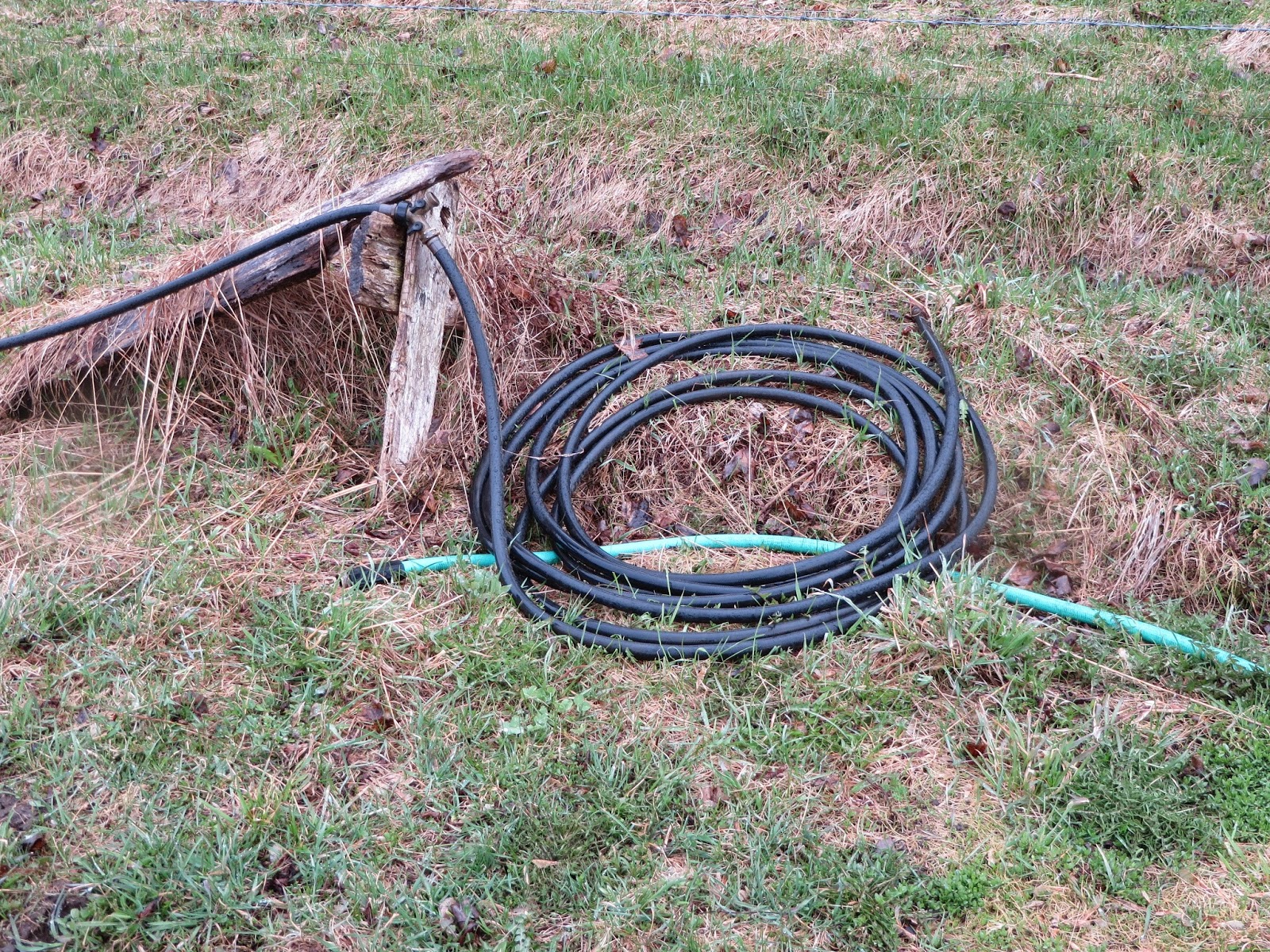
No matter how much work to be done, there is always the "put it all away properly routine" to leave time for.  Clean the tools, pre-position the buckets make coiled hoses  much more user friendly.  


Also makes the field more attractive, and improves the "thinking environment".  Less clutter, less distraction.


For three years running, tree swallows have favoured our birdhouse.   They are amazingly agile, feeding in mid flight on flying insects.   Here, the male is feeding the female during a brief break from brooding, or as part of their courtship.

Update as of June 2 - our Swallows seem to be having difficulty laying viable eggs.  The mating doesn't seem to stop and yet there are no tell-tale activities of feeding or brooding going on at the house.  

Time to quit writing about growing food, and start getting supper ready.


Talk to you soon,
Bob


Post Script:


Mush of the above is has now developed further, and new tasks have begun.  More pictures soon.


Tuesday, 15 April 2014

Update April 26:

Hello everyone...we are back on-line.  

If you are trying to contact us for purchasing one of the few remaining shares, call us at the house after 7 pm, or send to email (please find below).

Someone tried to call us the other day, but the number and name were too garbled to make out on the answering machine.  I think the first three numbers of the phone number were 407.  If this is you, try calling us again or send an email.  

As for the plants, New Zealand Spinach is finally germinating at a steady rate.  The Lettuces, Chard, and Kale are starting to show their first secondary leaves, and many of our flower sprouts look promising...Calendula, Zinnia, Primrose, Leopard flower, Bachelors Buttons, and more.  Thyme appears to be the most robust herb we have so far, the Rosemary and Lemon Balm being a little finicky.  Basil and squashes to be started in the nursery soon.  

The Garlic is also doing well (at least the visible part above ground).

I'll write more soon, I am in the midst of the pre-season field preparation for the season.  There's not much time for anything else, so my replies and communications may get a bit erratic over the next few weeks.

Hey Everyone…all’s well at Whitsend so far.

Thanks to those of you who are visiting this site for the first time.  We hope you enjoy our farm website as much as the real thing.  Unfortunately, the electronic farm experience is not quite as tasty, though I hope it will whet your appetite for fresh, certified organic produce.

If you have any questions about the farm, feel free to contact me at the email address or phone number below.

Your advance payment will ensure a share of this year’s harvest.  Harvest deliveries start in mid to late June and run through to the end of October.  There are a couple of deliveries anticipated for November (cold hardy leaves and storage produce such as carrots and kidney beans).  It is possible that there may be an early delivery of peas in the spring.

Tomato and Pepper starts

If you are interested in your own tomato or pepper plants, check out this site in the next couple of weeks.  We should have some extra.  These are free for season customers, $5.00 per plant  for everyone else.

The Whitsend Post
The Nursery is holding together.  The old hardening off shelter is rebuilt and easier to use.  Last year’s nursery is getting a new roof before it is moved outside to become a new hardening off shelter.  The workspace is going to be a lot more user friendly this year, allowing me to spend more time in the field.

At least, as soon as the barn has dried out.  Seems that our new gravel pad on the outside of the barn has caused a lot of melt water to drain into the storage area of the barn.  Some of my lumber has frozen into the ground.  We’ll manage, hopefully the new structures outside the barn that are going up this year will reduce the amount of snow against the barn wall next winter.  Farming always require keeping one eye on the horizon.  Some call it “Next year’s country”.

Speaking of the field, the snow receded quickly.  We were out last Tuesday checking on a few things.  The snow was down to its last few inches.  I was out again on Friday, and parts of the field were dry enough to work.  I sowed our first round of snow peas on Saturday.
The Garlic has not yet made its appearance (We spot checked two of the 6 beds), but that is probably good as I expect we will have at least one more cold snap.  Some of the Sage has survived the season under its mulch of straw.  All will depend on whether the roots were insulated enough.  The overwintered carrots have survived the cold.  They are small, Angela will let us know if they are up to kitchen quality soon.

Speaking of Angela, I am pleased to introduce our first intern this season.  Angela has spent her two week trial period helping out in the nursery, seeding and promoting your Chard, Kale,  Peppers, Tomatoes and Eggplants, as well as some of the less glamorous (but important) work such as mixing our custom potting soil.  I am certain she will make a very positive contribution to the growing of your food this season.  Welcome to Whitsend, Angela!

And speaking of the food, we have had our usual blend of successes and failures. 
We have managed to germinate some New Zealand Spinach.  We have improved from last year’s germination rate of zero to this year’s 6 %.  Of all the variables, it seems that soil temperature is the biggest determinant.  I seeded several trays and placed them on different shelves (some higher up in the nursery where the temperature is warmer and some near the bottom where it is cooler).  It turns out that the plant prefers the cooler soil, and the shelf that has germinated the most plants also successfully germinated the Parsley – another cool germinating plant.  I am continuing to try some different techniques, as the number of plants is still too low for our needs.  But I think I am on the right track. 


Whitsend Celery Sprouts (Photo 2013 last year by Randy)

The celery is off to a great start.  Most of the challenges with this plant (for us) is out in the growing field.  However, I always find it amazing that these tiny little sprouts manage to survive their nursery life…they look so frail one can hardly believe that they will grow into such large plants.  The celeriac is a bit late germinating, but we seem to have a good amount now. 


The Tomatoes, Peppers, and Eggplant all got off to a slow start.  I had to seed them three times for some varieties.  The earliest plants seem to have been stressed by the fluctuating temperatures in the nursery and many were lost to damping off.  This is a first for us, we rarely lose any plants to this mold condition.  However, we now have a good compliment of sprouts and seedlings in various stages of development.  We should have a lot of “Lime Green” Cherry Tomato plants available for those of you who want extra this year for your own backyards or containers.  Lime Green Cherries are a relatively compact bush, and are early producers (58 days).  Their flavour ranges between sweet and tart.

The Rosemary and Thyme have required a second seeding each, as they have been kept a little too warm in the nursery.  The Oregano is doing well.

As for flowers, The Primrose and Zinnia’s 
are coming along nicely.  I saw my first Nasturtium and Calendula sprouts as of today.  More flowers (including Oppopeos and Marigolds) are getting their first seeding in the next week or so.  The marigolds are companion planted in one of the Tomato beds.


Stock photo taken by Randy from same time last year. 

For the next couple of weeks, most of our work will be in the field, I will detail that in our next post.  I'll explain a little more about our Tomato companion planting, and the plastic pictured in the field picture here.


Talk to you soon,


Bob