Sunday, 12 April 2015

Thanks to those of you who are checking out our site for the first time.


First of all, a note about our flyers:

If you received a flyer on your doorstep, thanks for your patience (particularly if I upset your pup!)

I do not deliver to households that request no flyers, if I missed your sign, please accept my apologies.

As I deliver to specific neighborhoods, print advertising doesn't work for me...I would have to turn down quite a few inquiries.

I realise that my flyers are a bit rough and ready.  Most will wind up in landfills/recycling, so I don't spend money on slick plasticized prints.  I prefer to invest in quality seed and tools.

If you are interested in learning more about our produce, and are considering becoming a customer of our farm this season, peruse the website and feel free to contact me at the email or phone number below.  I look forward to answering your questions.

We still have room for two customers.  If you are interested in eating some certified organic vegetables this season, give me a call.  I will be happy to answer your questions.

Hey Everyone:

Work continues here at Whitsend.  The field is almost entirely clear of snow, and should be dry enough to walk upon in about a week or so.


My first tasks will be to do some work around the periphery.  A fence rail needs to be repaired and a fourth electric line added.  

This is also a good time to cut away some of the  weed brush, chiefly grape vine and manitoba maple that threatens to short out the electric fence in a couple of places.

Pictured to the right is one of the evening primroses.  Having overwintered, it should start to send up new shoots and start flowering this season.


Another flower that overwintered is the leopard flower.  Look very carefully at the base of last year's stalk - our first shoot for the season.


This plant is also called blackberry lily or leopard lily.  Genetically, it is an iris.


Much used in traditional chinese medicine, the common thread I find in its use is as an anti-inflammatory.


Seed procured from Sunshine Farm in B.C.


Some grass turf needs to be torn out for the next rock garden, and a small drain trench dug.

Speaking of the rock garden, it is a mess! Reminds me why I prefer autumn.  This time of year, everything is rotten and soggy.  


I don't know how everything gets so out of order when  snow is holding everything in place.  Must be the mice...


Meanwhile, the nursery is very busy, and almost at capacity.  The hardening off 

shelter has been insulated somewhat, and holding the hardiest plants to make up for the lack of space.

No matter how much experience I gain, there are a few little details that I still miss.

I planted 'extra' beets in the nursery, to make up for a less than 100% germination rate. When the began to germinate, I was reminded of something I learned the first time I planted beets.  


Beet 'seeds' are technically a little fruit with 1 to 3 seeds within them.  So I have a lot of twins (pictured) and a few triplets in the cell packs.  There are a lot of beets in the nursery, we'll have quite a first succession of them.


Usually when these are planted in the field, the first seed from the 'beet fruit' to germinate dominates and outgrows it's twins.  


I gingerly teased the twinned beets apart and promoted them to empty cell packs, at last count, there is approximately 350 plants (My target was 300), so a couple extra for everyone.  

Our first succession of beets will be a combination of striped chioggias and sweet kestrals.  Kestrel is a variety that has not done well when I have direct seeded it, and even in the nursery the germination rate was a little low.  But the flavour is worth the extra work.


Now that the first successions of  our crops are becoming established in the nursery, it is almost time to start planting the second successions.  Succession cropping is a technique that ensures a continuous supply of a crop throughout the season.  I’ll use lettuce as an example.

In mid April, I plant two 45-day lettuces for each customer and two 57-day lettuces for each customer, plus a few extra in case some fail.  This provides lettuce for the first two weeks of delivery.   They are transplanted out to the field at the same time.  


As lettuces grow very slowly in the spring (due to the shorter day length), they will have to be harvested a little smaller, hence two per customer to allow for a decent quantity for the first deliveries.

Two weeks after the first succession is started, I sow another succession of lettuces to cover the next two weeks of delivery.  This activity continues through to early July, when the last lettuces are sown.  

At that point, I start enough lettuce to cover the rest of the season, planting varieties that can tolerate shorter days and cooler weather.


Generally speaking, this describes succession cropping.   There are little details to think through. 


A 45-day lettuce (a lettuce that is harvest ready in forty five days) will take up to a week longer in the spring to reach its harvest date, due to the shorter days.


During the hottest part of the season, the lettuce may only have a forty day period of growth before heat forces it to go to seed early.  Excessive heat usually happens in late July and early August, though brief periods of heat (such as last May) can also alter the lettuce harvest date.


In the fall, leaf growth slows down considerably, most lettuce requires an additional three weeks to reach its harvest date in the late fall.  At a certain point in the fall, leaf growth all but stops, due to the shortening days and the cooler weather.  So for the last sowing of lettuce, I have to estimate when to plant based on when I expect my last lettuces to be harvest size by the time this period of growth ends. 


However, if I plant too early, these lettuces might go to seed before the growth period finishes.

These are factors that have to be considered when sowing the crop in the nursery, three to four weeks before transplant and several more before harvest.

One way around the planting first harvest date variables are by planting four varieties instead of two, each with different maturity dates.  Instead of two 45-day and two 57-day lettuces, I could plant one each of the 45-day, 48 day, 55-day, and 57-day varieties lettuce (Thankfully, there are thousands of lettuce varieties to choose from).


Worst case scenario, if I lose one or two varieties, I will still have some lettuce to deliver.  Best case scenario, the customers receive twice as much lettuce.  This does use up a little more bed space, but it is offset by the potential for some farm gate sales or very happy customers.

Recall I plant more than needed to offset poor germination or the occasional plant lost due to field damage – ie dug up by a vole, clipped with the whipper snipper, squashed if I happen to slip while walking by, etc.  So, there still might be lettuces left over. 


When this happens, I post the overidge on my ‘This Weeks Harvest’ page.  Customers then have the option of requesting this ‘extra’ lettuce on a first email, first serve basis.

If it still isn't spoken for on harvest day, the extra plants are either a treat for the pigs, or sent to the compost to become next year’s food.

As our first harvest day draws near, I will go into more detail about the different types of lettuce varieties.  We grow about a dozen or so, each with their own growing characteristics, shapes, sizes, colors, and flavors.

Talk to you next week.

Bob


Update later in the afternoon:

I pulled the straw off the garlic to get the beds warming up.


The soil is still frozen.  The bottom layers of straw are covered in grass and leaf molds.


Look carefully.  They have started to emerge from their bulbs.

Quite exciting.


Sunday, 5 April 2015

Hey Everyone:

The field is draining very quickly.  I anticipate that some beds may be ready to work in about two weeks.  This is a great head start for me, last year the snowpack lingered for some time.

As mentioned in a previous post update, last fall there was some tractor work done in the east half of the field to prepare for this year’s pigs.  This spring I noticed that the field was not draining in the way it has done in previous years, and assumed that the tractor work has altered a natural drain.  

 Now that the snowpack is clearing, I can see visually where the drainage is blocked – the land is not quite as level as it used to be.

This can be fixed once the field is dry enough to support the tractor.

Of particular concern is the way the snow melt pooled in the same area where the garlic is planted.  Prolonged exposure to moisture will cause the garlic cloves to rot.


The water that had pooled around the garlic has now receded significantly.  Presumably the ground is thawing enough to absorb more water, and allowing the sub-surface flow to drain toward the fens south of the farm.

A prolonged period of rain might still saturate the garlic beds more than it can tolerate.

For those of you who have been part of Whitsend farm for previous seasons, stories such as this will be quite familiar.  We have had several close calls, dodged bullets, potential failures, and gloomy predictions.

So much can go wrong very quickly.  Many times, I have thought ‘Oh well, what do I do now?’  Or ‘There’s nothing I can do (about something) now.’  Worrying, panicking, etc. won’t help.  All that can be done is make notes for next time and carry on.

At Elmtree Farm, Tom always used to stress the importance of being upfront with the customers about potential problems.  He felt that it was essential to inform the customers about both positive and negative developments, partly to reduce the impact of bad news.

More importantly, Tom suggests that withholding the difficult aspects of farming from customers is a disfavor to both the customers and for the farming community.  One should not portray an unrealistic picture of the craft of farming, for it creates an unrealistic expectation. 

The model of craft farming, or small scale mixed vegetable farming, that I practice is suited to mitigating a lot of risks.  Being small allows me to react quickly to challenges that arise from time to time.  (In this case, fifteen minutes of tractor work will likely resolve the drainage issue).  Growing a very wide variety of crops allows me to make a quick substitute when one crop appears on the verge of failure, with only a loss of a small portion of the overall harvest.

In this case, it is still too early to tell what the outcome will be.  I’ll hope for the best, jot down some notes in my journal, and carry on.

I checked the condition of the soil under the straw mulch and found it was still frozen.  The optimistic interpretation of this is that the cloves were not subjected to a large quantity of moisture.

As a precaution, I started some short season leeks in the nursery, in the event that we wind up with a poor garlic harvest.  At least we would still get our dose of allium (onion) family chemistry.

Speaking of the the nursery, the beets have sprouted.  Most root crops are directly seeded when the spring weather is settled.  For one, the act of transplanting often disturbs the tap root and grows an oddly shaped crop, this happened the first time I did daikon radishes.   Beets, however, are one crop that can tolerate transplanting. 

As well, most roots (such as carrots) require way too much space to start in the nursery.  Beets require three times more shelf than two harvest weeks of lettuces. 


In the past I have usually direct seeded our beets.  The results have been inconsistent.  I’ve seeded too thinly (not all germinate, too few for everyone); and I’ve seeded too thickly (and then needed to thin a lot of them out – wasted seeds).  On at least two occasions, I’ve thinned the beets out too late and the plants did not grow to their expected size.


I wanted to make certain that I got it right this time, at least for the first beet harvest.

There is another reason I am starting the early beets in the nursery, but ‘succession cropping’ is another topic altogether, I will revisit that in another post.

The finished product.  Striped chioggia beets (visually attractive, quick growing, leaves , suitable as a spinach/chard substitut), and detroit dark reds (good flavour, tend to be  larger than  chioggia).  Look carefully, and you can see  a couple of watermelon radish and some leftover turnip, these are on the verge of being roasted and enjoyed...


Here is the thyme starting.  Another plant with tiny primary leaves.

Below is the latest (as of Sunday April the 5th) photo of the celery and celeriac.  A very slow grower!


Still a couple of little details to see to in the period remaining before the field is ready to work, I'll be a very difficult person to pin down for the next week or so.


One last note, I heard the other day that California’s drought is now considered a ‘Twelve hundred year drought’.  

Do some homework and find out what percentage of North America’s grocery vegetables are grown in the golden state.

Bob


Saturday, 28 March 2015

Hey Everyone:

Not much change here.  The plants seem healthy, despite a 'damping off scare' earlier this week.  I lost one new zealand spinach sprout.

Still way more plants than we need, so no need to worry.

It seems that the air circulation is not quite as thorough as I would like, some of the shelves are in a dead spot.

So every day when I go in to water the trays, I shift them around to ensure that all of plants get an equal amount of time nearest the fan.

The celery and celeriac (pictured above as of Mar 28) are entering what I consider their most susceptible period for this condition, so if there is a continuing problem, a canary or two will let me know.

I always plant more than I need, to ensure that little events such as this don't decrease the projected yield.  Even if all of the plants did make it out of the nursery, there would not be enough room to transplant all of them.

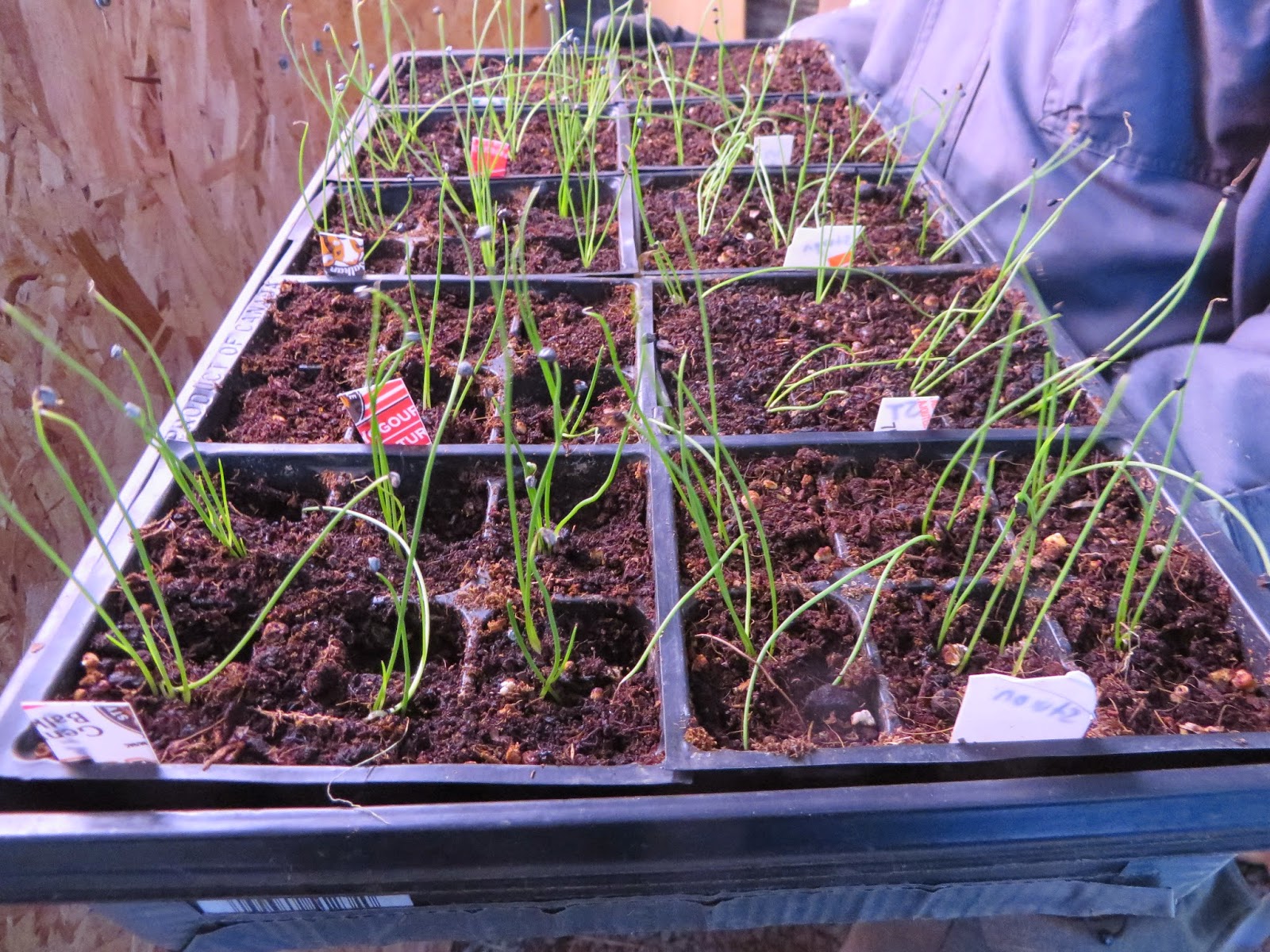
The onions are a lot less scruffy and easier to manage after their haircut.  These are trimmed down to about 1 - 2 inches, about a fifth of what they were a week ago.


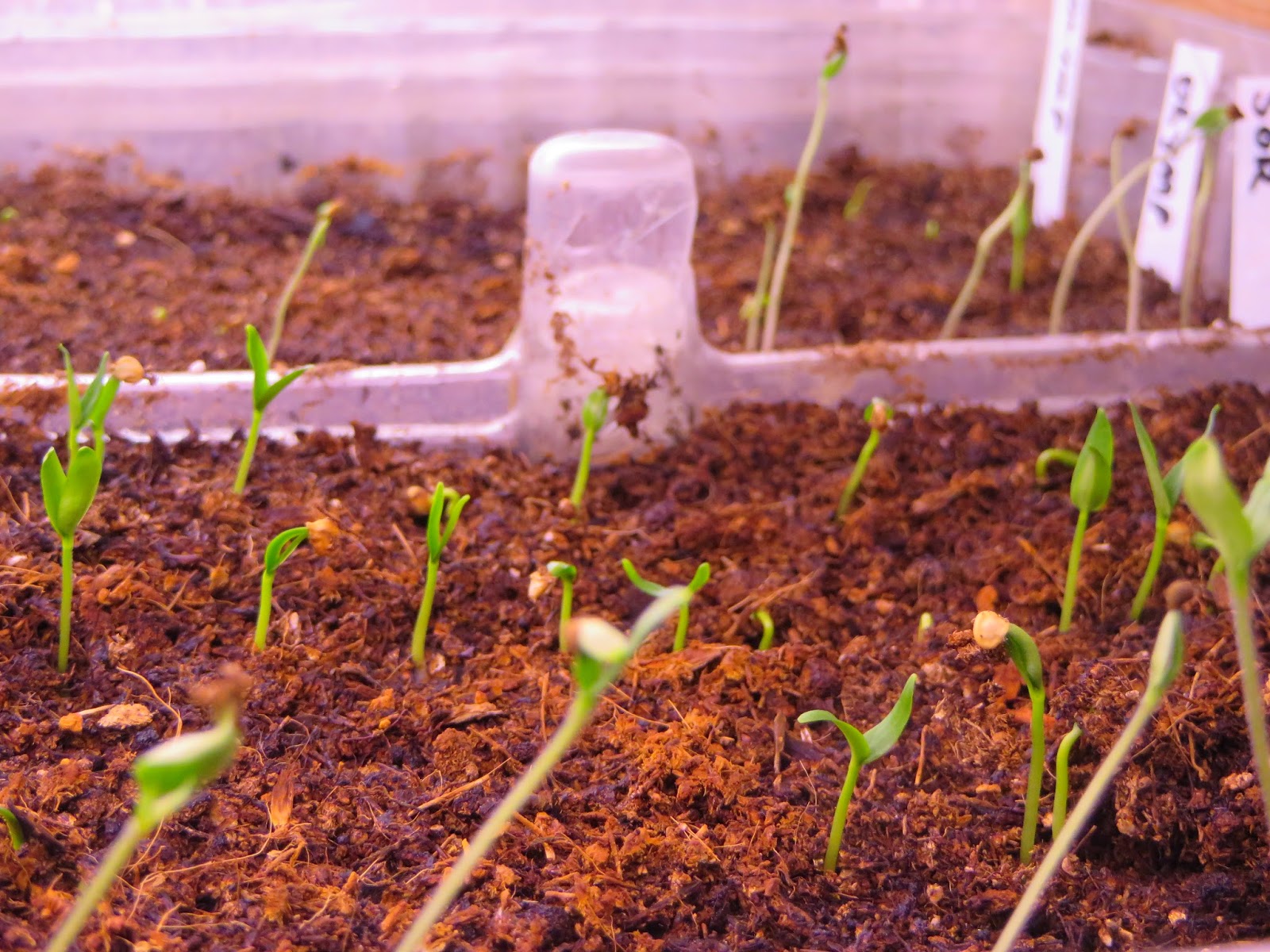
The tomatoes are sprouting.  These are the lime green and the moskvich.

Is it unfair to reference (at this time of year) to the rich flavour of moskvich?  How about the thick wedges of great whites in a burger?  Or the green and yellow lime greens providing a tart sweetness to salads?  Or a tomato sauce made from a base of nothing other that sorrento cooking tomatoes (no water, no canned paste, just slow cooked tomatoes with a bit of Whitsend garlic, hot pepper, and maybe some thyme?

Even at this stage, when the trays are disturbed during the watering routine, the plants give off the unmistakable scent of their forthcoming fruit.

It drives me nuts with anticipation...

The peppers are also sprouting.  These (and the tomatoes)  will be promoted up to 3" pots in a week, and then the big squeeze for space in the nursery shall begin.

Shortly after that, the peppers will get their 'cold treatment'.  This is a horticultural technique that I started doing two years ago, and refined somewhat last year.

The pepper seedlings are exposed to a controlled amount of cold over a period of time, which in turn forces the plants to set fruits a little earlier and with a slightly higher yield.

I believe it is one of the two factors that have contributed to our increasing pepper yield.  Last year we finally had our big breakthrough, both in quantity and size per fruit.


Here is what the field is looking like after a week of (some) melting.

Of concern to me ne is the amount of water (now ice) that has pooled just east of the straw covered garlic beds.  Evidently, something has changed in the field since last year, as there has never been pooled water in that area.                                                                                
It is probable that when the east field was plowed late in the fall (after the pigs left), a natural drain was cut off.  That will be easy enough to fix once the ground is thawed enough to work.


In the meantime, I'll have to watch how it melts away from the garlic, a crop that does not enjoy flooding.

Worst case scenario, I'll have to remove some snow myself.

Work such as this (plus worrying) is what I'm paid for...


Snow cover update April First:

Here's a couple of photos of the north end of the field.  The clover/rye paths have begun to appear.  The water table is still quite high, the paths are saturated and would be damaged by walking upon them.                                                                                                                           The snow cover is somewhat uneven across the field (hence the snow you see in this image). Snowfall accumulates on the side of the field closest to the hedgerow.


You will see a photo of the compost taken about two weeks ago further down.

With the blue sky in the background, it is hard to believe that freezing rain is on the way tomorrow.


I took advantage of the fair weather yesterday and did some work on the hardening off shelter.

Ordinarily, this unit is where the seedlings are sent about a week or so before they are transplanted in the field, to help transition the to the tougher conditions outside.

I've added an additional layer of plastic sheeting on the inside, to further insulate the trays,

This will give me a little more space for the nursery when the lettuce, kale and chard get started in the coming weeks.


Some of our plants are getting their start out here.  I sowed some lemon balm and parsley in here.  By the time these plants sprout, the temperature will have already started to moderate somewhat, these plants will have a head start on what life is like outside.

One other note, I started our Sage and Thyme.  I will probably start some more catnip as well, we had one plant last year and it appeared to have been eaten/destroyed by being rolled in/torn up and taken away by a four -legged critter.

I don't have to blame the usual suspects, but it may have something to do with the lack of mice in the barn this season.


Tuesday, 24 March 2015


Big news today - I have heard that our piglets are on the way.  Their anticipated arrival is in a month or so.  They'll spend the first few weeks with their mum, and then make the journey to Whitsend in late May.

Pork prices (listed on the 'Whitsend Pork' Page) shall remain the same as last year.  I thought I'd announce this after hearing about the rise in the price of factory produced meat last year.

The cost of my pork inputs have not changed, and the number of pigs in the supply chain I source them from seems more robust than last year.

First choice for pork sales are offered to Whitsend season customers, with the second offering expanded to contacts and inquiries of interest generated from our farm-gate stand and the open house.  Harvest is anticipated either late September or mid October.

Nursery Updates:

The onions are going to get a trim to keep them a little more manageable.  It thickens the stalks and ensures they remain a little more upright.

If left, the first leaves flop over and inevitably get damaged when trays are moved about.

It appears that our bulb onions this year will be white/yellow types.  The 'RedWing' variety germinated poorly, it's seed was a little old.  The later rounds of yellow onions have germinated well, it looks as if I'll be planting a few more than originally anticipated.  Assuming they grow well this year, we may have a few more per basket than originally anticipated.

Red Onions typically have a longer shelf life, though I have found our Cortlands and Sturons have lasted well into the winter (early February this season, stored in a less than ideal 8 degree room).

The daily routine of checking moisture and temperature levels in the nursery continues.  In this photo, the you can see the grow lights on. .

Typically, the lights are set to a timer that comes on after peak electricity hours.  This  gives the sprouts and the seeds about a twelve hour day.

I turn them on during the day as the barn is too dark to see what i am doing.

I now have three banks of lights going, to accommodate the tomato, pepper, and eggplants.

I should see their first leaves soon (The eggplants have already started to germinate).

Here is the Echinacea.

In the next couple of weeks, I'll be starting the Zinnia's and a few others.

Some marigolds will get planted in the nursery as well, and then transplanted into one of the four tomato beds.   This is part of the farm's soil fertility plan.

When the ground begins to thaw, I'll direct sow bachelor buttons and sweet peas in the next rock garden, these should eventually  establish and continue self seeding in future years.

Most of the flowers we planted last year (Leopard Flowers, oppopeo, calendula, nicotania, etc) are self seeding.  It will be interesting to see how many of these take care of themselves.

I'm very curious about how well the evening primroses overwintered.  I planted these in the rock garden last year.  With the extended fall season, they became quite established, some even flowered.
Primroses are a biennial, it is rare for them to flower in their first season.

The cut flowers are a complementary addition to your tables.  As well, the flowers are a boost to the pollinators, which in turn attract the birds, which in turn moderates the insect population.


The snowpack is slowly receding.  Here is the growing field two weeks ago.

As of March 23, the field is showing signs of emerging from under the snow.

No signs of mice near the rock garden, garlic, or compost (see previous posts regarding fox tracks).  

For that matter, there have been no mice tracks around the barn all winter, very unusual.  Must have been a bad year for them around here.

Here is the field as of March 24.  Note that the straw on the garlic beds and more soil in the east field is starting to appear.

The snowpack is about 4 to 8 inches deep.  In some places, it is starting to clear.


To the right is the compost pile.  Scroll up to the more recent post to see the difference three weeks makes.


Talk to yo soon, 

Bob