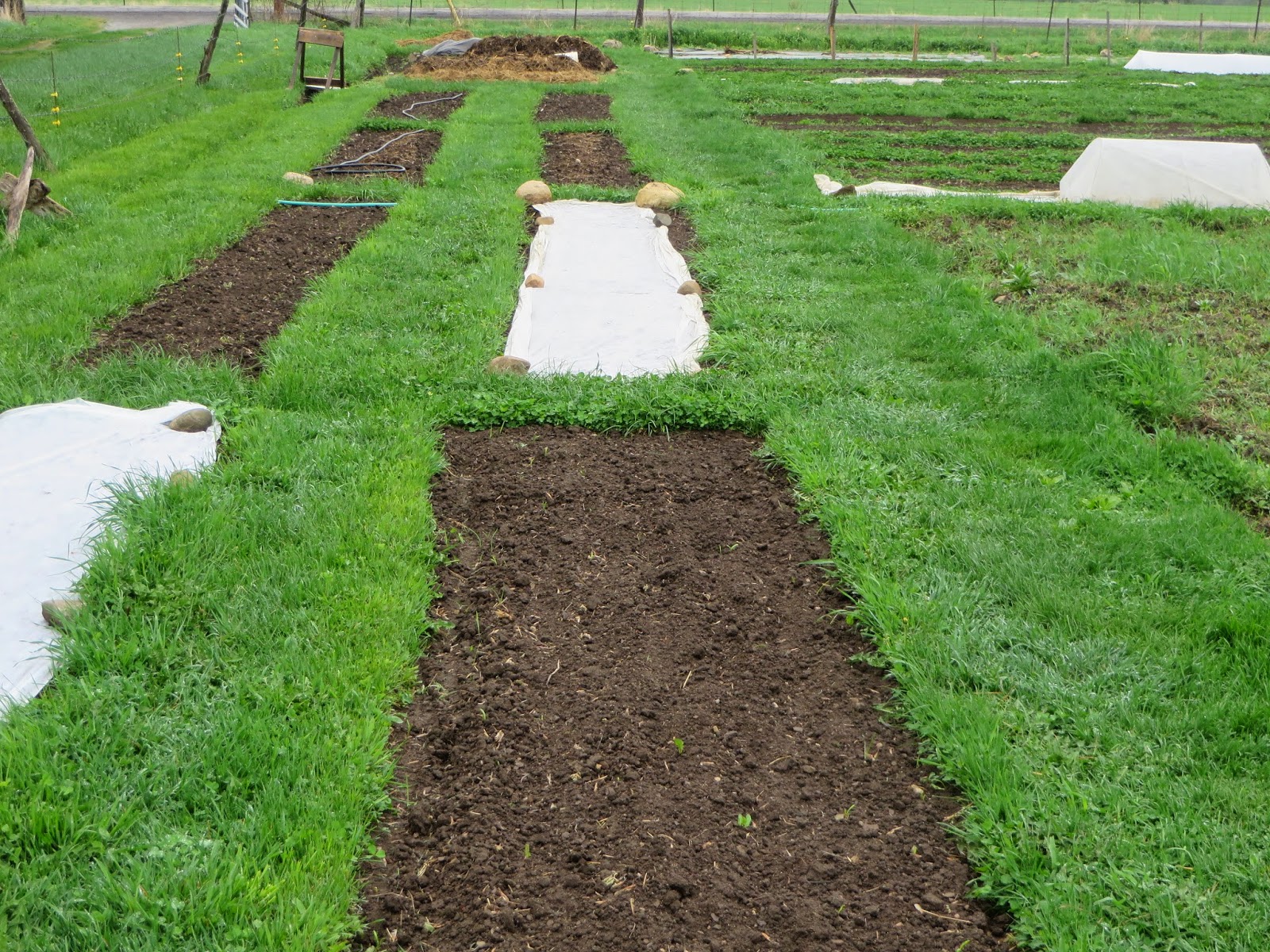
Wednesday, 10 June 2015


Update June 14th:

I have updated the 'This weeks harvest' page.

Very disappointed to see some of the first spinach plants starting to set seed heads almost two weeks before they ought to.  The plants are not big enough for a meaningful harvest.

I now have to decide if I should start harvesting the second round (planted a week later).

I assume that this is caused by the exceptional heat we've had this past few weeks.

Good news - I started cleaning out the rock garden and discovered that we have a fine crop of nicotiana flowers that have self seeded.  Also see that the opopeo flowers are starting to come up.

Talk to you soon,

Bob


Hey Everyone:

The delivery season is soon upon us.  A sure sign is the prep table taking it's place near the compost windrows.

This is the first stop for most of the produce coming out of the field.  Soil cleaned from the produce and culled vegetables are diverted back to the compost.

Then it is off to the prep station...


...which is almost finished.

The sidewall is the next addition, followed by a cabinet to keep prep tools and paperwork in.  The marker board (to track how much the field is producing per bed, and to keep track of requests) will get installed last.

This will be a big improvement over previous years.  It will double our counter space, keep the wind from disturbing the weigh scale, and provide a all in one place for storing harvest tools and supplies such as empty boxes, zip-lock bags, and burlap sacks.


For the first time in over a month, the hardening off shelter is starting to empty out.

Not a moment too soon, we had our first earwig in there nibbling on some kale sprouts.

Knowing they would inevitably arrive, I have an additional spot to harden off the plants.

The most vulnerable plants are being moved there - thyme and rosemary, lettuces, and cabbage family crops.


Many of these crops will be out in the field within a week.  Crops that are produced weekly, like the lettuce, will have to take up the new residence for a week.

During that time, some diatomaceous earth  will be the only food available for the bugs, thus rendering the shelter free for a couple more weeks.  I suspect I'll have to do this new routine a couple of times during the summer.

Earwigs are generally a beneficial insect in the field.  They consume organic matter, helping to break it down and or move it into the different layers of soil.

In the nursery, the only organic matter are the small plants.  

Speaking of small plants, our first couple of harvests are usually small, but this year seems to be exceptionally so (unless the lettuces and peas grow very fast in the next seven days!)

However, there is plenty to be optimistic about in the weeks following that.

Having just completed my twice annual financial snapshot, I decided it was time to take stock of what's out there.


The snow peas are just starting to flower. Probably in full flush in a week and a half.  I expect a few folks will get some peas next week, but probably not everyone.

Of course, as the peas will taper off in about three weeks, the customers who are missed during the first week of harvesting will get the last of the second flush of peas.
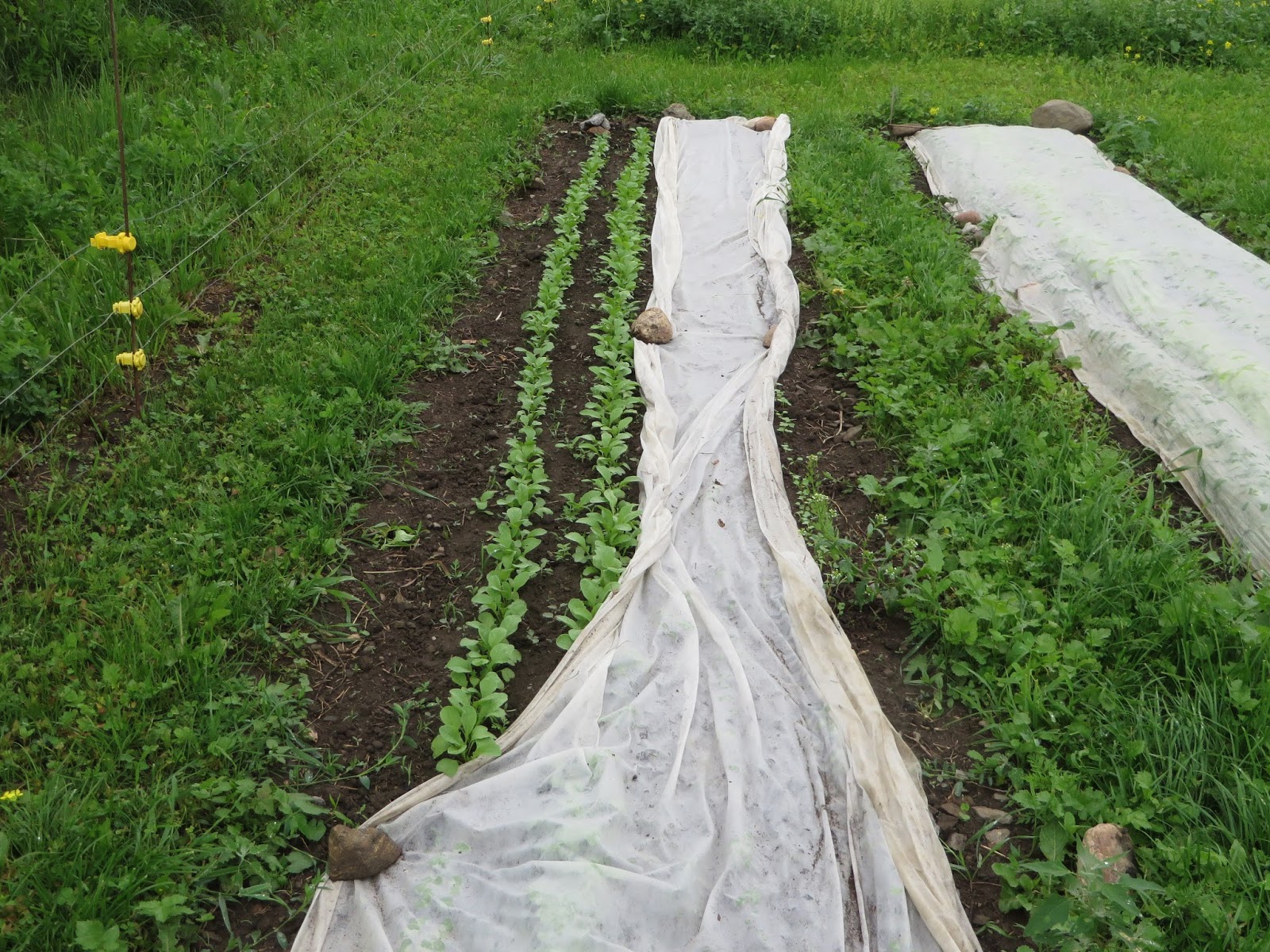


Radishes:  The 'Cherry Belle' radishes are nearing their maturity for the first week.  I have a second round on the way.

These younger radishes are still susceptible to flea beetle damage, hence the half covered bed.

I have a small quantity of seeds of 'Osterguss' radish.  This is a variety of german salad radish that I was curious about.

Let me know if you are interested, I'll be planting some by the end of the month.  They should be ready by fall.


Next to the radishes are the mustard greens.  From right to left mibuna (quite mild), Tokyo Bekana (somewhat peppery and hot-ish), and two rows of arugula.

Not sure why the mibuna is not as vigorous as the others, its north of the bekana so may have been a bit shaded by its quicker growing neighbour.

I'll give the option of either one of the three varieties or a blend.  First email , first serve.


Cress is a very quick grower.  The first year I tried it, it was a saviour on the first harvest day, filling in for a no show (can't recall what that was now).

It only grows in cool weather, and much prefers being in the shade, so there is only limited places for it in the field.

The first week or two are about the only times during the season I grow it.

It requires a lot of water, hence the soaker hose in the middle of the bed.


Here is one of the five spinach beds.  Still some inconsistency.

All the rows have germinated but some sections of this bed is producing better than others.

I'm  a little puzzled by this.  It may be that the larger plants germinated a couple of days earlier.

I'm going to harvest some of the crop next week, in an effort to give more space to the adjacent plants, this might spur some growth.


This is supposed to be a beet almost ready for planting.  It's supposed to be spherical.  I think the transplanting was a little too late, and the root was disturbed.

This will be a wait and see what happens, we may have some tasty (but oddly shaped) roots soon.  Assuming they size up.  If not, there are two more beds seeded and just starting to sprout.


You may recall my concerns about the garlic earlier this season.  I do have a tendency to think in worst case scenarios sometimes.

So far, the crop appears not to have been flooded by too much water.

We'll know when the time comes to pull the plants (I'll be doing a couple of test pulls in a week or so).

There has been some leek moth damage, but only a couple of plants have really suffered.


Here is a first for Whitsend - Rhubarb.  If you're with us for the long haul, this will be something to look forward to in about two years.  These were started from seed and so should take a year less than when propagated from a root.


Carrots carrots carrots!  I have several beds of these in various stages of growth.  Most of our carrots are orange this season, I reserved the colored carrots for the open house bed.

If no-one shows up at that event, then the customers will get orange and colored carrots.

Another success story are the parsnips.  A notoriously difficult crops to grow.  I think we have almost an entire bed, so at least everyone will get a meal's worth if not two or three.


These are the zinnias, about twice as many plants as last year.  I added a second color this year in case anyone finds these monotonous.

Other flowers that are doing well are the primroses.  They are a biennial which was planted last year and should be flowering fairly soon.   The oppopeo's have started to self seed and will soon tower over the rock garden.

Sage, thyme, and lemon balm were planted in abundance this year.  The oregano survived the winter and is thriving.


Two beds (of five total) of kidney beans.  In these beds, not a single plant lost to mice.


I had the row covers down tight, though the pants didn't appreciate it and were struggling to grow for the first week.

Now that their vulnerable period is over, the plants are out into the sun and growing to fruition, which will likely be late august.  At that time, they will be harvested and hung in the barn to cure.

They will probably be among the last deliveries of the year.

Speaking of mice, I received a tip from Dick about setting up the electric fence.

He pointed out that if the animal hit two lines at once, it would short the charge and cause little or no deterrent to the intruder.

We disconnected the middle line and attached it to the ground.  This will make stealing your food very difficult.

Protecting the food from damage is an ongoing task here at the farm.


This year is the earliest I have started coriander.

More folks seem to be catching on to this essential flavour in the kitchen.

I wouldn't think of making a pasta sauce without either it or it's cousin parsley.

Speaking of which, I have transplanted more so far this year than the combined total from last year.(we lost a lot of parsley in the hardening off shelter last year as well - I'm so glad I took the time to make those little improvements back in the spring!


This is the first of two beds of chard.  I intended to do a second bed for the fall.

When planting these in the nursery, the first round germinated very poorly, and the second round overheated in the hardening off shelter.

I panicked and over compensated.  We'll have two beds for most of the season.  Probably too much, but a good thing for those of you who will want extra.

If that is still too much, the pigs will be more than happy to take the surplus.  They love it!


They're here!  The colorado potato beatle.

Each day, the plants will get checked for these insects.  Every three or four days, the bottom side of the leaves will get thoroughly checked for the little clusters of hidden eggs.

I grew three beds of the early onaway potatoes. Two of these beds are covered with row cover. The third bed is left exposed, providing the beatles with a place to gather - easier for me to find.

I still need to check the covered beds, as these insects do manage to get under the covers.

These are the Dakota Pearls, the second round due in late July.

I leave them uncovered, the beatles always go to the Onaways first.

I have to make decisions such as this as I only have a limited amount of row cover to work with.

Besides, the tubers will grow better in the full sunlight.  After all, the purpose is to grow food, not control insects.


The moskvich tomatoes were not affected at all by the frost.  They are growing very well.


Moskvich is a russian variety, known for it's resistance to cold weather.

Other than gritmire's pride, moskvich is my favorite tomato.  I have to admire someone who earned the surname 'Gritmire'.

I'll discuss the basket weave method for staking produce in a future post.  It is simple and very economical - easily adapted to the garden.


We lost a couple of lime green tomatoes to the frost, and a couple to the mice.

This was fortunate, as I needed to place the hungarian black peppers somewhere away from the other peppers so as to save the seed.

The lost lime greens provided that spot.

These tomatoes are interplanted with green onions.  THis improves the soil health of the bed, allium family crops are a great soil conditioner.


This is a view of the pac choi in their row cover tunnel.

Pac choi and tatsoi are Brassica (Cabbage) family plants.  They are quite vulnerable to many insects that are otherwise fairly harmless - flea beatles, earwigs, and cabbage moths devour these even after the plants are mature (in most cases, these insects only damage seedlings or do aesthetic damage, such as the holes in arugula leaves.

Snails and slugs eat these up as well.
With most other crops, slugs usually prefer the withered outer leaves, such as on lettuce.


Squash family crops are also vulnerable at an early stage of their life.

After a week or two settling in, almost nothing except the end of the season will finish them.

Especially this zuchini, the variety dunja.  I planted a new zuke called goldy this year, but still had four dunja seeds left over.  Not wanting to waste them, I decided to start a few plants - besides, I had no idea what to expect from the new variety, and if they didn't work out, I knew I could count on dunja to produce a considerable quantity of fruit.

In the event that this plant needs to be removed from the premises, I placed it in a spot near the gate.  To understand fully what I am getting at, sift through the posts from late summer 2013, when my intern Randy and I decided that an entire bed of dunja zucchinis had to be removed.  This was accomplished with several scratches, one cut, a sliced irrigation line, a bunch of stepped upon turnips, and discouraging words...the plant looks harmless now!

The fennel continues to grow it's enormous tap root with nothing more than a couple of leaves to show for it's efforts.

Fennel is a difficult plant to get started.  It's one of my favourite foods.  Very versatile in the kitchen - all of it is edible.

The bulb may be cooked (try wedges of it on a shish kabob or baked with fish), cued,  or eaten raw, the leaves add a hint of licorice to salads and soup, and the stems may be cooked into sauces for an alternative to celery.


There's a lot of other plants out there that were not caught on camera - brussels sprouts, rutabaga, turnips, dill, celtuce, orca beans, basil...

I need to quit writing and put the farm away for a while.

Talk to you very soon.

Bob


Some new neighbours have moved in.

These are some of Dick's cattle, one of two herds of seven animals each.

They spend a lot of time watching me.

If you are interested in purchasing some beef, send me your contact and I will forward it to Dick (Google Littledown Farm for more info).  I think he sells by the half or whole cow, but best to ask him directly to make sure.


On the way home, I observed some interesting weather phenomena just down the road from the farm.

Same idea as a rainbow, but shaped more like a curtain.


Sunday, 31 May 2015

Hey Everyone:

Two weeks to our first delivery.

I'm constantly worrying about everything.  Have I planted enough?  Have I planted too much?  Will the rodents crash the fence and eat everything?  Did I wait too long to plant some crops?

I just keep planting food, keep the beds in shape, and shore up the fence every chance I get.

We had a frost last week that killed several pepper plants.  These plants were protected by straw and row cover (as were many other crops), but this particular bed didn't seem to withstand the test.

There are replacements, but not enough to fill the entire bed.  Extra tomato plants will have to cover the rest of the space.

Several other crops were touched by frost, though not to the same degree.  These oldest tomato leaves carry the scar of their first frost.

I left a little bit of straw at the base of the plant. This serves two purposes.

First, the straw reduces the evaporative pressure on  the soil above the root zone.

Secondly, the straw prevents cutworms from wrapping themselves around the stem to feed.

I adapted this tip from Natalie who helped out at Whitsend a few years ago.

Cutworms wastefully eat one part of a plant - the stem at ground level.

This is a green bean variety called provider, it germinates well in cool soil, so is the first bean variety I  plant  in the spring.  We should start to get these in the first or second week in July.

It will produce until the heat gets too much for it (or when the second round of beans starts to produce).  After that, these beans are picked one last time and the bushes composted to make way for the fall lettuce.

Look carefully - there are two plants that have had their terminal bud nipped.  These are finished, and will grow no further (Another example of wasteful eating).

The pattern of damage is consistent with rodents.  A groundhog would have eaten the entire row.  It is possible a rabbit may have snuck through the electric fence, as they are surprisingly nimble.  With such a small quantity of damage, I am more inclined to think mice ate these.  More catnip!


Lettuces.  The cool weather has been good for some.  This is a new variety for this season.  My usual first delivery variety is no longer available, so I chose one that seems very similar.  

Enough lettuce for our first two weeks is one of my chief concerns.  I'll need some good luck, and optimal growing conditions to ensure these size up decently.

What I can do to promote their growth is to keep the paths in check so that the lettuce receives as much sunlight as possible.


Unlike last year, the spinach has germinated very well this season.  Last year should have been good too (lots of cool, cloudy days).

Last year, I was using row cover to retain moisture in the beds (the seeds won't germinate if the bed dries out).  Consistently, the spinach didn't germinate.  Late last year (too late), I came across a reference in one of my tests that suggested that leaf crops tend to need a lot of sunlight to germinate, so I assumed that this was the mistake I had made.

This year, I am watering the beds more and leaving the row cover off.  So far, it is working.

I tried a new radish variety last year (Cherry Belle), and it was the first time I received compliments for this crop.  These will be delivered during the first two weeks.

Compare this bed of carrots with a post from two weeks ago - the nantes type carrots.  Growing very slowly from the ground up.

I have to keep reminding myself that most of the growth is occurring underground, as they drive their first tap root down.

A big success for this year...parsnips.  Parsnips are tricky for several reasons.

First, the seed naturally has a very low germination rate.  I purchased about fifty percent more seed and seeded thickly.

Second, parsnips take about 3-4 weeks to germinate.  Grass and most weeds require about seven days.  I do a little bit of cultivating to help keep the weeds down, but I can only go in between the rows to ensure I don't cultivate out the parsnip seeds.  Despite this, the bed is a weedy mess by the two weeks after the planting.

Third, when the parsnip does germinate, its first primary leaves look similar to many weeds.  At this point, each row needs to be weeded very carefully to ensure I don't pull out the wrong plants, or that pulling out a weed doesn't disturb the adjacent parsnip sprout.

If I can get through these three challenges, then we may have a decent crop in October.


I planted something here about two weeks ago.

Now some dark green leaves are emerging from the soil.  Any recall as to what this is?

To give you a sense of scale, the weed sprouts to the right are about 2 cm tall.

Right now, the potatoes are exposed to the first wave of potato beetles, which should be arriving any day now.  However, the beans need protecting from the rodents.  Which is worse?


Here is a fennel sprout at about two weeks.

Above ground, it is barely changing in size, and has added only one or two secondary leaves.

Below ground, it is driving its tap root down and could be up to twice the size of the rest of the plant.


Celery is a crop that demands patience.

While we wait, I've sown two rows of cress in between the celery.  If I can keep it cool and moist enough, these will be ready in three weeks.

Great space saver!

Shades the celery stalks.

Cress grows very thickly so also keeps the weed pressure down on this bed.


The first crop planted this season in the nursery finally makes it out into the field.  Echinacea.

The final decision as to where to plant it was long in coming.

If I can get it to settle in, you'll see where I chose to plant it during the open house.

Planting guides suggest planting it with mint.  I have some lemon balm ready for transplant (a mint family crop and also a capable self seeder), so i chose to place them together.  This will help me keep the lemon balm away from the closely related catnip - I don't want to get the two confused on delivery days!

So a lot of challenges to overcome.  I need to stay focused and maintain my cool.

Talk to you next week.

Bob


Saturday, 16 May 2015

Update May 26:

Hey Everyone:  It's been quite a busy week - lots of transplanting, seed sowing, mowing, and electric fence work.

I had my second frost day of the spring, a bed of pepper plats were lost but fortunately there are extra to replace them with.  As well, I can augment the lost peppers with some extra tomato plants tat I had in reserve.

I'll try to get a proper post in the next couple of days.

Talk to you soon,

Bob


Hey All:  We got through our first spring frost ok.  I covered everything up (or so I thought) except for the peas, which I figured were cold hardy enough to handle a slight chill.

That night, I dreamt I was presenting a delivery to a customer, and explaining that the little plastic containers had frozen peas in them.  That woke me up at 4 oclock.

I tossed, turned, and worried for about 15 minutes, wondering if I should have covered the peas. Finally, I got up and prepared for my day early, and got to the farm before sunrise to hose down the peas before the first rays of sunlight did the frost damage.  'Probably would not have made any difference', I thought, 'most of the frost is down here by the gate, such as in ....The primroses!'

I ran for the hose, got the primroses and leopard flowers hosed down, and thought that was a close call.


I'll probably be doing my 'frost morning routine'  possibly one or two more times this season, definitely next fall, so I will go into greater detail on the importance of watering unprotected plants on frosty mornings before sunrise.

By the way, knowing that the temperatures would be cold overnight, I removed the IRT mulch from the beds that are being rehabilitated, to gave the sprouting weedlets another knock back.  This is another example of "using what I have".


My first harvest of the year - grass clippings.

I use the same beds year after year, and gradually establish a path of ryegrass and dutch clover between the beds.  Ryegrass is great for suppressing weeds.  Also, it grows well in eastern ontario summers.

However, unlike the clover, it grows tall enough to shade the crops, so it requires mowing.  I don't think of it as mowing so much as nitrogen harvest.

Mowing is better known as a suburban pastime, but it is an important activity at Whitsend.  It is part of our fertility management.


Compost is the most important soil amendment I use.  It replenishes macro and micronutrients that are consumed by the crops, which are in turn consumed by the rest of us.

It also introduces a host of beneficial microbiology to the soil, and helps retain moisture in the beds.

Building compost is done by layering nitrogen (grass clippings, food waste, discarded portions of crops, some weeds) and carbon (dried leaves or straw).


I aim to get a 20-30 : 1 ratio of carbon to nitrogen, or about 1 inch of fresh clippings to 4-6 inches of straw.  These are layered into piles referred to as 'windrows'.

Compost windrows are typically 4-5 feet wide, about 4 feet tall, and long as necessary.  This size ensures that the windrows are large enough to generate enough heat to destroy pathogens and weed seeds.  The temperature range I look for is about 55-80 degrees C.


In a year, the compost will look like this.  To the untrained eye, it looks like soil.

This nutrient rich compost will then be added to the beds to feed the soil, creating an ideal living space for the crops.

The compost has reduced the macro and micro nutrients to a form that is accessible to the crops.
Depending on the crops stage of development, it can take up what particular nutrients it needs at any given time.


Here is the first of last year's grass harvest.  This is the bed where the chard will be transplanted.

The compost is applied to the surface of the beds (called top-dressing), and then incorporated into the soil when the beds are cultivated.  (I have discussed at length the collinear hoe in a previous post spring 2014).

Some of the top dressing will inevitably fall into the path over the course of the season.  It is taken up by the path growth (grass and clover) and then returns to the compost building process when the paths are mowed.


Compost is applied in in the previous year for fruit and root crops (ie, this year's tomatoes had their compost applied last October).  Leaf crops and corn have their compost applied the same year they are planted.  This means I have to know by this fall where next year's crops are growing.

Some very heavy feeding crops (squash, tomatoes, corn) have a little extra compost added mid-way through the season (called side dressing).  This is applied around the base of the plant.


Intuitively, mowing seems like something that one wouldn't expect on an organic farm.  I certainly thought cutting the lawn was something homeowners did, not farmers.  Grass is near the foundation of the food chain in nature, and I am co-opting its role in the food web to support the fertility of my farm.

You are what you eat eats (a quote from author Michael Pollan).  Think about it.


Here is the first row of spinach to sprout.

Timing the spring crops was very tricky this season.  (I think I say this every season)  These spinaches might not have germinated if they had been planted on time (the temperature that week ranged from 25 to 31 according to my field thermometer).  These will probably be a week late to your table, the second week of delivery.


This is the first bed of carrots.  These may be a week earlier than anticipated, as the soil was warm enough for them to germinate a week earlier than I had intended to plant.

The two varieties here are the 58 day Napoli and the 60 day yaya.  Both are mid sized nantes-type carrots.

The next bed of carrots is already sown.  I'm anticipating it will be a week earlier as well, mid to late July.


This is a brussel sprout plant.  When it first germinates, it looks no different than any other brassica - such as wild mustard, a weed that grows throughout the field.

To ensure I can tell the difference between the weed and the crop, I place a little ring of gravel (collected from the beds) around the planted seed.

When the crop has established (and I know without a doubt that it is brussels sprouts and not wild mustard), I remove the stones and add them to the gravel pad by the barn.  Over time, the gravel is removed from the beds.

By then, I should have enough experience to discern the difference between the weeds and their related crops.

I also use the stone identifiers for rutabaga - it also looks like wild mustard, and fennel, which looks like a couple of different weeds when it first germinates as well.


These are your second succession of potatoes, the mid season dakota pearls.  The beds are starting to fill up with food.

This coming week there will be a lot of transplanting and sowing of mid and long season crops such as fall potatoes, kidney beans, corn, tomatoes, peppers, eggplant, echinacea...

And then next week, a lot of short season crops will be planted for the first two weeks of deliveries (radish, mustard greens such as arugula, more spinach).


And every two weeks, the parade of celtuce, pak choi, parsley and green onions will roll out into the fields for transplanting as well. a continuing parade of lettuces

And now for the bad news.  I have lost a few chard plants during the hardening off process.  I will start some more, but I suspect our first chard harvests to be very small.

It wouldn't be farming if there weren't some disappointments, at least this one seems to be recoverable.

Talk to you all soon,

Bob

Monday, 11 May 2015


Hey All:

The field looks a lot different from two weeks ago.

Row covers, hoses, clean beds, and beds with FOOD in them.


The rock garden has begun to 'grow'.  Another plot for more perennials has been dug out, and the central path now has a layer of flat stones capping 8 inches of loose rock.

I have a couple of extra zucchini plants from last year.  They cannot grow too close to this year's zukes as they would cross pollinate and yield a fruit that might not be palatable.  There is nowhere else for them to go, so I will put them here for this season.


Not everything goes as planned.  I mapped out a more efficient setup for the hoses this season.

Unfortunately, none of them are 105 feet long.

The stump that is dug into the ground at the edge of the rock garden has supported the splitter tap in past years.

Moving it a couple of feet is no problem, but then I will have to work on building the path and base up around the stump, to ensure that i have a level place to put the watering cans while they fill up.  Three more (unanticipated) hours of digging and collecting rock!

I use row covers for a number of different applications.  Keeping bugs out of beds, retaining warmth on cold nights, and providing shade for heat intolerant plants are a few uses.

The bed in the background is freshly seeded with fennel, these seeds will get washed away by the heavy rain that could come with the predicted thunderstorms tomorrow.

The covered bed in the foreground is seeded with brussels sprouts.  They too can be washed out by the rain.  Furthermore, like all brassicas, they are susceptible to flea beetles at this age, the row cover will keep most of these little bugs out.

Leek moth is the one insect that I haven't yet figured out how to beat.  For now, keeping the garlic and onions covered as much as possible is the only way to prevent them from damaging the onion family crops.

Despite their uses, I don't care for the appearance of row covers.


I grow a little coriander at a time, as it is consistently requested by a few customers for much of the season.  To make up for the extra space, I intersperse them with green onions, dill, and a few other limited quantity crops.

Here, I've used hoops to protect the transplanted onions; the coriander seeds are protected from rain.


The green onions are transplanted in clumps to make harvesting quicker.

I've had a lot of success in the nursery this year, though I am finding that the green onions are still challenging me.


Like many transplanted plants, these lettuces look pathetic when they first go into the ground.

It took me a couple of years to get used to this. It's hard to believe that these will be healthy lettuce heads in six weeks.

Transplanting is very tough on many crops. Cool, cloudy days are ideal for transplanting.  I did not have much of that this past week, so I created some shade with the covers and hoops.

By leaving the ends of the covers open, the cover does not retain the warmth that would be too much for this cool weather crop.

On very hot days, I've sprayed water onto the cover to evaporate heat away from lettuces.

Look carefully - around the plants, the soil looks slightly different.  That's freshly applied compost (and straw).  Leaf crops prefer to have their compost applied the same year they grow in the amended soil.  The straw helps to retain some moisture on the bed as well.

I planted our first peas a week ago.  They are just starting to sprout.

Peas are not heat tolerant.  Early last week, I was looking at the forecast and thinking that there might not be any point in trying to grow the second round of peas, and prepared the first green bean bed.

When bean planting time came, I saw the forecast was now calling for cooler weather, and so went back and planted a few more peas.  The beans will have to wait a week until the warmth returns.  as a result, they may be a week late getting to your table (Hopefully the peas will make up for that).

I was ready to give up on the spring spinach as well - at 30 degrees, I would be very surprised if the spinach seed germinated, the beds would have been put to better use growing something else.

As soon as I saw an extended period of cooler weather on the way, I raked down the bed and started planting.

I had assumed that with such as early heat wave, there would have been a bounce back in the temperatures at some point.  Deciding when the optimum time to plant is part instinct, part experience, and much guessing.


Some gardeners use string to 'draw' their seeding lines.  I learned this technique at Elmtree Farm - a couple of tubes (old hose) inserted onto the rake tines, draw consistently spaced lines that are fairly straight.

Planting in straight lines makes cultivating the beds much quicker when the crops have started to grow.

Some of our customers from two years ago may remember me raving about a variety of spinach called 'samish'.  I took a chance with the cool weather and planted it (as opposed to a heat tolerant variety, which will get planted next week - unless the temperature foes back up to the high twenties again).


Infrared Transmitting Mulch (or IRT).  This covering allows heat to get into the soil but blocks the light wavelengths that promote growth.

These are new beds and are not as 'tame' as the more established beds and will take a lot more work to prepare

In this case, I'm using the IRT as a means of keeping the beds dry and suppressing the weeds.

The IRT will buy some time while I attend other tasks.


Beds 1 through 8 and the (future) trellis bed are still a year away from being fully rehabilitated.

These were some of the first beds I prepared five years ago.

Everyone makes mistakes, beginners make more mistakes.

This is a job for two pigs...


It seems ironic that as an organic grower (and as someone who considers oil as old fashioned) that i am relying on spun bound nylon row covers and polyethylene irt mulch - and rubber hoses and plastic zip-lock bags, and a nylon mosquito jacket...

Traditionally, pine boughs were used for shoulder season crops, but there are no pine trees on Dick's land.

I have tried using straw whenever possible to protect plants, and particularly for cold protection and moisture retention, this works well.

Unfortunately, it does leave the leaf crops quite messy on harvest day.  I'll try straw in the fall, though I suspect you will notice the difference.

An alternative material to oil based row covers could be corn-based fibre.

I question the use of corn for manufacturing materials.  It is a very heavy feeder and would require a lot of good cropland to be reserved for non-food use.

I am certain there are alternative methods out there, hopefully inspiration will strike.

Talk to you soon...

Bob

PS - All customers, I will be sending out an e-blast in the next week or so to ensure that all of our new customers are getting their email alerts from Whitsend.  I'll have a few more details about the forthcoming season...first delivery is five weeks away!