Monday, 1 May 2017


Talk to you soon...


Hello Everyone:

The past two weeks have been a blur of activity.

Beds are getting prepared and the first seeds are gong into the ground.


A sure sign the season is opening is the first day I remove the straw from the garlic beds.

Always a bit of a breathe catcher doing this, as I never know what I will find.

This year, as every year before, almost 100 per cent emergence.

I was particularly nervous seeing mice trails under the straw.  However, they seem to have confined their activities to storing oat seeds under the straw.  I wonder if the owl found them?


Typically, most growers leave their garlic mulched by straw all season.  This keeps moisture in the ground around the shallow rooted garlic, and suppresses weeds to an extent.

However, I need my garlic beds to be clean enough to plant cabbage in within weeks of the garlic getting harvested, so I continue to maintain the beds while the garlic is still here.

Also, due to the Euopean Leek Moth, I have to use row covers on the garlic when the night temperature goes over 10 degrees.  The straw tends to damage the row covers, so another reason why I take the straw out.


The straw is set aside for later use in compost making and mulching crops such as celery, or in this case, rhubarb.


The rotation pattern I follow is important for many reasons.  By following it, I usually know where crops are going to be planted during the following season.

Knowing this, I can prioritise fall cleaning for the first crops that are seeded, such as spinach and peas.  The peas are just starting to germinate.
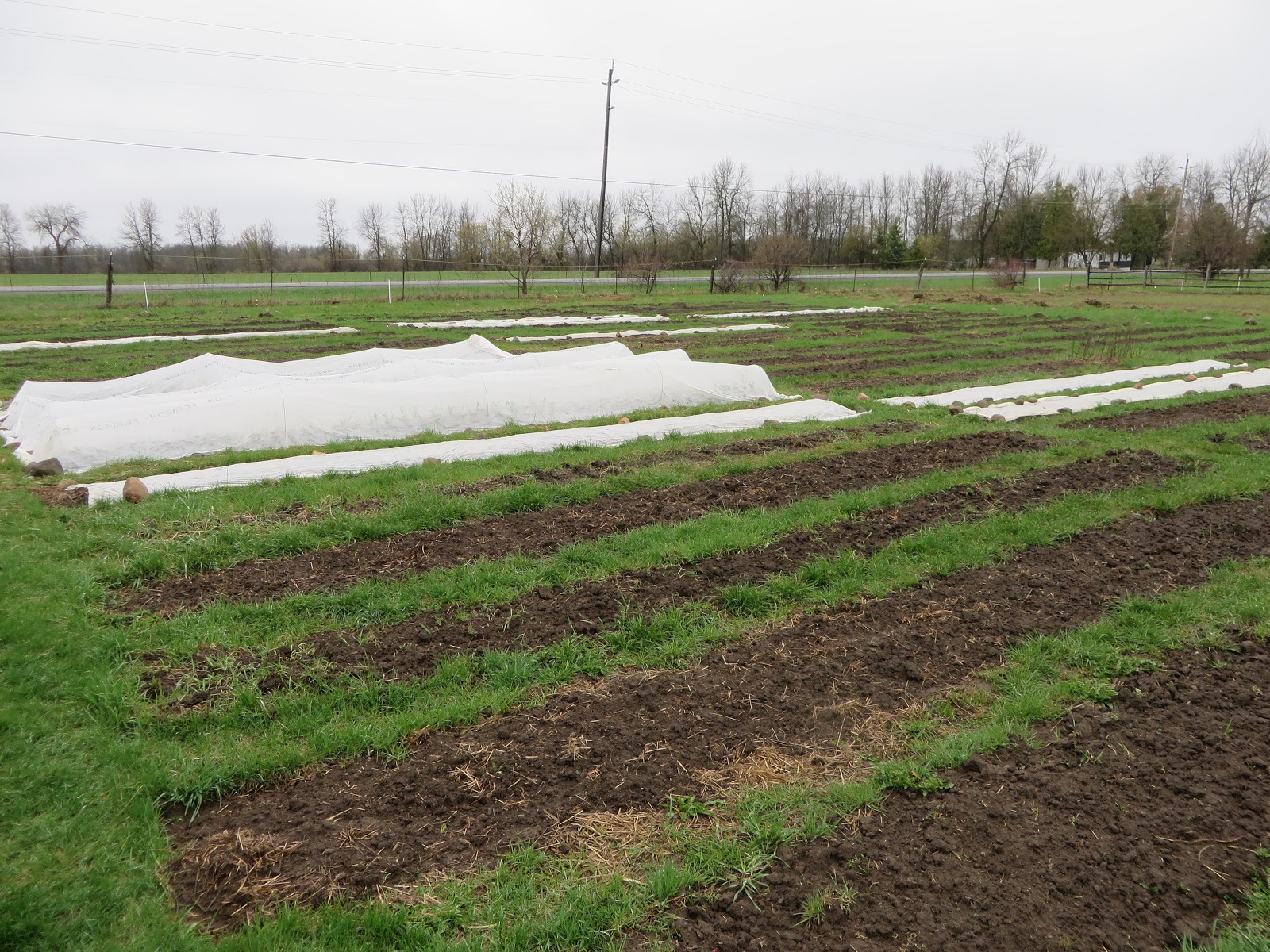


The biggest amount of labour goes into cleaning beds that became a bit messy last year.  I expect a few of these every season particyularly late season crops.

Quack grass is the biggest offender, though over th eyears I have reduced the amont in the beds considerably, partly by teasing out the long rhizomes (roots to the lay person), and by starving the rhizomes by clipping off the blades of grass that emerge.


This year, there are many of these beds, as our work flow was quite inturupted last spring.  Loosing time in the spring is

There won't be much effect for this year's crops, but it is delaying me from working on the new beds for next year - I might not have time to capitialize on what the pigs accomplished last year.


The beds developed last year (where we grew potatoes and squash) are looking quite good.  I have given them two cutivations this year to suppress weed growth before it starts, and hoped for one more.

Cultivating is best done with dry soil, so I used plastic mulch as a temporary cover for then next period of rain.

The wind had other plans, despite our attempt to pin down the mulch.  You don't win every game in this sport.


Many growers who use plastic mulch bury the edges of the plastic, but this stirs up the lower layers of soil and expose seeds in the "weed bank", which would negate the reason I use itin the first place.

By the way, cultivating is the process of disturbing the top inch or so of soil, just as weeds are starting to sprout.  Ususally, three passes with a hoe over a period of three weeks will deplete the germinating weeds and leave a relativley clean bed for the remainder of the season, provided the soil surface is not disturbed too deeply.

I can culivate twenty beds in about an hour; weeding mature weeds takes about three times as long; as well, the weed roots pull a considerable amount of soil (and compost and other amendments), and exposes more dormant seeds in the weed bank.

 For a detailed look as the type of hoe I use, check the posts dating back to this time of year, I think 2015 or 2014 has a considerable description of the use and benefits of a co-linear hoe.


Lots happening in the nursery as well.

Chard, Kale, Pak Choi, parsley, celeriac, celery, five types of tomatoes, four types of peppers, green and bulb onions...all of these need to be tended.

Primary concern is ensuring that the seed and seedling trays do not dry out.  It happened once this year, and the egplant was quite wilted looking when I found it.

Jus tin time, a quick soak brought them back to form.  A heart stopper for sure...


Here are the squash plants that germinated last week, now promoted to their cell packs.  As the weather warms, they will move out tot the outdoor nursery to get used to cooler temperatures, and then to the hardening off shelter to prepare for transplant.

Still a bit to write about, but all this writing and thinking about food reminds me that it is approaching 4:30 PM, and it is my turn to get supper started tonight....

Talk to you very soon

Bob


Monday, 17 April 2017


Update as of April 19 2017:  We have eight shares left to sell.  If you are interested in taking part in the coming season, please order soon.


Hello everyone:

Happy Easter to you all, I hope this spring is treating you well.

Plenty is happening at the farm, read on.

I'll be going over accounts in the next day or two to ensure everyone is making their payments on time and double checking where we are at for customer count.  I think there are only eight more shares left, so if you are still trying to decide, bear in mind space is limited.

Call now if you have any questions.


(613) 831-8218.  I'mm usually home by 6 pm, though some evenings I am a bit late.


The nursery is now getting crowed.  The outdoor nursery is now ready for taking the oldest onions for all but the coldest nights (On those nights, the onions are placed on the storage shelves inside the nursery).

The nursery is almost full - we are onto the fourth bank of lights, with kale, chard, tomatoes and the third round of onions just starting to emerge in their seed trays.

Over the next few days, I'll be counting tomato seedlings and determining if any more need to be planted.


Here are your peppers at two weeks.  They have opened their primary leaves and are establishing their roots.

We are growing four types of pepppers this season - Olympus, a standard green bell pepper; Lipstick, a cone shaped sweet peper, Hungarian Hotwax, a banana pepper that is somewhat hot; and Hungarian Black Pepper, somewhat hotter but not extreme, according to our hot pepper experts.


The celery is a little older, having progressed to its secondary leaf growth.

As with the peppers above, much of the growth is in the root systems, so the plant appears to be growing very slowly.

These will be following the onions to the outdoor nursery in the coming week, though spending the first few nights back inside until the weather gets a little warmer.


Along with all the work in the nursery, more tasks for outside are added to my spring routine.

Some of last year's late season beds need to be cleaned out - kale and brussel sprout stems need to be pulled and sent to the compost, and a few blades of grass and a few overwintered dandelions need removing,

Some beds near the edge of the buffer zone were left mostly untended last year until I knew for sure where the buffer zone was.  These beds are first on the list, a task that will only get more difficult if left.


The next beds to get cleaned up are the ones that are direct seeded early in the season - snow peas and spinach; and the first successions of carrots, beets, turnips, parsnip and rutabaga.

After that, the beds that take the first transplants are cleaned up - onions and parsley.

Fortunately, many of these were cleaned up last fall, and only need some light working.


If this is not enough to seem daunting, the rock garden needs some cleaning, compost windrows need turning,  and a broken part needs to be ordered for one of my tools.

A night of sub zero weather was put to use the other day.  I added a bit of grass and clover seed to some paths that had a few bare patches.

Grass and clover seed often germinates better after exposure to some cold, the temperature change helps break the seed open.

I use all the help I can get.


Some beds need deep aeration - the tool pictured here is used for that it is called a broadfork.

The five tines reach 10 inches into the ground and create passages for moisture and air to get into.  The air stimulated aerobic bacteria, which in turn speed up the decomposition process of organic matter, which in turn releases nutrients into the soil.

The passages also allow worms, bugs, and amphibians opportunity to move about in the soil easier.


Insects and worms overwinter in the soil below the frost line, consuming organic matter and helping to break down nutrients that are deep in the soil - too deep for most crops to reach with their roots.

When these soil dwellers sense the warmth of spring, they migrate to the surface, bringing these nutrients from below the root zone back up to the surface.

This is just one of many activities on the farm that develop soil health, which in turn leads to healthy food.

This is a photo of me using a broad fork in my first year working the earliest beds.  The broadfork is one of my favourite tools to use.  An excellent all body workout that will do the same things a treadmill, stationary bike, and rowing will do...and at the end, one can say the exercise accomplished something.


I have a few perennial crops.  This is a self seeding bed of primroses in our rock garden.
The rock garden also contains oregano, thyme, sage, and amaranth flowers.

I am gradually establishing sorrel here as well.

Instead of broad forking, I use dandelions as my deep aerators.  dandelions are biennial, so when their deep tap root dies, and decomposes, they provide the same kind of hole in the ground that the broadfork does.


Our first crop of the year - rhubarb leaves emerging from dormant plants.


Rhubarb is in the plant family Polygonaceae, which also includes sorrel and buckwheat.

I also grow buckwheat (as a cover crop), and I am establishing sorrel in one of the perennial beds as an additional herb.

The oldest rhubarb plants are ready for harvest in early June, a few of our customers shall receive some.  The other plants will take another year or two to mature.


Tuesday, 4 April 2017


We are down to 9 shares remaining for our capacity.  If you are interested in having your certified organic produce delivered to your door this summer, contact me soon...


Hello Everyone:


We are back from another farm and dog sitting assignment.  We may be reached at our usual phone number, (613) 831-8218; or by email.


Beau just refuses to give up - I suppose after fifteen years, it's difficult to change change careers but I suspect Beau prefers being a Labrador Retriever more than anything else.


As for Whitsend, there has been a lot of activity the past week.

The growing field is 90 per cent clear of snow, though still a lot of draining to take place.

The ground is still much to wet to walk onto, without tearing up the permanent paths.

A few of last years beds still require cleaning up (late season crops such as the remnants of the brussels sprouts in the foreground).


One of our new customers requested Kohlrabi.  This is our third request for this crop, so I have finally opted to give it a trial this season.

This is a curious looking crop, another member of the cabbage (Brassica) family.  With so many Brassica's in the field already, finding space for another is difficult.

This season, I have planned to concentrate on small turnips.  Harvesting them young means they are less fibrous, have a milder flavour, and do not require peeling.


By harvesting turnips smaller, I can seed them a little more thickly - they'll take up less space, which leaves room for planting a few Kohlrabi plants.

There will be a limited amount of Kohlrabi this season for those of you who are interested.  If the crop works out well, we'll try more for next season.

It is an heirloom variety of Kohlrabi called 'Azure Star'.  Kohlrabi is unusal in appearance, I liken it to something off a B-movie set about carnivorous vegetables.   The heirloom variety goes one step further visually from what you have probably encountered...


In other "new crop" news, I am currently corresponding with some other producers on how best to grow miniature pak choi, so as to honor another request from last season.  I have the seed, but I want to ensure I can get the choi at the right size while still tender and crisp.

There is no end of things to learn!


In the nursery, a few more light banks are switching on as the crops there increase in number.

The first planting of celeriac didn't germinate too well, but it was started early enough to allow for a supplemental planting - these are now just starting to sprout.


The bulb onions, parsley, eggplant are coming along well.


Eggplant is one of the most challenging crops I have ever tried.  The difficulty starts right from when the seeds germinate.

Eggplant requires about twelve weeks of growing before it can withstand transplanting.

Unlike the onions or celery, it has no tolerance for cool temperatures.  This makes working in the nursery in March a challenge, getting seedling trays out for work and the doors closed back up as quick as possible to prevent the eggplant from getting a draft.


The first two rounds of celery are up, and the second round of green onions is emerging as well.

Tis is a tray with celery, celeriac, and parsely.  At thsi stage of growth, they all look the same, so every cell pack is tagged.

Even at tranplant time in another , it is impossible (for me) to tell the difference.


Most of the action has been outside, on the gravel pad next to the barn.  The photograph at the very bottom of the page, you can see how the front of the barn appeared in my first season.  Since then, I have laid down a ten inch layer of stones (removed from the growing field as it wasprepared) around the front of the barn, bordered it with some old barn logs, and covered it over with gravel.  This has made a useful workspace.

Since the first season, I have added a tool shed (left) and the outdoor nursery (not visible).

The new structure I have been working on is a three sided shed constructed to shade our newly constructed ice fridge.


This project has gone a lot slower than I had hoped - after all, I'm a farmer, not a carpenter.

Most of my work has to be done piecemeal inside the barn during the winter and then dragged out when the snow  cleared off the pad.

I designed the ice fridge after consulting old handbooks on how to build ice houses.  It is a cedar wood structure for storing produce on harvest day.


This is the ice compartment, capacity three feet by three feet by five feet tall.  The walls are four inches thick, and filled with pounded sawdust.

Sawdust is the traditional insulator for ice houses.  Unlike most materilas, sawdust insulates well even when wet.

As the first layers of ice are applied, several insualted panels are inserted into the "doorway" to close the compartment.  When it is full, anotehr four inches of sawdust are poured on top.


The final task then is to place screen over the sawdust, to prevent rodents from getting in to cool off.

Ideally, the ice compartment should be on top of the fridge, but this would make the structure much too top heavy.  Instead, I place an uninsulated wall between the ice compartment and the produce compartment, and then insulate the produce compartment.


The produce compartment.  I'm not too good at building doors, and the four inch thick doors posed considerable challenge.

At one point I was so irritated by door building that I altered the design and put in a pair of sliding shelves.

It's very rustic looking, but shoudl do the job.


By the way, I should thank Jack and his brother down the road for coming over to help - the outdoor nursery weighs well over 200 pounds and it was in the spot where the fridge was to go.  Thanks for the lift!


Talk to you soon....


Friday, 10 March 2017


New post to follow soon...I have a few notes on some new additions to our farm, a new crop request (Kohlrabi) and updates on the onions, celery, peppers, celeraic, eggplants, and more...


The growing field is starting to emerge from it's winter break.  The remnants of last years brussels sprouts are visible just beyond the stalks of oppopeo.  

Beyond them, the windrows of straw covering the garlic bulbs is now visible as well.  

In addition to the anticipation, the receding snow reveals some clues as to what has been happening out here when I am not around.  


A length of electric fence wire has been dragged out into the lane way at some point during the winter, evidently tripped over by an animal.  A quick examination shows the wire was snapped in the process.  

One more task to add to my spring clean-up list.


Inside the nursery, the onions continue to grow. 

The next procedure for these sprouts is to gently tease them out of the soil in the seed tray and into the cell packs (called "promoting" in market garden jargon).  

After they recover from the transplant, I trim the leaves down to about six inches or so.  This allows the stalks to grow thicker, and enables the primary leaves to stay upright and off the damp soil.


The transfer of sprouts from seed tray to cell packs is time consuming.  The benefit is that it saves on use of space.  The promoted plants will be bunched in groups of five to each cell.  In another 8 to 10 weeks, these clumps will be transplanted into the ground together.


This is a tray of cell packs with the promoted onion seedlings.

Onions depend on cues from day-length to know when to start setting their bulbs.  PLant them too early or too late, and the bulb will not form to it's potential size.  

For these onions, at our latitude, the transplant time is early May to very early June.  They are slow groers, and require about 8-12 weeks in the nursery before being ready for transplant. 


At the time these 'extra' onions were sown, I found there were just enough onions to cover our needs fo rthe season.  Kowing that I will loose a few between promoting and transplanting, I have sown a few extra to make sure.  


Now that the seed trays are empty of onions, the next sowing starts.  

These are celery seeds.  Amazing that such small seeds yield such a large plant.

Celery, celeriac, parsley, and eggplant are sown today, as well as a third and final round of onions just to make sure that I have enough.  

All of these crops require about 10-12 weeks of growing in the nursery before they are ready to transplant.  


If I do not plant enough at this time, there won't be enough time to start more plants, so I plant about fifteen per cent more than is needed.  I usually wind up with more than I need, which allows me to choose the healthiest looking plants for transplanting.  The rest go to the compost heap to become "next year's food".

10 days later - A picture of the cell packs that the celery is seeded directly into.  Can you spot the first celery plant to sprout?


Promoting Parsley - this sprout has been teased out of a seed tray and inserted into a cell pack.  

The frst time I did this as an intern, I was certain none of my transplants woud survive.  How could these delicate sprouts tolerate such handling?  

Plants are very optimistic creatures, and young plants are quite resilient.  

The trick is to hold the sprouts by the leaves, not the stem.  


We are down to 9 shares remaining for our capacity.  If you are interested in having your certified organic produce delivered to your door this summer, contact me soon...