Sunday, 24 September 2017


Earlier in the season, I was taking lunch in the car (I think it was raining) and happened to catch Ed Lawrence on CBC.  He was speaking about the wet, cloudy start of the season, and noted that the weather conditions were delaying a lot of crops such as tomatoes.

This pleased me, as I felt that having a better known expert than me pointing this out would carry a little more weight than just myself (when explaining to customers why their tomatoes were so late).

However, his next statement caused me a little dismay.  He said that the rain would bring about BIG potatoes.  I was in the midst of packing the spring harvest of potatoes, and they were not big.

What determines the size of potatoes?

There are several factors that determine the size of potato tubers - distance between plants, the classification of the seed potato, and soil fertility are three.

Like many other crops, the size of the fruits is directly proportional to the distance between plants. Plants that are close together have to compete with one another for sunlight, water, and soil nutrients.

Typically, potatoes are planted between eight and twelve inches apart.  In most cases, I plant the maximum twelve inches, though a couple of years ago, I planted a late season bed at ten inches due to having too many seed potatoes.  This resulted in a record breaking yield of baby sized potatoes.

As I have written elsewhere on this blog, seed potatoes are produced over several years.  First, a potato seed is sown, which grows into a plant that produces pea-sized tubers.  The best of these are selected and re-sown.  The best and biggest of the subsequent yield are classified as "foundation" potatoes.

These are then either sold to growers such as myself, or replanted to create larger "Elite 2" tubers.  These can be sold to growers, or resown again to create "Elite 3" tubers.  In theory, one could carry on indefinitely, but in most cases, "Elite 4" is the maximum.

Elite 3 or 4 seed potatoes yield what most folks find in the supermarket.  I assume that the potatoes called "Chef size" by wholesalers are grown from Elite 4.

Each generation is a clone of the the parent seed potato.  With each generation, the number of genetic mutations build up, eventually resulting in a weaker plant.  Knowing this, my seed potato supplier has started to focus on selling elite 2 tubers, and in most cases, that is what I purchase from him.

I don't have enough experience growing potatoes yet to have been able to observe a difference, but I think I can accept the opinion of a third generation organic seed potato producer.

Soil fertility is the biggest determinant of any crops growth, be it size, overall plant health, or resistance to insects and disease.

Our field's fertility is a work in progress.  Older, more established farms that have been maintaining and building soil fertility for years have a more advanced and complex soil than I do, but I have the advantage of being on a field that supported organic cattle many years ago.  One clue to the latent fertility within my field's soil is the abundance of stinging nettle.

The biggest determinant for soil fertility  (according to Eliot Coleman and others), is determined by the crop rotation pattern.

In my field, potatoes follow leaf crops and precede either roots or brassica (I treat potatoes as a fruit, as most of my fruits are nightshades, closely related to potatoes).  Potatoes require a moderate amount of nitrogen (why they follow the leaves instead of the nitrogen fixing beans or peas) and a higher amount of phosphorus.

One advantage to placing potatoes before brassica and roots is that brassica and root crops often do not tolerate competition from weeds very well.  The hilling and thick foliage of potatoes tends to suppress weed growth, they are often known as a "cleaning crop.  As well, when harvesting the tubers, a lot of soil is dug up and persistent roots and grass rhizomes can be extracted from the soil.

All fruit beds receive a soil amendment of rock phosphorus the season before they are planted.  This on it's own is not enough, so I often plant buckwheat - which is very good at taking up phosphorus - at some point the following season.  Usually, this happens in the fall, so the potatoes don't get this added benefit - the following season's brassica's and roots do.

The other soil amendment that I apply the season before I sow potatoes is compost.  Fruit, root, and brassica plants tend to do better when their compost is applied the season before.  Roots grown in soil recently amended with compost tend to be covered in lots of tiny rootlets, and fruits tend to grow lots of foliage and less fruit.

So far, so good.  I have the potatoes in a reasonable spot in the rotation pattern, and their soil is amended with phosphorus and compost the season before.

So this is not explaining why the tubers are relatively small - even elite 2 seed potatoes at 12 inches (with lots of rain) should be producing tubers 25 per cent larger than I am getting.

In this instance I know why.

As mentioned above, potatoes are an excellent cleaning crop.

As mentioned in other posts on this blog, two parts of my field are relatively new - they were developed within the past three years.

Potatoes have  to another characteristic that has made them such an important crop.  They are good at scrounging nutrients, even when grown in poor soils.

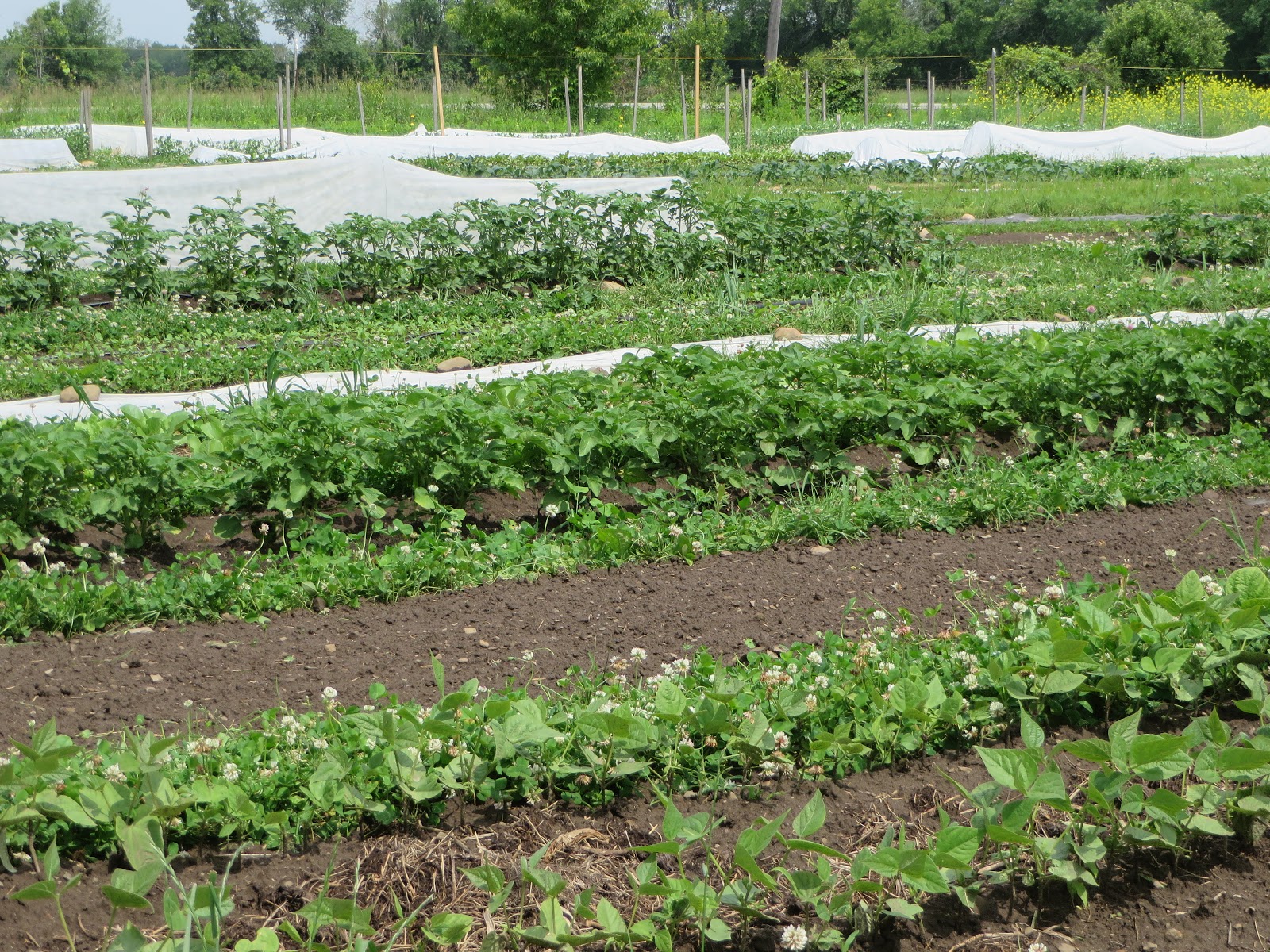
After developing the two new parts of my filed, I took these three factors into account and decided to concentrate my potatoes in the new beds.  The new beds had a lot of weed seed and quack grass rhizome, and they did not have the advantage of several years of accumulating compost applications.

The alternative would have been to plant fruit crops that require high levels of nutrients, such as tomatoes, in these beds.

So this is he reason why our potatoes are smaller.  For the time being.  In theory, I had concluded that with each passing year, the tubers would gradually reach their natural potential.

This seems to bear out.  Customers who received russet potatoes last year might have noticed that they are larger this season than last.  I will be growing the russets in the next set of beds in the same "new"field, to gauge the increase in fertility.

As I consider what my production plans are for next year, I look at the beds that are going to have potatoes planted in them.  The early leaf crops were cleaned out in time to have a cover crop of buckwheat sown, so I am anticipating another increase in size.

As I have all too often heard since starting to farm...."This is next year's country."

Bob


Sunday, 3 September 2017

Hey Everyone:

There is lots of info to catch up on.  It’s been a very busy season.  Too busy. 

Curing onions
One of my observations the past couple of years is that the amount of work required maintaining the growing field interferes with other aspects of the farm, such as keeping customers and other readers up to date and informed; and to see that their money is well spent on my labours.  Regular posts provide an opportunity for customers to learn about their food.  As well, it creates expectation and a bit of drama, which appeals to my sense of showmanship. 


It’s also an opportunity for folks who might be interested in becoming a customer next season to see how the farm is progressing. 

Why is the field taking up so much time?  The industry standard for this type of farm is 2 ½ acres of work per professional.  I am currently working half that. 

Each year, I have found little efficiencies to improve my performance, and improved the infrastructure to provide an accommodating work environment where work flows from the nursery to the field to the prep station to the car to the customer.  Yet these improvements are not enough this season.  

Some of the difficulties are compounded by last year’s spray – several beds were in disarray this spring owing to the fact that their distance to the buffer zone was in question until late last year.  Giving these a hard cleaning in spring (when weeds are growing like crazy and many crops are getting planted) caused me to lose control of other beds...these then needed a hard cleaning to prepare for their crops, which in turn backed up work maintaining other beds...you can see where this is going...


Some of the challenges are ‘built in’.  The farm is essentially a hay barn and converted pasture.  The original fences, the well, electricity source and the barn itself provide a few challenges.  Some challenges are design flaws from when I first set up the field. 

Without going into a lot of detail (I could write a book...), it appears that this farm is reaching its capacity for what I can do with it.  There is room for over forty customers in the growing field, but the infrastructure is very close to capacity. 


When we first started at this location (a year after losing the first farm we found – that was lost 24 hours before signing the lease), the idea was to achieve the eighty customer base in about five or six years, enough to generate an income stream to support the building of a permanent farm. 

This photo and the barn above show the state our farm was on day one.  The barn had no doors, and the field was fenced on just two sides.  


Now this is in doubt; and to increase the urgency, Dick has indicated that at some point, he and Bev will retire and sell the farmland.  I have considered what purchasing this location would entail, but there are a few reasons why this is not the choice for us – too close to the city, with suburbs closing in from three directions being just one reason.


So I have made some novice mistakes building this farm, had a lot of practice building sheds of various shapes and styles, and generally learned a lot about growing vegetables.

One thing in my favor - all of my constructions were built to be dismantled, stowed in a truck, and moved.  


I need time to learn other aspects of farming – how to build high tunnels (for late season growing, my eventual goal being to sell shares that are good well into December), how to manage wood lots, how to grow field crops such as spelt, and how to go about buying land and building large infrastructure, such as a one and a half story production facility with a root cellar or a 900 square foot house.

My current farm is interfering with my development as a farmer.  Something needs to change.

I have considered several options and have come to the conclusion that the most likely course is one of the following:

Option 1:  No shares next season; use the year for farmland searching and career development.  However; rent, organic inspection, the car, and cover crop seeds to maintain the field in a holding pattern all need to be paid for.  Not an option.

Option 2:  Reduce share size next season.  Focus on low maintenance crops (such as winter squash, potatoes and kidney beans); and some high value crops such as tomatoes.  Assuming I can finally get the east field ready, I can experiment with improving the bed set-up, and still have room to grow some spelt.  Delivery season would be short (about mid July to mid September, with additional deliveries as squash, potatoes, etc. are harvested.  The biggest drawback is that I lose sales momentum, and probably a few customers. 

Option 3:  Go for 40 plus shares and hire an employee.  This option has the most appeal and most risk.  I can spend some time away from the farm developing my own career, and have the second pair of hands to increase the amount of work done, while covering my costs.  35 shares would allow for a break-even season, 40 starts to generate additional income for investing in the new farm.  However, hiring entails many risks.


One of my observations when I was an intern was that by early summer, about a third of the interns from our CRAFT farm group were no longer with us, and a further third were gone before summer was up.  Farming is a tough career.   It is very rewarding, but I know that many aspiring farmers change their minds after harvesting basket loads of beans on a wet, cold day. 

Aside - Elmtree Farm went up for sale spring 2016 - had we started a year earlier, we would have been able to buy this...


The federal government has created an internship program that subsidizes the salaries for farmers, but these are typically announced in May – my budget is set in November – and the busiest time of year is in April and May.  So this avenue is out, and does little to mitigate risks mentioned above anyway.


Tornado warning
For the past month, I flipped between option 2 and 3 on an almost daily basis. 

After the request form mess up last week, I lost it, had a bit of a rant, took the day off, and made up my mind - some configuration of option 2.  I’ll lose sales momentum, and a few customers will leave to find a csa that delivers all season.  However, if I do not change course, I will lose all my customers and my reputation, and cease to develop into a whole farmer.  So option 2 it is.  Details to be considered...


Speaking of the request form.  I had hoped that using an online request form would be a bit of a game changer for reducing the amount of time wading through emails the day before harvest and delivery.  It has not worked out that way. 

One reason is that the google form is inadequate (it’s “spreadsheet” is some kind of hybrid between excel and adobe), it lacks a bcc function (I can’t find sarcasm strong enough to express how dumb an oversight that is), and it doesn’t work for all customers.  Perhaps if I were a good (and very quick) coder), I could work on tailoring the form to fit my needs.   There are too many other things to learn...

At the back of my mind, I have a feeling that a request form is a step in a positive direction.  I can envision:

I load in the quantity of food available for the coming delivery, including the estimated or actual amount of options.  The customer logs on and makes their selections, and the form retains this for the customer and myself to review as the summer progresses – even tracking the value of the requests and the total value of food that the farm is delivering to the customer.  Skipped delivery weeks could also be input by the customer. 

This would give me a lot of information that can be viewed on a page or two, avoiding flipping through binders, cutting and pasting data , etc. 


How to get this to work is something that I will have to figure out.  Ideally, I would like to trial something new this season, so that flaws can be found and fixed.


If there are any ideas out there, I will gladly take them.


In other news:

We seemed to have passed our first brush with frost (see previous post, below).

The cabbages appear to growing well, albeit with a few nibbles by whatever gets under the row covers.


A second round of cucumbers seems to have survived the cold, and is covered in flowers.


Generally speaking, I have been quite pleased with how the squashes have progressed this season.  I have doubled my yield of cousa despite growing the same number of plants.  

Weather might be part of the reason, these plants have deep roots and the irrigation tape doesn't seem to help much.  


The new zucchini, cocozelle, has outperformed my expectations, and the fruits from the winter squash were a little more uniform in in size.   


Snap pea success.  My timing for planting fall peas has taken 5 years to get right.  I’ve planted too early, and had plants succumb to heat; and I’ve planted too late, not allowing enough time for pods to develop.  Last year, I had enough peas for about a quarter of the customers, and added snow peas to make up the difference.  However, the snap peas yielded poorly and the snow peas had no resistance to downy mildew – a common fungus that builds up on stressed plants late in the season. 


This year, I found a snap pea variety (called Cascadia) that promised “...ideal for summer planting and downy mildew resistance...”  

Worried about trying an un-trialed variety, I have planted it and now the pods are ready for picking.  

By Wednesday, I will know if the yield is comparable to other peas.  With luck, I should be able to get enough peas for all customers over the next two weeks.


The garlic is a big disappointment for this year.  However, I can top up the shares by adding good cloves.  Many of the bulbs are partly compromised, but still have good cloves in them.  Over the next few weeks, I will be taking apart bad bulbs and salvaging what I can out of them.  This way, everyone can get to experience rocambole garlic.

Garlic types: 

Porcelain - this type of garlic grows best in eastern Ontario.  Garlic’s of this type tend to be hotter and less flavorful, though they tend to last much longer on the shelf.  I find they are best for cooking, particularly slow cooking, to allow the flavour to come out.  Varieties of porcelain I have grown this year include Fish Lake, Leningrad, Yugoslavian, and Majestic.


Grading and sorting
Purple Stripe, or Marbled – Another type with characteristics of both porcelain and rocambole.  Each variety has some variation in heat, flavor, oil, storage capacity, etc.  I grew Persian Star this season from this type, and trialed Russian Red.

Rocambole – Sometimes referred to as French Garlic.  Less heat, more flavor, and lot’s of oil.  Cloves tend to be smaller on some varieties.  Very difficult to grow in the eastern Ontario climate.  To date, French Rocambole is the only variety of this type that has shown good growth at our farm.  I have tried many over the years.


My favorite means of eating rocamboles in food is with light cooking, or even raw.  With such high oil content – the clove sometimes starts oozing oil after being sliced in half.  These are ideal for mincing into a salad, or stirring into cooked pasta, along with parmesan or cottage cheese and parsley.

This is making me hungry, so I have to sign off for lunch...

Talk to you soon.


Hey Everyone:

Our first frost event of the fall season has passed without too much incident.  There are two ways I protect the crops from the frost – row covers and early morning watering.

Judging by the leaf cover on the trees, this is probably an early spring photo.


In the two days leading up to Saturday morning, I pre-positioned the row covers, and set aside time for covering the plants Friday evening.  The row covers hold the daytime heat in the ground, and prevents the moisture from condensing on the leaf surfaces overnight.


Here are the lettuces for te coming weeks (and a small amount of basil).  The red crop next to the lettuce is the spent bed of amaranth.  

The bed in the foreground has finished it's lettuce, and is ready for a round of late fall lettuce.


Ready for the cold.  The lettuce is covered, and the end of the bed with he basil is covered twice.  I doubt the basil will make it, but I'll give it a try considering how the first round of basil was missed.

The amaranth stems will be  turned into the soil to provide some extra organic matter for next years food.


 As well, I set up my hoses so that I could reach most parts of the field in the early hours of the morning.  Frost damages the plants when the sun rises.  During the night, ice crystals form in the plant cells.  When the sun rises, the plants turn toward the light, causing the ice crystals to pierce the cell walls.  Watering down the plants before sunrise warms the plant enough to melt the crystals in the cells.


During my last trip through the field on frost evenings, I rehearse my route (checking the paths for any obstacles), and figure the most efficient way to get each bed.  If by chance I am delayed (One year I was stuck in a 5 am traffic jam behind a road-blocking accident), I determine what the most important beds to water.  This year, it is the red tomatoes, lettuce, and summer squash. 


Not all beds need to be covered or sprayed.  

Brassicas, carrots, fennel, and potatoes are frost tolerant enough to not require protection.  In fact, carrots and brassica’s improve their taste with cold.  Potatoes can take one frost at minus six before the tubers are compromised.  Some crops are so close to being finished that they are disregarded. 


At home, the last two steps to prepare are ensuring that my headlamp is packed, and that the alarm is set for a very early start.

Zzzzzz......Dreaming of long, warm summer days with gentle rain and lots of pollinating.

So Saturday I arrived to find only a small amount of frost around the barn and along the lane way.  Places that were shaded for most of the afternoon, and thus had less ground heat. 


Good rehearsal for the next time...


Sunday, 16 July 2017

Hey Everyone:

Here  is an indication that we are having a lot of rain.  The barn wall is sprouting dandelions.

Until a couple of weeks ago, I had thought that I was relatively unaffected by the amount of rain.

The east field, which the pigs cleared last year, has been too wet to have the tractor on it for preparing new growing space.  It is now a lawn of quack grass.


After the first harvest of Kale, it has become evident that the lack of sunlight has also had an impact.

Most of my calculations for the amount of food to grow has been based upon the last few years as my customer base expanded.  During this time, our springs have been hot and sunny.

Many of my crops this season are growing much slower than expected.  I had intended to have the first carrots delivered this week and the first ripe tomatoes arriving on a few customers plates as well.


Some leaf crops are growing less full - I had more than enough Kale last year for everyone, and with about the same number of customers this year, planted the same amount to get us started for the first months.  When harvesting kale two weeks ago, it was apparent that there was less leaf growth to pick, and many leaves were yellowed from what I suspect is stress from too much water - plant leaves will start to turn yellow when getting too much or too little, and I doubt anyone needs an agricultural degree to determine what the case is here.


The cool weather is making some remarkable leaf growth for the kale.  It looks great, just not enough quantity.

On the other hand, the lettuce is doing very well, possibly the best I have ever grown.

I have tried growing this red leaf, called Merlot, a few times the past two springs but the weather has been too hot.  As it appeared that the warm weather was not coming, I sowed a succession of these with some more dependable lettuces, and this has paid off.  We will be eating some of this in a couple of weeks.


Our parsley is growing well, though it is s slow grower at the best of times.  Just starting to reach harvest size now.

I consider parsley a leaf vegetable - not an herb or garnish.  Easiest way to make it the main flavour in a dish is as follows:

Place cleaned parsley in bottom of colander, (optionally with green onion, garlic scape, mint, lemon balm, or peas) .  Cook pasta and drain into colander, then let sit while the heat of the pasta cooks the greens.  Stir in some olive or sunflower oil, season with pepper, lemon, etc, and serve.

Tabbouleh is a real treat for those if you who like an oily (filling) salad that is sharp and fresh on the palette.

Essential in tomato based sauces as far as I am concerned.

A very nice addition to a cream based pasta sauce.

Even typical British cuisine can use it - simply boil and serve...LOL!


Another crop which is enjoying the water is the very thirsty crop amaranth.  Islanders from the Caribbean call it callaloo and folks who have weeds in their yard and gardens call it pig-weed (which is green instead of red but still very edible).

It is the leaf variety of a south american grain.  It is tasteless, taking in the flavor of whatever you cook it with. Use it wherever you would cook spinach - in patties or samosa, casseroles or meatloaf.


If eating as a boiled side dish on it's own, I recommend lemon, pepper, and sunflower seeds.  Make sure the rest of the meal has something very flavorful...

It may be eaten raw (it is sometimes found in pre-packaged salad mixes), though I harvest it a little older as the amount of land required would dwarf my farm.


This could be a good sign or a bad one.   The winter squashes are setting a lot of flowers.

Either they are really liking the weather, or they are setting all of their fruit at once, a behavior that plants express when struggling to survive.

This is the bush delicata that we have grown in previous years.

(Most years) the straw mulch is used under the plants to reduce moisture evaporation.  This year, the straw is keeping wet soil away from the plant stems.


The green peppers are just starting to fruit.  A little late, owing to the fact that I pinch the first round of flowers to force the plant to increase fruit set.

 Most of  our green peppers are cone shaped (an heirloom variety called lipstick).  These are similar in flavor to standard bell peppers.

Our hot peppers are also cone shaped, but these are colored yellow and black, respectively - just starting to set flowers as of this post).


The eggplant have finally set a few flowers.  The cool weather is not to there liking, and I am not anticipating decent fruit for a while yet.  I planted twice as much this year to honor requests - the farmer doesn't always win.


All of the beans have recovered well from the hail.  Most of our beds have germinated well, though one kidney and one green bean crop have been damaged by critters.

Something is eating the terminal buds of the beans and beets for several years.  Most of the time it is just a few plants in each row, and by planting  extra seeds, the damage has not had a noticeable effect on the yield.

The damage is consistent with what rodents do to bean plants.   However, the row covers have not stopped this from happening and there are no footprints or tail tracks in the soil.


So my next theory is earwigs, which damage both beans and beets on occasion.  I have tried trapping them but to no avail.  (I will have to sacrifice a good nights sleep to find out for sure).

I am currently looking into purchasing predator insects - lacewings - to help head off aphid damage this fall.  Lacewings also eat earwigs, and I know that earwigs tend to prefer wet, cool weather.  We could have a bumper crop of these little insects next season if I can't find a control for them now.

I have had to do some research and a lot of communicating with the insect supplier and my organic agency, as the insects are not certified organic.  I need to be able to provide adequate proof that there is not modified genetics in the lacewing population before I purchase them.  Sounds simple, but a little more complicated than I thought....


I am uncertain if this crop is doing good or not. This is the first season that I have grown kohlrabi, an heirloom variety called 'Azure Star'.

Kohlrabi is a brassica, and has a taste similar to broccoli stem.  The 'bulb' may be eaten steamed or raw, often used grated in a slaw.

The leaves may be used interchangeably in Kale, I sampled some steamed leaves the other night and found it does not require tearing the leaf away from the central leaf vein as is often the case with Kale.


The stems are also edible, but in this case,the skin DOES need peeling.
Kohlrabi is a common staple in Europe, parts of India, and northern  Vietnam.


One bed is producing very nice  (bulbs?  roots?  not sure what to call these), the other they are quite small but otherwise very healthy.


The bulbs I sampled raw last week were eaten whole - no peeling required and I am usually a bit picky about this sort of thing, so I will go out on a limb and suggest that the smaller bulbs are fine with their skins still on.


There are two factors that I need to check as to why the size is different with both beds.

The larger kohlrabi is in a richer bed and receives a little more sun; the smaller bulbs from a weaker bed with just a little more shade.  As I write this, I am starting to recall I did two successions a week apart.  Time will tell on that, both what the plants do over the next seven days and what my notes (at the farm) tell me.


Fruits need a lot of sun to develop fruit.  As this is another new variety for me, I am uncertain what to expect.

A few fruits have developed blossom end rot, sometimes a sign of lack of calcium.  I know this not to be the case, as I add a rock amendment of calcium phosphate to the beds a year before fruiting plants are sown.

So I can only assume that too much moisture may be the cause as well.


The plants are just starting to fruit, but the seed catalogs assure me that this variety is a heavy producer.


The cucumber is growing in a similar fashion, but instead of some blossom end rot, a few stems on two vines have withered.  This has never happened while growing this variety here - a standard marketmore.  Therefore, I also assume it is excessive moisture.

This year, I planted two successions of cukes, to try and even out the harvests a bit (last year we had a lot of cucumbers in a period of about three weeks and then the yield dropped a lot).


So, if the wet weather damages the first round, (and the summer starts to dry out a bit), the second succession will make up the difference.  For once, the farmer gets the last laugh!

Either way, the first plants are setting a lot of fruit, and I am reasonably confident we will have a decent yield.  I'll be harvesting them a bit small just to make sure.


My biggest concern is the potatoes.  Almost all potatoes are sown in fairly low areas of the field, for no other reason than coincidence.

I have been taking the hoe to the beds to try and get the moisture wicking up out of the soil to prevent the tubers from rotting.

I won't know the results of my efforts until harvest time, but I did do a test pull of the early white potatoes and the mid season fingerlings and could  find no problems.


These are the very late season red chieftains, not yet sprouted.  As an additional fail safe, I delayed planting slightly in hopes that the worst of the rain has passed; I used the extra time to aerate the beds again to try and get excess moisture out of the ground.  Plastic IRT mulch has also been useful keeping the beds a bit dry, though on windy days this is a very time consuming effort -  and probably quite humorous to see for passers-by...


I've often said that I can handle dry weather better than rainy weather, at the very least, I can take a certain amount of water to the field much more efficiently than I can dry the filed out.  However, I am not helpless and continue to devise tricks to keep the soil a bit dry when necessary.  Yet another advantage of small scale farming.

Simple tasks such as spreading out row covers to dry, so that the wet fabric is not pressed against the leaves, often help mitigate the effects of the wet weather..


One side note - as our current farm is starting to show it's limitations, we are now searching for a permanent location.

There is so much potential here in Eastern Ontario...barns that may be renovated for livestock or simply keeping hay dry.


Plenty of flat land with a wide variety of soil types...


Cedar wood lots for fence posts, tomato stakes, and shed beams...


The search continues...