Monday, 11 May 2015


Hey All:

The field looks a lot different from two weeks ago.

Row covers, hoses, clean beds, and beds with FOOD in them.


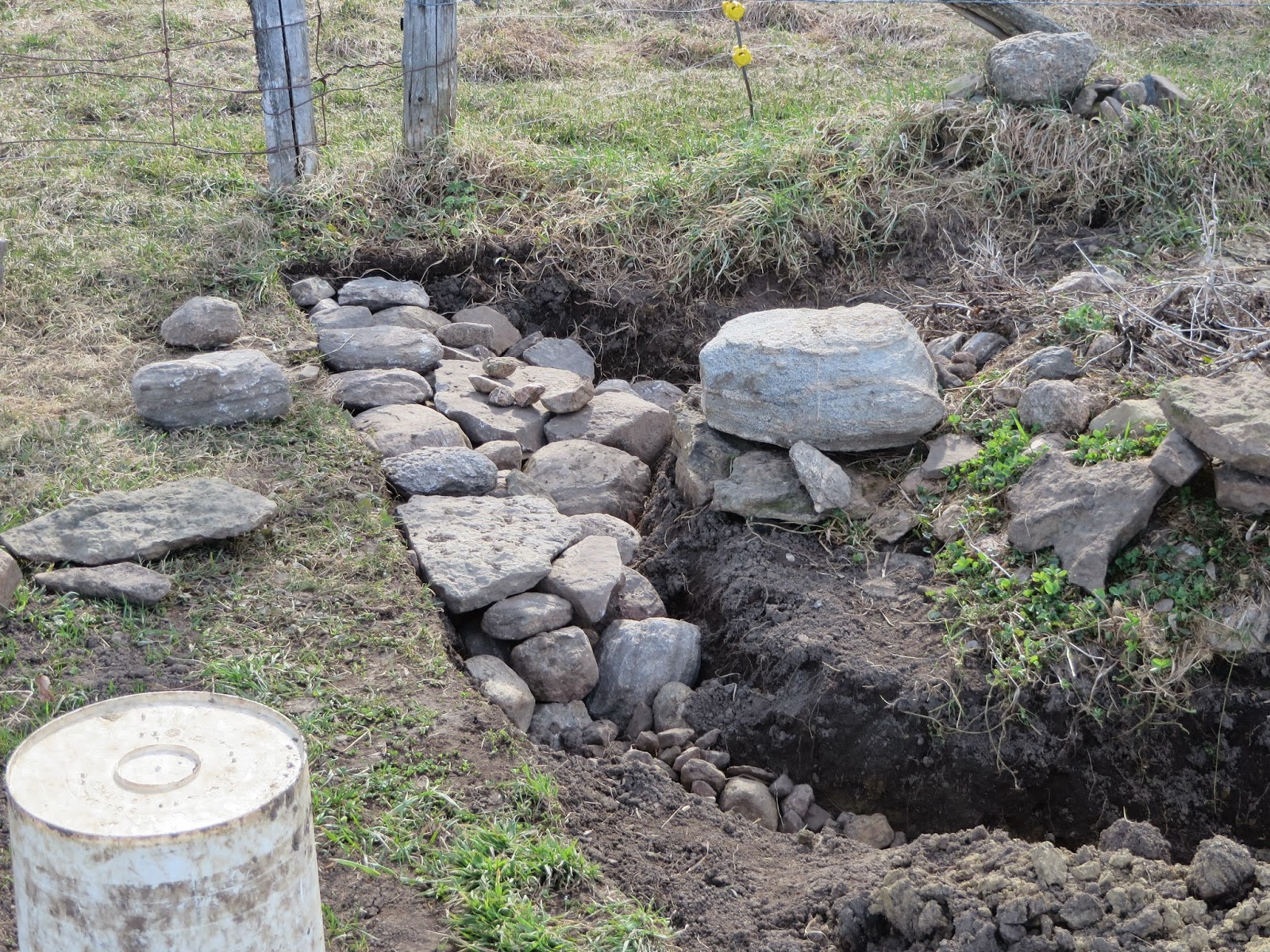
The rock garden has begun to 'grow'.  Another plot for more perennials has been dug out, and the central path now has a layer of flat stones capping 8 inches of loose rock.

I have a couple of extra zucchini plants from last year.  They cannot grow too close to this year's zukes as they would cross pollinate and yield a fruit that might not be palatable.  There is nowhere else for them to go, so I will put them here for this season.


Not everything goes as planned.  I mapped out a more efficient setup for the hoses this season.

Unfortunately, none of them are 105 feet long.

The stump that is dug into the ground at the edge of the rock garden has supported the splitter tap in past years.

Moving it a couple of feet is no problem, but then I will have to work on building the path and base up around the stump, to ensure that i have a level place to put the watering cans while they fill up.  Three more (unanticipated) hours of digging and collecting rock!
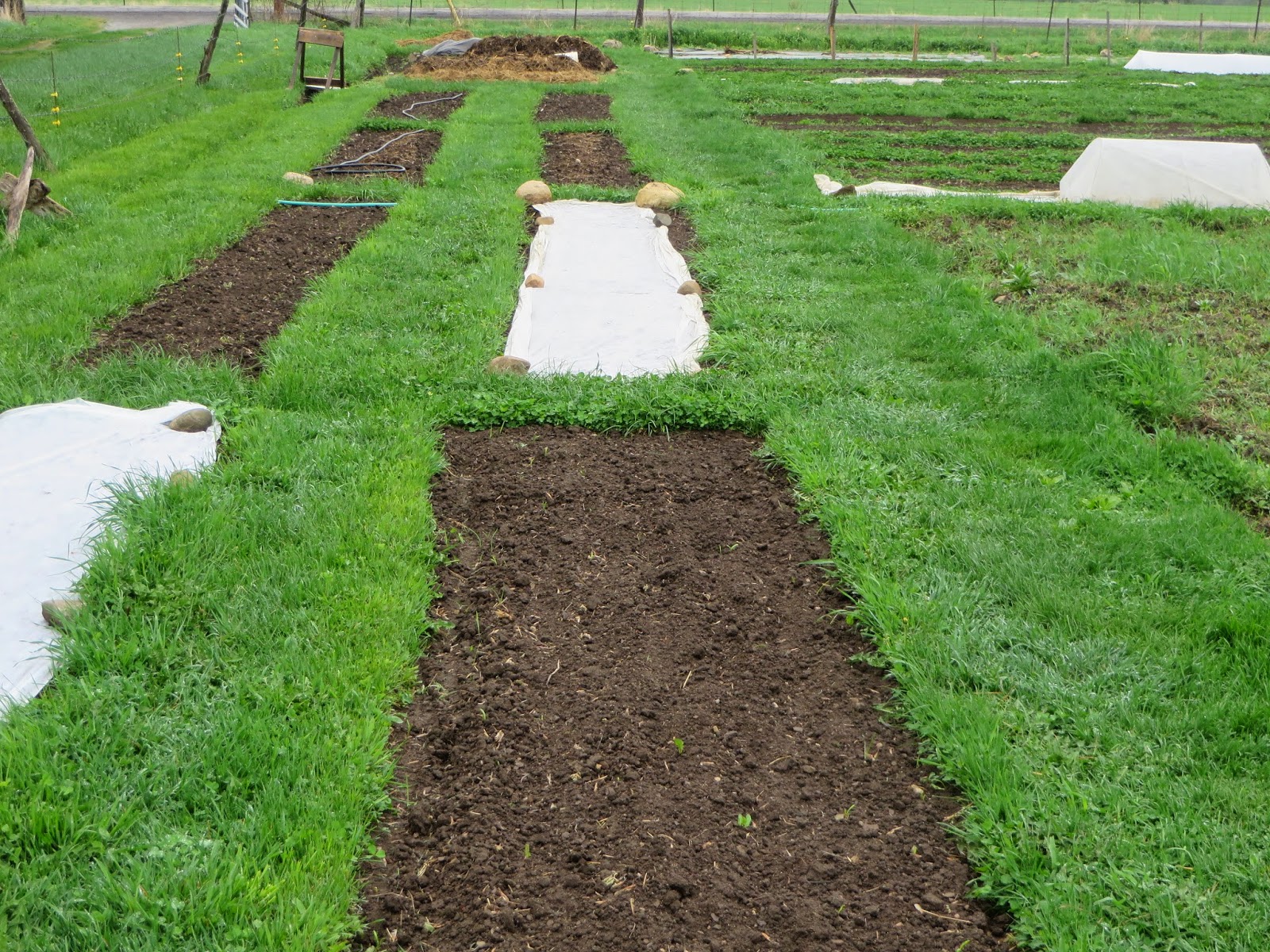
I use row covers for a number of different applications.  Keeping bugs out of beds, retaining warmth on cold nights, and providing shade for heat intolerant plants are a few uses.

The bed in the background is freshly seeded with fennel, these seeds will get washed away by the heavy rain that could come with the predicted thunderstorms tomorrow.

The covered bed in the foreground is seeded with brussels sprouts.  They too can be washed out by the rain.  Furthermore, like all brassicas, they are susceptible to flea beetles at this age, the row cover will keep most of these little bugs out.

Leek moth is the one insect that I haven't yet figured out how to beat.  For now, keeping the garlic and onions covered as much as possible is the only way to prevent them from damaging the onion family crops.

Despite their uses, I don't care for the appearance of row covers.


I grow a little coriander at a time, as it is consistently requested by a few customers for much of the season.  To make up for the extra space, I intersperse them with green onions, dill, and a few other limited quantity crops.

Here, I've used hoops to protect the transplanted onions; the coriander seeds are protected from rain.


The green onions are transplanted in clumps to make harvesting quicker.

I've had a lot of success in the nursery this year, though I am finding that the green onions are still challenging me.


Like many transplanted plants, these lettuces look pathetic when they first go into the ground.

It took me a couple of years to get used to this. It's hard to believe that these will be healthy lettuce heads in six weeks.

Transplanting is very tough on many crops. Cool, cloudy days are ideal for transplanting.  I did not have much of that this past week, so I created some shade with the covers and hoops.

By leaving the ends of the covers open, the cover does not retain the warmth that would be too much for this cool weather crop.

On very hot days, I've sprayed water onto the cover to evaporate heat away from lettuces.

Look carefully - around the plants, the soil looks slightly different.  That's freshly applied compost (and straw).  Leaf crops prefer to have their compost applied the same year they grow in the amended soil.  The straw helps to retain some moisture on the bed as well.

I planted our first peas a week ago.  They are just starting to sprout.

Peas are not heat tolerant.  Early last week, I was looking at the forecast and thinking that there might not be any point in trying to grow the second round of peas, and prepared the first green bean bed.

When bean planting time came, I saw the forecast was now calling for cooler weather, and so went back and planted a few more peas.  The beans will have to wait a week until the warmth returns.  as a result, they may be a week late getting to your table (Hopefully the peas will make up for that).

I was ready to give up on the spring spinach as well - at 30 degrees, I would be very surprised if the spinach seed germinated, the beds would have been put to better use growing something else.

As soon as I saw an extended period of cooler weather on the way, I raked down the bed and started planting.

I had assumed that with such as early heat wave, there would have been a bounce back in the temperatures at some point.  Deciding when the optimum time to plant is part instinct, part experience, and much guessing.


Some gardeners use string to 'draw' their seeding lines.  I learned this technique at Elmtree Farm - a couple of tubes (old hose) inserted onto the rake tines, draw consistently spaced lines that are fairly straight.

Planting in straight lines makes cultivating the beds much quicker when the crops have started to grow.

Some of our customers from two years ago may remember me raving about a variety of spinach called 'samish'.  I took a chance with the cool weather and planted it (as opposed to a heat tolerant variety, which will get planted next week - unless the temperature foes back up to the high twenties again).


Infrared Transmitting Mulch (or IRT).  This covering allows heat to get into the soil but blocks the light wavelengths that promote growth.

These are new beds and are not as 'tame' as the more established beds and will take a lot more work to prepare

In this case, I'm using the IRT as a means of keeping the beds dry and suppressing the weeds.

The IRT will buy some time while I attend other tasks.


Beds 1 through 8 and the (future) trellis bed are still a year away from being fully rehabilitated.

These were some of the first beds I prepared five years ago.

Everyone makes mistakes, beginners make more mistakes.

This is a job for two pigs...


It seems ironic that as an organic grower (and as someone who considers oil as old fashioned) that i am relying on spun bound nylon row covers and polyethylene irt mulch - and rubber hoses and plastic zip-lock bags, and a nylon mosquito jacket...

Traditionally, pine boughs were used for shoulder season crops, but there are no pine trees on Dick's land.

I have tried using straw whenever possible to protect plants, and particularly for cold protection and moisture retention, this works well.

Unfortunately, it does leave the leaf crops quite messy on harvest day.  I'll try straw in the fall, though I suspect you will notice the difference.

An alternative material to oil based row covers could be corn-based fibre.

I question the use of corn for manufacturing materials.  It is a very heavy feeder and would require a lot of good cropland to be reserved for non-food use.

I am certain there are alternative methods out there, hopefully inspiration will strike.

Talk to you soon...

Bob

PS - All customers, I will be sending out an e-blast in the next week or so to ensure that all of our new customers are getting their email alerts from Whitsend.  I'll have a few more details about the forthcoming season...first delivery is five weeks away!


Tuesday, 28 April 2015

Update May 1st 2015:

Whitsend has reached its sales capacity for 2015.  No more shares are available for this season.

If you are still interested in our certified organic CSA Farm for next season, please keep an eye on our website and track our progress.

We will have our open house on August 8th, and there may be food available at the farm gate stand for purchase on that day.

We may also have surplus as late summer and fall approaches, contact me if you are interested.

I am considering offering a bigger early bird discount next season as well.

Thanks again for your interest!

Bob


Hey Everyone:

Just returned from our annual seed potato pick-up.

I snapped a couple of pix at the Ellenberger farm, wishing now I had taken a few more.

This is the cellar your seed potatoes spent the winter in.  It is in the lower floor of a barn that is built into a hillside.  With three walls surrounded by earth and an insulated ceiling, Henry is able to keep the tubers at a stable 3-4 degrees throughout the winter.


In the dark, humid environment, mold can be an issue, so like the nursery at our farm, a fan keeps the air circulating to prevent the tubers from going bad.  To allow better air circulation around the potatoes, they are stored in large wood crates.

He also noted that by keeping an unfinished floor (earthen), ground warmth allows the temperature to remain stable.

Despite the time and cost of an annual trip to Coe Hill, it is worth the value in knowledge that I glean from several generations of potato growing experience.  This year, i had many questions about storing tubers to use as seed for next year.


During our travels to Hastings county, we found a park specialising in 19th century homesteading.

The park was closed, but the walking trails were open, and a few of the restored period implements were displayed in open sheds, so I was able to get some photos of a few items.

This seems to be an ancestor of my wheel hoe.

I find it odd that the modern equivalent (to be pictured below) has reverted back to the wooden handles.

The other most obvious design change is the method for adjusting height and working angle.


I wish I had one of these rock lifting machines last week.

This would have been worked by a team of horses, first to move and position the implement above a rock.

The chains would be hooked to the rock.

Then the horses would be hitched to a circular hitch (not pictured) and they would walk around the machine and winch the rock out of the ground.


After that, the horses would be hitched to the front of the lifter again and the entire apparatus (now carrying the rock) hauled to where the rock was to be deposited.


For the tractor buffs out there - a vintage ford. Small tractors were the norm back then.  Nice lines!


With the (partial) resurgence in market gardening, or truck farming as it was once called, the need for small tractors is growing once again.


By the way, the phrase 'truck farming' comes from the french word "trouque" - to trade.

Many of the year round small scale techniques that are being used by folks such as myself were first developed in the Paris region of France in the 19th century - the  golden age of market gardening, according to Eliot Coleman.


Trade farming is what came after 'subsistence farming' - what the first settlers practised before the economy had developed enough to make growing extra food for selling or trading feasible.

Speaking of the resurgence of market gardening, I was astounded by the potential of the region around Madoc.  There is a lot of under utilised land there that is very suitable for veg growing.

The soil is a rich blend of sediment deposit from ancient sea-shore and the phosphorous rich soil that has eroded off of the canadian shield.

The market potential (Brockville to Scarborough), and the transportation link (Hwys 401 and 7) could make this a great place for getting us off the dependency of shipping our food from drought stricken california - something that has been on my mind a lot lately.


I'm into the field this week for a lot of bed preparation.  A couple of crops will get planted as well. There will be more to write about next week - assuming I am not too tired out!

Talk to you then,

Bob

Sunday, 19 April 2015

We still have two "picnic baskets" or four "snack baskets" available for purchase.  I will have to close sales for the season soon so as to concentrate on growing for our season customers.

Please contact me soon if you are interested, I would be glad to discuss what we offer for the season and see if our produce and delivery are suitable for your fresh local farm food eating..

Our contact info is at the bottom of the page.  talk to you soon...


Hey everyone:

A very busy week, plenty to talk about but not much time to write.

Remember those small celery's from several weeks ago?  They are getting bigger, and spending more time outside in the hardening off shelter.

They should be ready for transplant in a couple of weeks, assuming the weather settles somewhat.


Kale sprouts.  These are a week old, and just about to be promoted into cell packs.  They grow much quicker than the celery and celeriac, thus planted much later in the nursery.

They will be ready for the field in a couple of weeks as well.  Being more cold tolerant than the celery, they just need a little extra protection (some straw and a row cover) to see them through the period of unsettled spring weather.


Lime green tomatoes, about five weeks old.

The toms are transplanted into larger peat pots so as to keep them from becoming root bound.

It takes a lot of space, but necessary as root bound plants will have a much longer period of time adjusting to the beds after transplant, and will shorten the fruiting season.

All of the tomatoes, peppers, and eggplants are doing well.


Here are our first lettuces, less than a week old and already promoted up to their cell packs.  Good thing I planted extra, the tari variety germinated poorly, the bergam green germinated very well.

Likewise, the jericho romaine did not germinate, but the anuenue (pronounced ann-yew-en-yew-eh - hawaiian named variety from the B.C.) exceeded expectation.  It is a crisp-head type, similar in texture to iceberg.  Not my favourite type of lettuce - I prefer the leaf lettuce - but variety is a great thing.


The peppers are ready for the cold treatment.  Now, I have to figure out how to get them into a 10 degree nighttime environment.

The hardening off shelter is a little too cool, and other plants need the warmth in the nursery.


The bottom storage shelf of the nursery sits at about his temperature (but where will the stored items go?)

Inevitably, it will mean moving a few things around.


I have a theory that 'moving things around' is the lowest common denominator of farming.  Moving seeds from the supplier to the farm, then to the nursery, then to the hardening off shelter, then to the field, then to the prep station, then to the car, then to your door.

All the while, veg waste is moved to the compost, compost windrows are turned over, finished compost applied to the growing beds, straw and straw bales always need to go somewhere else, the lumber stack is sometimes in the way, rocks are always piling up at the ends of the newly built beds, before you know it the hoses need uncoiling and positioned across the field, etc...

...and there's no time to stop!

One corner of the field, up by the compost windrows, has always been one of the last areas to drain.  Last year (with a little help from a friend) I started work on a drain.  even though it is incomplete, there was a measurable difference in the amount of standing water in this area,

This drain is going to lead to the rock garden at the far end of the field, where the water will be trapped in a reservoir.


The reservoir is a trench dug around the rock garden.  It is dug down to the hardpan (very compressed subsoil) that is not very water permeable.  The bedrock is not much further down.


Like a french drain or a dug well, the lower layer is filled with golf ball sized gravel.  This allows plenty of space for water to fill, without eroding the sides of the trench.

This gravel is then capped with stones that have at least one flat surface.  This becomes the path around and through the rock garden.

In theory, the  should hold water for some time.  It's dimensions (deep and narrow), and the proximity of the tall perennials in the rock garden should slow down the evaporation.  The turf around the rock garden is subjected to a lot of foot traffic, so will be very compacted, whereas the worked soil of the perennial bed is much looser.  I am thinking (hoping?) that the moisture will wick up into the garden.

Some of the larger plants, such as the ever thirsty oppopeos should be able to reach to water table as well.

Loose rocks make a great hiding place for mice, so a little catnip planted in the bed will take care of that.


At the opposite end of the field, we have another area that tends to hold spring melt.

If the rock garden works as I anticipate it will, then I will do the same over here, though on a much larger scale (a tree has crossed my mind as being appropriate - something everyone should do at least once in their life).

But not until I see how the rock garden performs.

Until then, I simply cut a little channel under the fence and join my little edge of the field drain to the big one that takes run-off down the the fens.

Talk to you next week.

Bob


Sunday, 12 April 2015

Thanks to those of you who are checking out our site for the first time.


First of all, a note about our flyers:

If you received a flyer on your doorstep, thanks for your patience (particularly if I upset your pup!)

I do not deliver to households that request no flyers, if I missed your sign, please accept my apologies.

As I deliver to specific neighborhoods, print advertising doesn't work for me...I would have to turn down quite a few inquiries.

I realise that my flyers are a bit rough and ready.  Most will wind up in landfills/recycling, so I don't spend money on slick plasticized prints.  I prefer to invest in quality seed and tools.

If you are interested in learning more about our produce, and are considering becoming a customer of our farm this season, peruse the website and feel free to contact me at the email or phone number below.  I look forward to answering your questions.

We still have room for two customers.  If you are interested in eating some certified organic vegetables this season, give me a call.  I will be happy to answer your questions.

Hey Everyone:

Work continues here at Whitsend.  The field is almost entirely clear of snow, and should be dry enough to walk upon in about a week or so.


My first tasks will be to do some work around the periphery.  A fence rail needs to be repaired and a fourth electric line added.  

This is also a good time to cut away some of the  weed brush, chiefly grape vine and manitoba maple that threatens to short out the electric fence in a couple of places.

Pictured to the right is one of the evening primroses.  Having overwintered, it should start to send up new shoots and start flowering this season.


Another flower that overwintered is the leopard flower.  Look very carefully at the base of last year's stalk - our first shoot for the season.


This plant is also called blackberry lily or leopard lily.  Genetically, it is an iris.


Much used in traditional chinese medicine, the common thread I find in its use is as an anti-inflammatory.


Seed procured from Sunshine Farm in B.C.


Some grass turf needs to be torn out for the next rock garden, and a small drain trench dug.

Speaking of the rock garden, it is a mess! Reminds me why I prefer autumn.  This time of year, everything is rotten and soggy.  


I don't know how everything gets so out of order when  snow is holding everything in place.  Must be the mice...


Meanwhile, the nursery is very busy, and almost at capacity.  The hardening off 

shelter has been insulated somewhat, and holding the hardiest plants to make up for the lack of space.

No matter how much experience I gain, there are a few little details that I still miss.

I planted 'extra' beets in the nursery, to make up for a less than 100% germination rate. When the began to germinate, I was reminded of something I learned the first time I planted beets.  


Beet 'seeds' are technically a little fruit with 1 to 3 seeds within them.  So I have a lot of twins (pictured) and a few triplets in the cell packs.  There are a lot of beets in the nursery, we'll have quite a first succession of them.


Usually when these are planted in the field, the first seed from the 'beet fruit' to germinate dominates and outgrows it's twins.  


I gingerly teased the twinned beets apart and promoted them to empty cell packs, at last count, there is approximately 350 plants (My target was 300), so a couple extra for everyone.  

Our first succession of beets will be a combination of striped chioggias and sweet kestrals.  Kestrel is a variety that has not done well when I have direct seeded it, and even in the nursery the germination rate was a little low.  But the flavour is worth the extra work.


Now that the first successions of  our crops are becoming established in the nursery, it is almost time to start planting the second successions.  Succession cropping is a technique that ensures a continuous supply of a crop throughout the season.  I’ll use lettuce as an example.

In mid April, I plant two 45-day lettuces for each customer and two 57-day lettuces for each customer, plus a few extra in case some fail.  This provides lettuce for the first two weeks of delivery.   They are transplanted out to the field at the same time.  


As lettuces grow very slowly in the spring (due to the shorter day length), they will have to be harvested a little smaller, hence two per customer to allow for a decent quantity for the first deliveries.

Two weeks after the first succession is started, I sow another succession of lettuces to cover the next two weeks of delivery.  This activity continues through to early July, when the last lettuces are sown.  

At that point, I start enough lettuce to cover the rest of the season, planting varieties that can tolerate shorter days and cooler weather.


Generally speaking, this describes succession cropping.   There are little details to think through. 


A 45-day lettuce (a lettuce that is harvest ready in forty five days) will take up to a week longer in the spring to reach its harvest date, due to the shorter days.


During the hottest part of the season, the lettuce may only have a forty day period of growth before heat forces it to go to seed early.  Excessive heat usually happens in late July and early August, though brief periods of heat (such as last May) can also alter the lettuce harvest date.


In the fall, leaf growth slows down considerably, most lettuce requires an additional three weeks to reach its harvest date in the late fall.  At a certain point in the fall, leaf growth all but stops, due to the shortening days and the cooler weather.  So for the last sowing of lettuce, I have to estimate when to plant based on when I expect my last lettuces to be harvest size by the time this period of growth ends. 


However, if I plant too early, these lettuces might go to seed before the growth period finishes.

These are factors that have to be considered when sowing the crop in the nursery, three to four weeks before transplant and several more before harvest.

One way around the planting first harvest date variables are by planting four varieties instead of two, each with different maturity dates.  Instead of two 45-day and two 57-day lettuces, I could plant one each of the 45-day, 48 day, 55-day, and 57-day varieties lettuce (Thankfully, there are thousands of lettuce varieties to choose from).


Worst case scenario, if I lose one or two varieties, I will still have some lettuce to deliver.  Best case scenario, the customers receive twice as much lettuce.  This does use up a little more bed space, but it is offset by the potential for some farm gate sales or very happy customers.

Recall I plant more than needed to offset poor germination or the occasional plant lost due to field damage – ie dug up by a vole, clipped with the whipper snipper, squashed if I happen to slip while walking by, etc.  So, there still might be lettuces left over. 


When this happens, I post the overidge on my ‘This Weeks Harvest’ page.  Customers then have the option of requesting this ‘extra’ lettuce on a first email, first serve basis.

If it still isn't spoken for on harvest day, the extra plants are either a treat for the pigs, or sent to the compost to become next year’s food.

As our first harvest day draws near, I will go into more detail about the different types of lettuce varieties.  We grow about a dozen or so, each with their own growing characteristics, shapes, sizes, colors, and flavors.

Talk to you next week.

Bob


Update later in the afternoon:

I pulled the straw off the garlic to get the beds warming up.


The soil is still frozen.  The bottom layers of straw are covered in grass and leaf molds.


Look carefully.  They have started to emerge from their bulbs.

Quite exciting.