Sunday, 19 July 2015

Hello Everyone:

It's been a busy week at Whitsend as I clean up the first beds and start planting the fall succession of crops.

Succession farming is a production model that produces a succession of crops throughout the season.

To use lettuce as an example, I sow enough lettuce for one to two weeks (plus 10-20 per cent for anticipated seed or plant failures) in the nursery several weeks before the anticipated harvest date.

About 3-4 weeks after the seeds are sown, the plants are moved out to the hardening off shelter for a couple of days.  This allows the plants to get used to a controlled amount of wind, wider temperature fluctuations, and the intensity of the sunlight.

When the plants are ready, I take them out to the field and transplant them into the designated bed.

The nursery sowing is repeated every one to two weeks.  This practice continues throughout the season until mid to late summer.

When the lettuce is harvested, the bed is cleaned up.  Any lettuces that failed (too small, went to seed, succumbing to pests, or just extra that no-one wants) and weeds that grew in the understory are composted.

The bed's surface is cultivated once a week for (ideally) three weeks.  An additional application of compost is added for the soil.  Then, the following crop is planted.  In this case, the lettuce bed is turned over to another leaf crop not related to lettuce, such as coriander, amaranth, spinach, etc.

The same bed then provides an additional crop for the later part of the season, effectively doubling my farm field size.

The next season, the leaf bed now becomes a fruit bed (in my rotation pattern, fruits, onions, celery, fennel, and potatoes follow leaves).  Most fruit crops perform best when their soil is amended with compost the previous year.  (Leaf crops do best when their compost is added during the year they grow).

Since most fruit crops grow all season long, the meaning of succession takes on a slightly different meaning.  When I start my first tomatoes in the nursery (about March 10th), I consider this the first succession.  After a week, I observe how many seeds have germinated.  If I don't have enough, I plant a second succession of tomatoes.

The first succession goes out to the field in mid May; if frost takes some of them, then the second succession is available to replace the first losses.

Several successions can share the bed simultaneously.  I interplant the green onions between the pepper plants.  The peppers may only have one or two successions represented in their bed.  With 32 plants per bed, there is room for 32 clumps of about nine green onions.  I only grow about a dozen clumps of green onions at  time, so it often happens that three succession are in the bed.  With two pepper beds, each interplanted with onions, the last successions are going into the second bed as the first successions are being harvested from the first bed.

Another example of multiple successions in a bed are with a crop such as pak choy.

This crop has a lot of appeal to a limited number of customers.  An entire bed is way too much to serve up at once, so the bed is divided into quarters and receives four successions over a period of four weeks.  As pak choi matures in three weeks, the fourth succession is being transplanted as the first is being harvested.  Coriander is grown in a similar fashion.


It would be very convenient if I could plant four dissimilar crops in the same bed that could be planted and harvested at the same time.  This would make caring for the bed easier (also, there tends to be a shading issue with the first few plants in each succession growing next to the taller plants in the preceding succession).

However, I have not yet found an ideal match.  Here are four crops that initially appear similar, yet would conflict if placed in the dame bed.

Pac Choi - 3 weeks after transplant.

Arugula - 3 weeks after direct seeding, this might actually work BUT the pac choi will attract flea beatles.  These will not affect the established choi too much, but will do considerable damage to the freshly sprouting arugula.

Coriander - 4-5 weeks after direct seeding, but is considered a leaf crop which are not planted in cabbage crop beds.

Spinach - 5-7 weeks after direct seeding; this crop needs lots of sun and won't tolerate the shade from surrounding transplants as it germinates.  As well, it prefers a more alkaline soil and grows best after peas.  Not to mention the fact that I require several full beds of spinach for a decent serving at harvest time.


So, for all the times I have referred to succession planting, here it is, a hopefully easy to understand explanation of succession cropping.

I'll leave with a note about another model which I am familiar with - in fact, it is how I have started to grow many of my herbs and flowers.  It is called permaculture.

A permaculture "bed" or garden is a self seeding garden that provides its "spring crops" once in the spring and possibly again in the fall.  Most are harvested and some are left to go to seed; the seed falls to the soil and sprouts the following year.

After the spring crop finishes, the mid season crop(s) have begun to mature, and the process continues until the last fall crops are harvested and or go to seed.  This could be considered succession cropping of a sort, but succession cropping usually refers to the successions of individual crops.


*                    *                    *


I  consider it very good form to bring my writing to a point, but the point may well be that it is getting late, I am tired, and want to "get off the farm" for a few hours.

Talk to you next week.

Send your questions!

Bob


Sunday, 5 July 2015

Hello Everyone:

Thank-you for all of your positive comments this past week.  Hearing your compliments about the produce, particularly the arugula, was very encouraging.

Hearing comments about the pleasure of preparing and eating food with flavor and aroma make a lot of the efforts feel worth it.  I know I must be doing a few things right.  Thank-you.


There are a lot of ups and downs in farming.  The spinach germinated consistently this spring (something I have had difficulty achieving in past years).  Then it failed to size up consistently, and a lot of it went to seed much earlier than expected (due to the intense heat of May, I presume).  The heat wave in May also caused some difficulty with the lettuce, though I should have started even more in the nursery, given that one variety was new for me and thus I did not have a fuller idea as to how it would perform.


May also presented another challenge for me.  Within days of the heat wave starting, I began to have difficulty sleeping.  Eventually, I figured out that it was caused by strong tea (my beverage of choice at all times).  As the days became hotter, I started taking a second thermos to stay hydrated, and was over caffeinating myself.  This led to several shorter than desired days and some mistakes while working in a sleep deprived haze.  I used to drink tea with impunity, but I suppose those days are gone. 


I still expect some improvement as my farm infrastructure and growing experience develops.  To that end, I am looking ahead to next year. 

I anticipate starting harvests earlier, with our first harvests in the first two weeks of June (Apr 30/Jun 3 and Jun 7/Jun 10), then a one week break, then the last two weeks in June (Jun 21/Jun 24  and Jun27/Jun30 – Canada Day falls on a Friday next year so one harvest week will have the deliveries pulled back 24 hours.  This will probably cause me some snow pea schedule headaches.


Most market gardens start their season in the beginning of June.  Being a one-man show on a farm that still requires a lot of building, I have aimed in the past two years for a mid-June start to ensure the farm was ready for the first harvests.  Now that the prep station, nursery, and field are starting to develop, I know the efficient work environment will allow me to do more in less time.


With eastern Ontario’s may weather becoming hotter and hotter, I suspect that growing many of the cool weather leaves (spinach, mustard greens, pak choi, cress, etc) will be less challenging.

Timing the harvest of early crops by mid June will provide a couple of fresh beds in which to plant a second round of mid-season crops, which in turn will allow me a little more flexibility for the production plan.

It also means that the customers will receive an extra week of deliveries.  As I often say on this site, lots to look forward to.


Speaking of looking forward, I see that the crops are at an in-between period this coming week. 

Some crops are finishing, and will not produce enough to serve all customers.  The peas are finishing their second flush, and will be done by the end of next week.  Customers who have only received one serving so far will be prioritized. 

The current round of mustard greens and choi’s will also be finished, and the next ones have yet to be planted as the space is not opened up yet for more cabbage family crops.


Some crops are not quite ready for harvest.  The beans are in flower now, and will probably have a small quantity of beans ready for next Friday, but not enough for everyone.
The carrots still have a long thin tap-root on them, and the lettuces are still quite small.  This tells me that they have another week or so of growth.  The potatoes are still in flower, and may require another two weeks of growing.  The zucchini might have two or three fruits by next week – too little for all of you to share.


I will have to be a little inventive with your deliveries next week.  Check out the “this week’s harvest” page to see what I have in mind – there will be several options but I am certain I will not be able to fulfill all of them.

Despite the small delivery next week, there will be a lot of harvest work for me to do.  The first round of garlic bulbs will be pulled and strung up for curing.
Harvesting garlic is a time consuming task. 

The bulbs are very susceptible to bruising, which in turn compromises the shelf life of the bulbs.  So a lot of extra care will be required.


Garlic is one of the major crops at Whitsend.  I grow several varieties each year in order to find the varieties that work best in our climate and soil. 

As each variety is harvested, the bulbs are examined and graded.


As garlic is propagated from a single parent, genetic accidents slowly build up in my seed stock.  Each bulb needs to be examined for signs of virus infection.


Samples of each variety are measured for size and number of cloves per bulb, and compared to the parent seed plant.  The very best performing varieties are then reserved for next season’s seed stock.  So far, much more complicated than pulling carrots out of the ground.


The next stage is to cure the bulbs to ensure a good shelf life.  The garlic has to sit out for a couple of days so that the soil will dry out of the roots.  Then, the roots and leaves need to be trimmed off to promote the bulb curing.  After that, the plants are bundled together in groups of eight, tagged with variety names and harvest dates, and strung up in the barn for two weeks to cure.

All along, the bulbs need to be protected from being bumped, exposed to sunlight, or getting wet.  As well, if any bulbs indicating viral infection are found, steps need to be taken to avoid cross contamination.


With the small delivery anticipated, and the dry weather, I should be able to pull a considerable portion out of the ground next week – there are over five hundred plants to harvest.

When the garlic is out, the beds are cleaned, and preparation begins for planting the fall cabbages.

In a previous post I believe I mentioned "succession cropping" as a potential topic for a future write-up.

This period of late spring/early summer is when many beds have their first succession of crop harvested and their second succession planted.

It makes sense then to devote the next post to that very topic.  Talk to you then...

Bob


Sunday, 28 June 2015

Hey Folks:

Fennel take so long to grow.  This one is about a month old, still two inches or so in diameter.

It should be ready in about another forty days.

Fennel is a great pairing with fish, and thick wedges of it are a fine addition to a kabob.

Eaten raw, it makes a tasty salad with apple, almonds or sunflower seeds, and a small quantity of sweet onion (I recommend Cipollini).  Dress with lemon and a spot of olive oil and serve slightly chilled.


Here is another surprise out of the rock garden...self seeded calendula.  I know theey are self seeded as the originals were planted on the other side of the rocks, which are now buried under the clover.

And one more surprise.

The farm gate store is now "open' for non- customers.

I have a surplus of scapes.

See the "farm gate store" page for details, forward the info to friends and family.


I'm still tweaking the harvest routine to make packing the delivery quicker.  Each year gets a little more complex, and changes need to be made to keep the process efficient.

I mentioned in the previous post that there was a curious absence of cucumber beetles and cabbage moths.  They started to arrive this week, I assume that they were knocked back by the frost in May.

These insects are only a problem when the plants are young and vulnerable.  After the crops are established, they tend to outgrow any damage.

I identified the red frog (pictured in the previous post).  It is a wood frog, probably travelling from one hedgerow to another and eating terrestrial insects along the way.  This is a new species for the farm (and me - I've never seen one before in the many hours of hiking and camping I have accomplished).  Hopefully, I'll find a salamander at Whitsend next - we came across these regularly at Elmtree Farm.

The only other nature note are the fledgling birds being guided into the field by their parents.  The sparrows like to sit up on the tomato stakes and watch for insects on the ground or in the foliage.  Every time I seed another bed, the crows come to check it out (hoping for corn or forage oats I suspect).

I had observed in past years that the summer solstice brings a change in the weeds and grasses - leaf growth slows down and roots and seed heads start forming very quickly.

During the last week or so before the solstice, I mow the paths as much as possible to gather up the leafy material for the compost.  This material is known as 'green manure'.

Mowing the paths is half the task.  To make room for the new compost, the older compost windrows have to be turned to make way.  It is a dance, one activity cannot resume until the other is finished.

After rolling the older compost windrows, I took a temperature reading, one windrow had reached an internal temperature of 94 degrees (34 degrees C).  Too hot for any weed seeds or pathogens to survive.

Some of this compost will be applied in the fall to beds where next years root and fruit crops will be planted, the rest is for next spring.

As for this year's application, all of the bean, pea, and leaf crops are getting a double application of compost.  It's taken a couple of years to build up a decent supply of this amendment, and not soon enough.

I wrote in previous years about a suspected imbalance of nitrogen, potassium, and phosphorus in the field - root crops did very well, and fruit crops did poorly.  I seem to have corrected that with added application of rock phosphate in the past two years (last year's peppers did very well, and when I get them right, the roots are doing as good as ever).

However, the three macro nutrients are only a small part of soil fertility building.

Signs of high soil fertility:

Crumbly soil surface.  When the soil is wet here at Whitsend, the soil surface takes on a crumbly look, but when it dries it becomes flat and hard.

Earthworms.  A farm with very high fertility can have up to 100 earthworms in a cubic foot of soil. * Whitsend has much fewer (I've not done a formal count yet, the number varies in different parts of my field.  It is certainly less than 100 worms per cubic foot).

Soil structure.  A block of soil can have numerous cavities and tunnels built by worms, other insects, decayed roots of dandelions and such, and the action of broadforking.  Again, there are variations from one part of my field to another.

Water retention.  A fertile soil retains water much longer.  Within 48 hours of a heavy rainfall, my soil surface is dry, and within 96 hours, even the soil just below the surface is drying out.

These observations tell me that I have the macronutrients in balance, and now I have to bring out the  the fertility of the soil.

During my internship at Elmtree, I learned that Stinging Nettle was a plant that grew where there was a 'latent fertility'.  This plant grows vigorously at Whitsend.  The potential is in the ground, but needs to be worked out.

The answer for the time being is to begin adding more compost.  Now that my compost material is at a sufficient quantity, I can start doubling the applications.

It makes sense in hindsight.  When I first began to work this acreage, I removed a lot of quackgrass roots, which are very difficult to compost properly (I lost one of my compost windrows in my second year because of this).

This quackgrass was fertility locked away in a form that was not usable by me, and by tossing it into the hedgerow, I essentially removed it from the field without replenishing it.

Kind of like a physics equation about energy.

If

Whitsend Fertility (WF) = QGrass + Other growth (crops, other weeds, insects, fungi, etc...)

Where value of

Whitsend Fertility = 10
QGrass = 5
Other growth =  5

Then

WF (10) - QGrass (5) = Other Growth (5).


Yes, I know I'm no PhD, I understood math but didn't care for it and my science teachers were either nerds or bores and even the good one wasn't inspiring.  So I never learned the language.


But I like the concept of the equation.  It explains what I need to do...add as much compost (or more) as it takes to replace the amount of quackgrass that I removed.

Responsible farming is all about maintaining a balance.  And learning.


Talk to you next week, perhaps with some pictures.

Bob


* "Grasp the Nettle", Peter Proctor, Random House New Zealand, 1997, page 27.

Sunday, 21 June 2015

Hey Folks:

First harvest is always a bit nerve racking.  Much of it is so routinized that it just happens. But there always a few little details that slip by.

This year was the need to hydro cool the leaves a little longer - I realised this during delivery, after seeing a few leaves look a bit wilty.

The new prep station is a pleasure to work in.  More shelf space, easier and less time consuming to set up, clean, and all tools and supplies within easy reach.

The station still requires some work, but I figure using it a few times will allow me to figure out how best to arrange shelves, cabinets, etc.


Cleaning the vegetables is far more time consuming than the actual harvest.

Selling food is all about presentation.  If it doesn't look good, the customer won't want to eat it right away, and then it looses its best qualities in the fridge.

Cleaning the produce provides an opportunity to retain fertility for the farm.  Soil from the plants is redirected back to the compost, water from the cleaning is drained back to the beds, and cuttings are also sent to the compost.


Onion (and garlic) roots are a great addition to the compost.  As well, soil that grew onions is great for conditioning the soil mix used for seed starting.

With a little practice, packing the food for delivery has become an efficient task on harvest days.  Iv'e tried several ways of packing to allow for a quick delivery, and gradually I am finding the best ways to pack it all up.

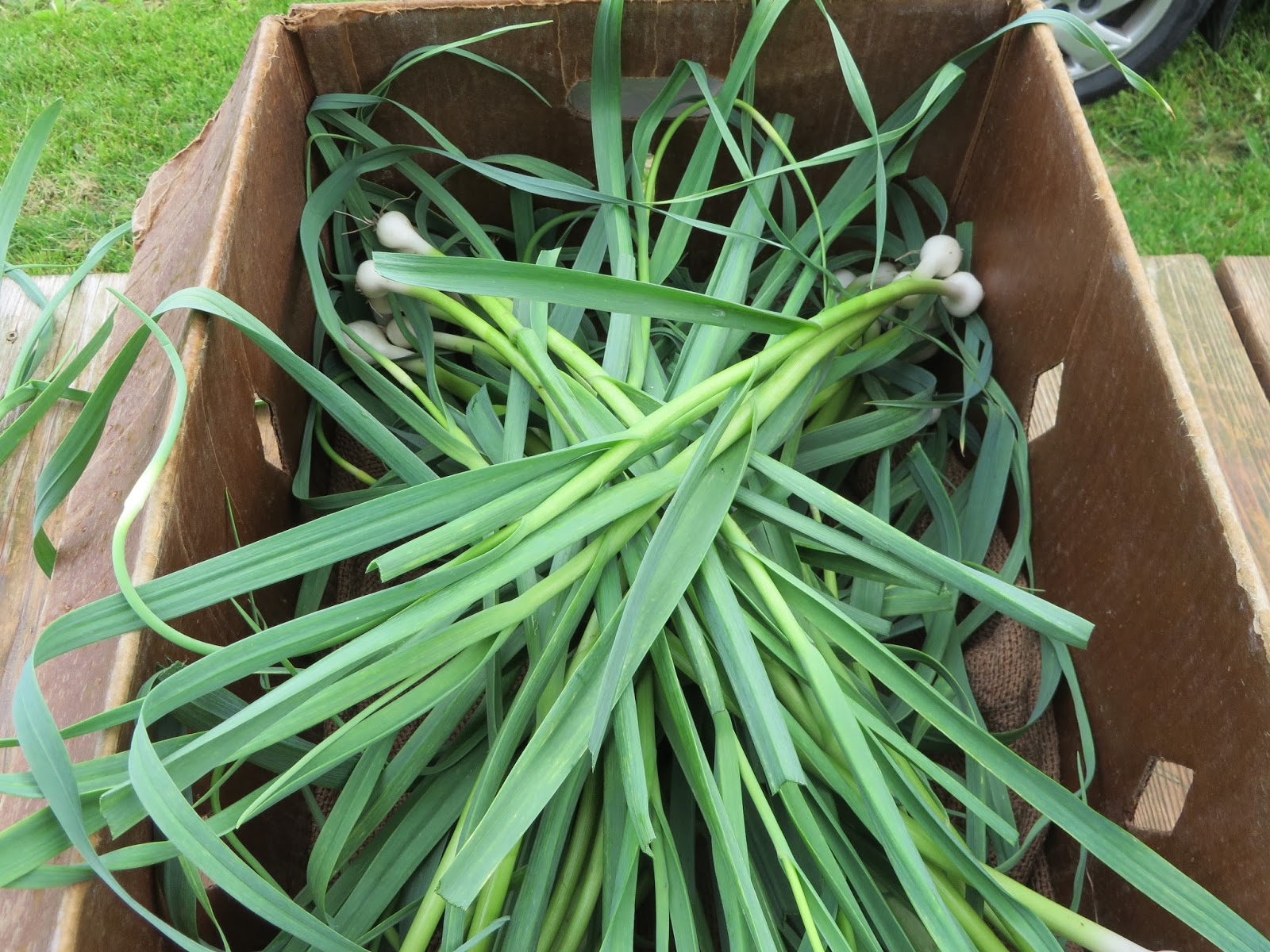
Here, I have places the garlic shoots in a crosshatch pattern so as to grab the three stalks for each customer.


Garlic scapes are ready for harvest when the scape reaches it's two curl stage.  About half of the scapes are ready for next week.

Scapes are the 'flowering' head of the plant.  If allowed to 'bloom', the garlic bulbs would shrivel up to provide the plant with he energy to create it's bulbils.

Garlic can be propagated from the bulbils, but it is a long term process.


Bulbils are not seeds in the usual sense, they are not pollinated and only carry the genetic material of the parent plant.

New varieties of garlic only occur by genetic accidents that are viable enough to continue to propagate.


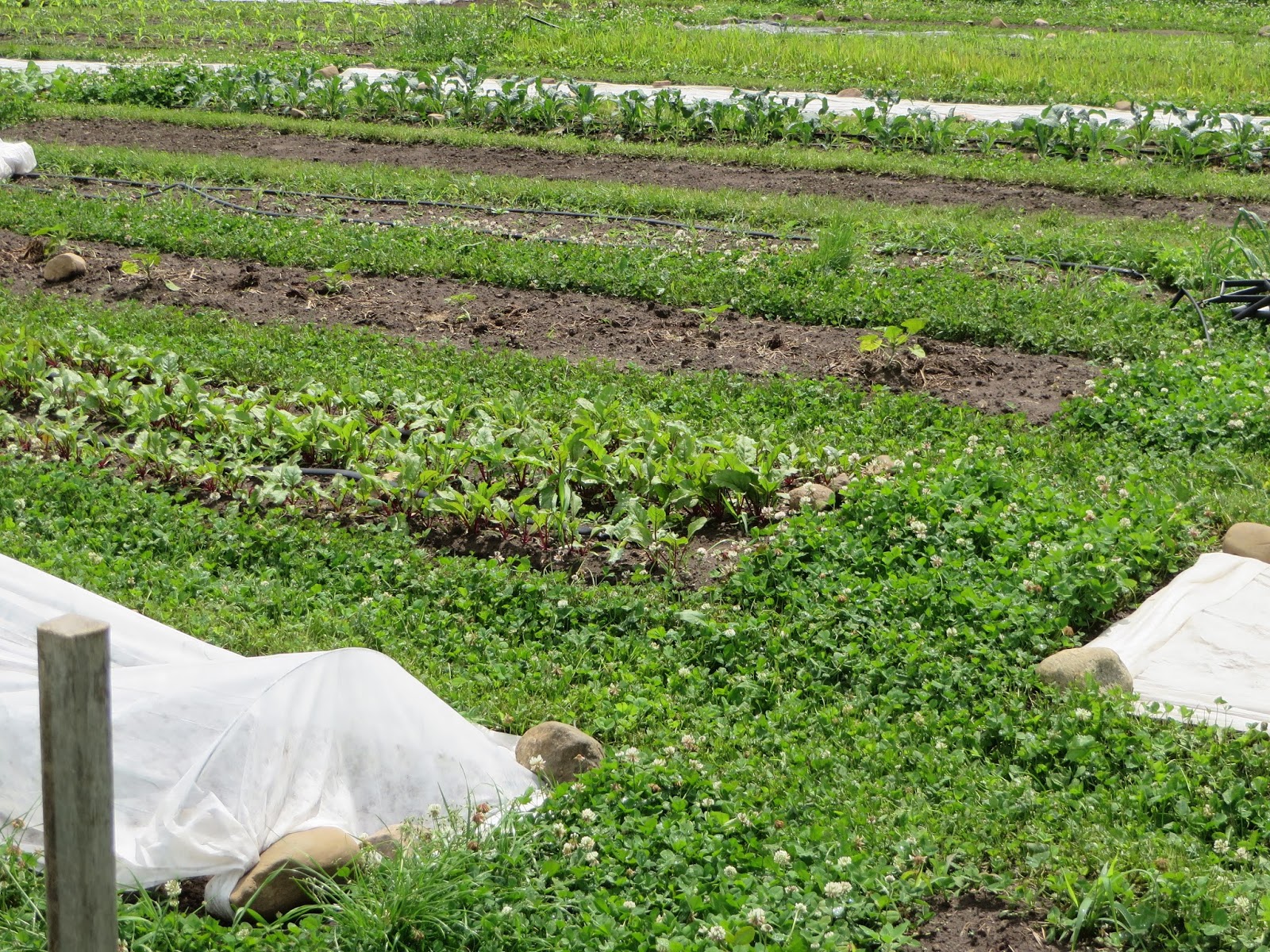
Meanwhile, out in the field, the food keeps growing.  These cracks in the ground indicate that the potato stalk and leaf crown is about to emerge.
The young plants are very susceptible to potato beetles.  Keeping the row covers on helps, though the plants still have to be checked regularly for adults, larvae, and eggs.

The row covers also reduce the sunlight for the plant, which in turn causes the plant to put more energy into its leaves than its tubers.

Each year, I start taking the covers off earlier and earlier.  This may be one of the reasons why my yields are going up.

As for the beetles, they seem to prefer the onaways, so the first generation of the year goes to this variety first.  THat allows me to reduce their numbers by destroying their eggs.  Last year, this reduced almost the entire population in the field.

After the onaways were finished, the beatles then went to the nicotiana flowers.  There they remained.  the nicotiana was so vigorous that they just outgrew the beatles, and despite three rows of red chieftain being a dozen feet away, the beatles remained in the rock garden.


The first two successions of potato, the early 'Onaway' and the mid season 'Dakota Pearl' are starting to flower.

We are a couple of weeks away from harvesting the onaways!

I was astounded the first time I tried 'real potatoes'.  They have flavour!


Speaking of insects, I have been noticing something amiss this season after I transplanted the squash and cucumbers.  No cucumber beetles.  I have also noticed a distinct absence of cabbage moths.

I must be one of the few growers that would find a lack of bugs worrisome.

Until the other day I had only seen one frog and two toads.  Usually, there are quite a few more.

Two days ago I saw a red frog.  What's up?


This is an example of companion planting.  Here are the basil transplants settling into the tomato bed.


The row cover behind te plant reflects more light onto the tomatoes.  This is an unintended benefit.

Gives the thinking part of my brain some ideas for a few other light loving plants...


Everytime i mow (or harvest nitrogen for the compost), I always feel like the place looks less like a field of vegetables, and more like a farm.


So much to look forward to, so much to look after...

See you soon,

Bob

PS, yes this is a short blog this week, but I'm starting to tire out and should leave the farm alone and enjoy the rest of the week-end...