Sunday, 11 October 2015


Hello Everyone:

Much talk about, there has been a lot going on at the farm over the past couple of weeks.  Too much to do and no time to write except on my  day off, and with an uptick in the farm workload for fall, the day off is all the more important. 

First of all, the farm has corrected it’s aphid imbalance.  My own actions probably had an influence, but I can’t be the only reason why they have returned to normal levels so quickly.

My approach to farming is to mimic nature, not replace it.  As with a natural or balanced setting such as a wild meadow or forest, there will always be a background population of a wide variety of insects (and bacteria, viruses, fungi, animals, plants etc.) that will compete and co-exist.  When I plant a concentrated amount of nutrient rich foods, I tilt this balance somewhat.  Nature responds by introducing a means of reducing all of the extra nutrient to it’s ‘balanced’ level.  How nature does this informs me as to how I can continue to tilt the balance toward more food, and then mitigate natures first response.

In simplest terms, when a particular insect population starts to increase beyond it’s background population, I interpret that as a symptom.  One factor that leads to aphid’s  thriving is water stress experienced by the crops.  This has been a fairly dry season. 

Compounding that, I may have inadvertently introduced some aphids with a compromised bag of potting soil, as mentioned in a previous post.  The aphids started in three transplanted crops  - cabbage, russian kale, and lettuce, all transplanted around the same time in three very different parts of the field.  The russian kale was very close to the toscano kale (unaffected), and the cabbage very close to the closely related daikon and arugula.  Neither of these neighboring crops were affected.

The aphids on the lettuce are only suspected.  The lettuce in question had no aphids on it, though it was transplanted at the same time and with the same soil as the kale and cabbage.  However, a couple of small pig weed plants on the bed had small populations being tended by ants.  Easily removed, the ants actually helped by concentrating the aphids (which seem to do better on pig weed than lettuce, if the ants farming activity are any indication).  At any rate, these cleared up with no damage that I am aware of.

The cabbage was so bad that all of the plants in the affected bed were removed and destroyed – sealed in a metal container until nothing was left alive and then kept in the sun to sterilize any possible eggs.  The Kale was only affected in a couple of plants.  I removed the worst of these , and the worst of the leaves of a few neighboring plants. 

Since then, I carefully observed the other crops for aphids and found only two other instances.  One (of two) zucchini plants were near the cabbage, and had aphids.  These were concentrated on a couple of leaves, again, tended by ants.  I estimate that more than ninety per cent of the aphids were removed by removing about four zuke leaves.  I also noted what appeared to be an uptick in ladybugs on the zukes, though only because I had never really noticed these bugs in zuchinis before – maybe they were always there and I never saw them.

I also found aphids on the nicotiana.  The nicotiana showed no signs of un-health, so I left them as a ‘trap’ for any aphids that hatched from the soil of the now empty cabbage bed.  If this particular species likes nicotiana, I figure that the aphids will go to these plants first (these are also close to the cabbage).  That way, I can use the flowers as a means of monitoring the progress of the aphids for the rest of the season and for early next year.

What have I done?  Simply remove the worst infected plants, and allow the farm to run it’s course. 

In certain conditions and certified procedures, I can use “organic pesticides” such as a chrysanthemum based solution; or I can make a spray of crushed garlic from my own farm to apply.  These may work against aphids, but they have several drawbacks.  

They would kill aphid predators such as lady beetles (and I suspect ants as well).
I would also loose valuable information such as nicotiana being such a great trap for the aphids.

Finally, I would waste a lot of time spraying every leaf involved, and have no time to relieve the crops water stress or solarise the potting soil, in order to prevent another outbreak.

A final lesson that I have learned from this episode is that I sometimes tend to assume worst case scenario.  I thought at one point that I would loose all russian and toscano Kale, cabbage, arugula, zucchinis (green and gold), lettuce, and just about everything else; plus have aphids hatching next spring from the soil and an entire season of battling tiny insects.  

Faith and confidence are as important as knowledge and activity when it comes to farming. 
Julia calls plants “…the worlds greatest optimists”.  I spend plenty of time around our crops, I should allow some of this optimism to rub off on me!

Before I sign off, I have a couple of other stories and farm updates to relate, but no time for the writing.  See below for a sneak preview, I anticipate being back from a self imposed farm email holiday for the next few days and will continue this edition of the Whitsend Post a week from now.  Time for family.

Have a good holiday.


Bob


By the way - Littledown Farm (whom we rent our land from) still has beef for sale.  Here is a link to their farm:

www.littledownfarm.ca


Also, I am certain most of you know, but just in case - we do NOT have pork this year.  The forage crop did not do so well in the spring and I was obliged to not buy the two piglets as there would have been too little for them to eat.


Coming post:

Preparing the field for next season:


Those of you who were here for the Open House may recall that this patch was covered in grass.


Beds 1 through 8 were lost after the third season due to mistakes made building them (too much tilling, resulting in an overabundance of quack grass.

I started clearing this group of beds using a low wheel cultivator with curved tines.  The tines pulled the grass rhizomes up from under the soil. After allowing them to dry out for 24 hours, I then used a bed rake to collect and remove.

Next year, I will grow crops here that will help clean the beds further - beans and potatoes.


Preparing fertility for next season:

All of the remnants of crops that are finished (tomato vines, squash vines, discarded celery, cornstalks, etc.) are gathered and piled onto one last compost windrow for the season.

This will likely be ready by late summer next season, thus becoming "next years' food".

Very little goes to waste here!


Frost mitigation - no one size fits all solution!

Some crops have two row covers - the first on short hoops.  After placing the row cover on the short hoops, I then put down a second set of long hoops over the short ones, and use a second row cover on these.  This creates an extra layer of air between the crops and the cold.

Some crops receive just one row cover, these are fairly cold tolerant but not as much as kale.


Sometimes straw is preferable to row cover:

I had a final celery or two reserved for the farmhouse.  As we are falling behind in putting food by (not to mention running out of fridge space!), I chose to leave these in the ground.  

Straw is a little more effective than row covers, though it does make a mess of the crops, particularly items like lettuce.

A little longer to apply than a row cover, but much cheaper than nylon row cover.


Some crops taste better after being frosted.  

Kale takes on winters might without much complaint.  Russian Kale in particular can survive a lot of cold.

For deep winter harvesting, plenty of straw helps to keep the leaves from drying out from the wind.

I often wondered if eating a lot of this will improve ones own cold tolerance...


Preparing for next year:  feeding the soil with rock phosphate and boosting the phosphate with buckwheat.

I apply rock phosphate to each bed once every four seasons (in beds that will receive fruit and bulb crops the following season, such as squash,  peppers or onions).

Typically, only 3% of the applied phosphate is in a form usable for plants.  Some plants, such as buckwheat, are more efficient in drawing rock phosphate from the ground, so I have started to plant this after application.  When the buckwheat dies off from teh cold, the plants decay and are incorporated back into the soil.  The extra phosphate that was taken up by the buckwheat is now available for the next crop.


Preparing for garlic:  Other than preparing the Kidney Beans, this is the final 'big task' for produce this season, though the garlic being planted now is for next year's harvest.

Cleaning and aerating the beds:  These beds were cleaned back in late August, after the lettuce was harvested.  A couple of late pig weed's and dandelion sprouts were cleaned out and the edges of the bed trimmed back.


Applying compost...last year's food is now returning to the field.  All of those carrot tops, squash vines, bruised tomatoes, un-formed turnips, gone to seed lettuce and past their prime arugula return to the field as nutrients for the soil.

Note the holes in the bed surface, these were made by the broad fork to provide oxygen to the lower levels of the soil column.  Oxygen promotes the bacteria and other living bio-mass in the soil which is so important for building fertility.


Compost continues to break down in the soil, processed by bacteria, worms, etc.  Each 'processing' of the compost - such as through a microbial mats 'digestive process', then a worm, which in turn may pass through a bird, etc.. - breaks down the nutrients and re-combines them in more complex and novel molecular arrays.  Complexity and diversity strengthen the community (in this case, the soil), which in turn makes for a better place to grow (the crops).

Soil is alive when viewed this way.  A considerable amount by weight is living organisms, one way or another.

Good food is simply a by-product of effective fertility engineering.


Garlic loves leaf mold.  Current research is devoted to the peculiar preferences garlic has for growing locations.  One suspected factor under study is the relatiobnship garlic has with mold and fungus.


These leaves were collected last fall and kept in a separate pile to accumulate a mold colony.  If these leaves had been mixed with grass clippings, bacteria would have broken them down into regular compost.

By leaving the nitrogen out of this particular cycle, the leaves decay much more slowly by mold activity.

After applying compost, I apply the moldy leaves and incorporate it all into the bed.


As garlic (being a bulb crop) falls into my 'fruit' category for the rotation pattern, the beds are also amended with rock phosphate.  three of the four beds for garlic this year had some buckwheat on it, so I will be paying extra attention to these beds in order to compare the efficacy of the buck wheat application.  No end to learning and fine tuning.


The rock garden was too warm for (last weeks) frost...the Thyme and Sage rocked on!

This week, with the minus seven predicted lows, the herbs were covered with straw.

The straw will remain on until next spring, when (hopefully), the plants will come back either through their roots or by having self seeded.




Saturday, 19 September 2015

Hello Everyone:

Much talk about, there has been a lot going on at the farm over the past couple of weeks.

I’m going to start by answering a couple of questions that have been posed to me by a couple of customers over the past few deliveries.

Why are the potatoes so small?”  There are several factors that influence a potato size.  First is the number of generations between the potato plant that bore the seed and the seed tuber sown in the field.  Each generation produces progressively larger tubers.  Typically, elite three or elite four tubers are used for sowing potatoes (four or five generations from the seed bearing plant).  My supplier has started using elite two tubers, as it tends to produce a healthier plant.  As a result, the potatoes harvested this season are a little smaller – the largest could be classified as elite three if used for seed.

Another factor is space between plants.  Suggested plant spacing for potatoes ranges between 8 and 12 inches – less for smaller tubers and more for larger ones.  Last summer, I had too many seed potatoes to fill the last potato bed at the 12 inch spacing, so I planted at 10” spacing.  When this bed was harvested, the tubers were smaller, but the overall yield was almost 30% higher than any previous potato yield.  Because of this, I experimented this year by planting some of my beds at 10 inch spacing to determine if this factor was influencing the higher yield.  I still have to go over my notes, but it appears there is little difference – something else is influencing yield increase.

A third possible factor is the time of sowing (I have to talk to Henry about this to confirm, but I think it is the factor that is most responsible for the small size).

Many roots are influenced greatly by the time of year in which they are growing; the change in day length is a signal to the plant to start storing food in the roots.  For instance, the russets were supposed to be a 90 day potato, producing medium to large tubers.  I wanted these to be available in late September in time for Thanksgiving. 

However, the plants matured at about 70 days (leaving them longer would have allowed the wire-worms and scab producing viruses to mar the surface of the tubers – as it was, I left them in the ground a little too long and we lost a few).

I suspect that if I had sown them a little later, (so that most of their growth occurred after the midsummer solstice), they may have been larger tubers.  We had a very dry season, this probably had an effect as well.

A chat with Henry the next time I am buying seed potatoes next year should help clear this up.
It is commonly said that smaller potatoes are of higher quality for texture and taste.  I’m not sure if this is true or just a hopeful sales pitch.

Why so few cucuzinis?”  All of the squash seedlings spent too much time in the hardening off shelter.  The plants were already stressed from too much time in their pots by the time they were transplanted.  The delay was in part due to the late frosts.

Typically, I place the young transplants under row covers for the first three weeks or so, I took the covers off early and this did not help the plants.  Fortunately, I had planted too many in the first place, so that even as we lost a few, the others were able to make up for the losses – particularly with the winter squash varieties.  The cucumber and zucchini's did not fare so well, and have under performed this season. 

Why is the Celtuce so small?”  This is a new crop for me, grown for customers who eat verry little salad such as lettuce.  Information on this crop has been difficult to obtain (It’s a new crop for the seed house I purchased it from as well), and much of what I have found is contradictory. 

As it is a close relative to lettuce, I assume that plant spacing makes a big difference in the size of the celtuce stalks.  A big lettuce is achieved with 12 inch spacing, so I presume that a thick celtuce stalk is achieved the same way.  However, the culinary use of celtuce is different.  One to two large heads of lettuce is satisfactory for a customer per week, but an equivalent amount of celtuce requires about 5 plants.  In other words:

25 lettuces per week = 25 heads of lettuce at 12” spacing, three rows per 25 foot bed.
Requires about 8 feet feet of bed growing space.

15 celtuces per week = 50 stalks at 12 inches per bed, three rows per 25 bed.
Requires twenty five feet of bed growing space.

My only options are to grow about 30 per cent less celtuce (meaning I have to grow more pac choi – which has its’ own challenges, see below), or grow the celtuce at a smaller spacing.

I assume the very big celtuce stalks available at the store also have the “advantage” of petro-chemical fertiliser.

The big news in the past two weeks is a case of aphids in the field.  I'm not going to go into too many details on these little insects that are literally born able to reproduce (Reminds me of an episode of a famous Sci-Fi television series).

Aphid infestations are rare on organic farms in most conditions.  Usually, they are a sign of too much nitrogen in the soil.  It is possible that the poor water delivery and lack of rainfall contributed to this to some extent as well. 

However, one of my earliest observations seems to point to another factor.  The aphids were originally concentrated in the russian kale, asian cabbage, and one succession of pac choi.  These were all sown in the nursery and transplanted at about the same time, but the kale was planted in a different part of the field.  Some lettuces were sown and transplanted at about the same time as well. 
I first found the aphids near the lettuce in question on a few nearby pig weed plants.  I next found the aphids on the cabbage and pac choi.  When I located aphids on the Kale, none of the crops in between the cabbage, lettuce, and choi had any aphids.  (They have since spread to the last turnips and some of the squashes).

This suggests that the aphids got into the plants either in the nursery, the hardening off shelter, or some other source.  I have kept some cabbage plants in these places as earwig monitors.  These have not produced any aphid activity.  Therefore, their must be another common factor to all of these plants, and my farm journal has provided the answer – a new bag of potting soil.

So I have another task ahead of me, I’ll have to solarize the entire bag which is time and space consuming – essentially setting out the soil in a thin layer in direct sun (but keeping dry) until any aphid eggs are cooked beyond viability.

In the meantime, I have to chase the little critters through the field and remove infected leaves until the crops are harvested (or in the case of the cabbage, sealed in a garbage can until everything is dead).  Not fun!

So the result for this year is likely no more arugula or radish, small cabbages, and possibly no Kale if I missed any infected leaves.

More worrisome is next year.  Now that aphids have established themselves on this farm, I need to take steps to wipe out that first generation when it emerges in the spring.  That means that a few beds may be kept off limits for a couple of months, covered by a plastic mulch.

I have contacted a supplier of beneficial insects and looking into the possibility of releasing some aphid eating insects into the growing field.  Hopefully, pesticide bans will come into effect so that the upper end of the food chain (where the pesticides accumulate) will allow our insect populations to balance out.  Predators are important!

Better news:  After a really tough slog, I managed to get the patch of 'lost beds' into a workable state.  2,880 feet broad forked, cultivated, tilled.  Now I begin raking the area down to drag off as much quack grass root as possible.  The dry weather is really helping me with this!

This will result in 27 new beds.

Well, 26 beds.  The last bed is situated near a main path, and had 6 old barn logs (foot diameter, about ten feet long sitting on it - these used to support the cistern).  We brought in a tractor to move the logs, only to find a colony of bumblebees underneath.  I couldn't take away the last two logs, bees are having too tough a time as it is, and I appreciate the fact that I have bees living in my field infrastructure (last year, a colony of wasps made a nest in the compost...)

Lot's more to talk about, but now it's time to tend the kitchen for some real food.

Bob

Sunday, 30 August 2015

Hello:

Thanks for your patience waiting for the next post.

It's been a busy period, so in a way, having an excuse has allowed me some genuine week-end time on Sunday afternoons, when I should not be thinking about the farm at all.

We had a good open house, a visit from the folks at COG Ottawa, and the annual organic inspection all within a six day period.


I delivered one of my best harvests ever.  The Fennel is a bit tough due to some inconsistent watering, but the arugula, choi, beets, and peppers are in particularly good shape.

Not pictured are the potatoes and garlic.

The rutabaga pictured is among the largest I have grown this season, and bigger than all of the previous years roots.  The biggest so far has weighed in at over seven pounds.


According to the seed house I purchased these from, planting Rutabaga earlier can make for a larger root.  However, that means they need to be harvested before the onset of frost (which improves the flavour of the roots).

Should I go for quality or quantity next season?

How big is your fridge?

The more I farm, the more I begin to disdain modern fridges, the shelving in ours seems to be ideally suited for little plastic packages and the 'crisper' has trouble with more than one large lettuce head.  I want to build my own....


Speaking of unusual roots, check out these  carrots.

Despite clearing a lot of the little stones out of the beds over the years, many still remain.

As the carrots grow around these, they assume unusual shapes.

Sometime the carrots intertwine, producing even odder shapes.  These two (A white satin and a pair of Berlicummers) are the most unusual I have come across.


Three years of progress.  The first year I tried eggplant, the plants died within a week of transplant.  The second year, The plants survived transplant but never grew more than a couple of inches tall, and dropped all of their flowers.

I looked for advice everywhere, but the tip that may have had the most effect was from one of the locals on our road.  Keep them warm at night.  So I put the row covers back on every night, even when the low temperatures were in the low twenties.

I also piled some rocks around them to soak up heat during the day and moderate the air temperature around the plants at night.


The goal for next year is larger fruit.

Which is what I had said about the peppers in past years.  However, I think the black peppers are at their average size.

There are a couple of real hot pepper fans in our customer base.

They declare that our Hungarian Black peppers (pictured) are a 2 1/2 out of 5 on a hotness scale.
The Hungarian Hotwax rank about 2 out of 5.


Peppers are another crop that has steadily improved over the years.  Despite losing most of a bed to the late May frost, the bed of  cone peppers (variety Lipstick) has produced enough to provide a decent quantity for everyone.  And the size is consistently larger each season.


Larger fruit eludes me this year for the winter squash.  This year, I am growing two different strains of delicata, in addition to the acorn squash.

One strain of delicata is in a  new bed, so it's fertility is not as complex as some of the beds worked for the past four years.  That may explain a slightly lower weight in the fruit.

I am uncertain if the new strain of delicata is naturally a bit smaller.  Or, I may have spaced the plants a little too close together - this makes a big difference in the amount of sun they receive, and the size of the fruit.

I will be finishing our acorn squash  seed this season and trying another winter squash or two that were recommended to me.  Something new to look forward to.


Speaking of looking forward, here are the rhubarb plants about six weeks after transplant. We should have some stalks in about two years.

Only seven plants made it out of the nursery, so I will be sowing some more next spring.


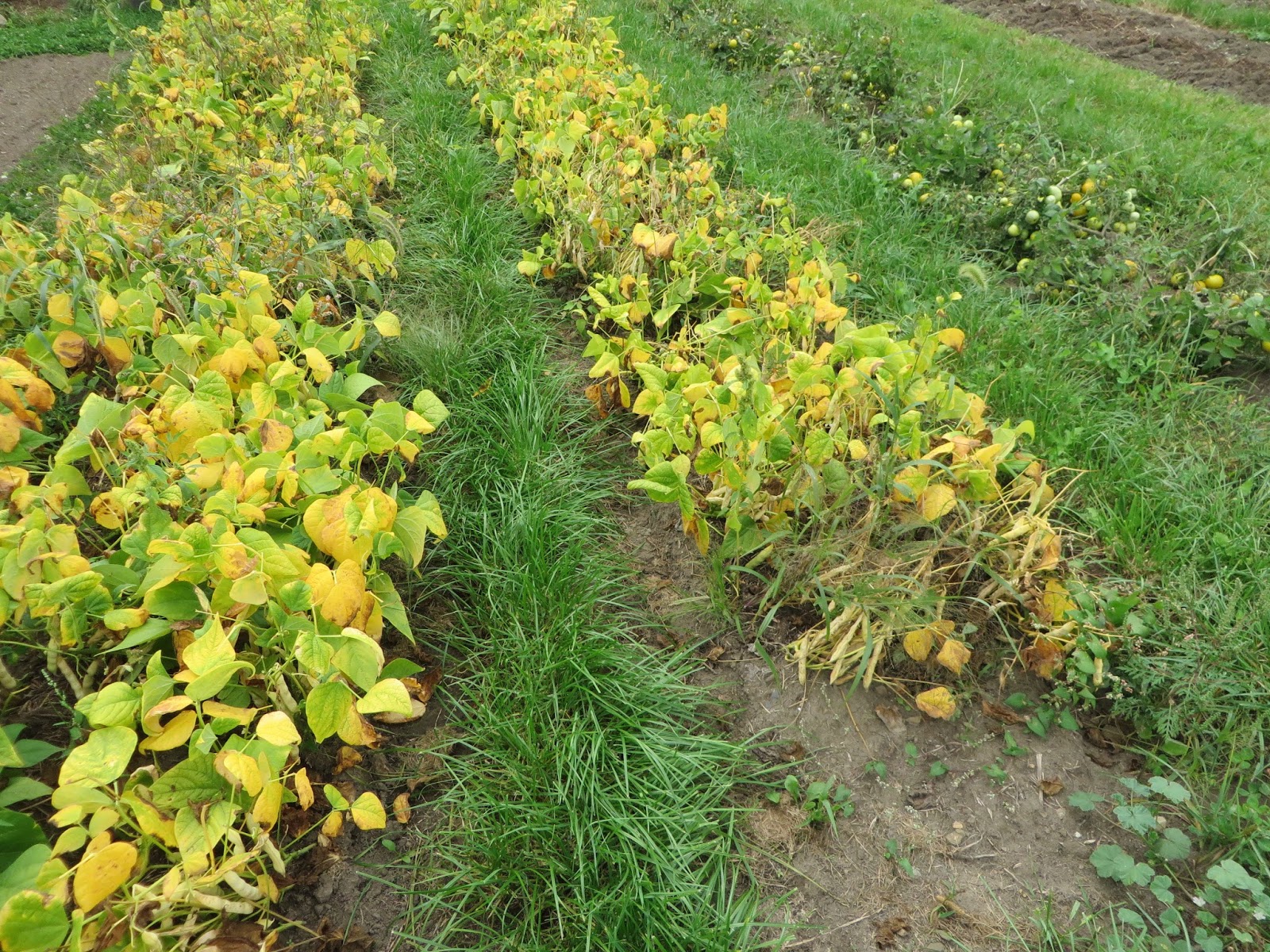
These are one of the two varieties of kidney beans.

As the plants mature, the leaves start to die back.

This allows more sunlight and air circulation to assist the drying of the bean pods.

The leaves fall to the soil and begin to decompose.

Garlic benefits from leaf mold, and it likes a fair amount of nitrogen (which beans indirectly fix within the soil), so the garlic will be sown here in the fall.


The bean pods are starting to "rattle", which indicates that the beans are almost ready to pick.

The plants will be pulled sometime this week, bundled together, and strung up in the barn to finish drying.

the weather forecast is suggesting a dry week, so this will be an ideal time for this task.

In previous years, I have shucked the beans before delivery.
Each year I have said "this is the last year I do this.

With our customer base (and amount of beans) increasing, it is probable that the beans will not be shucked by me this season.

It makes more sense that 30 people each shuck 3 Lbs of beans instead of one shucking 90 lbs!.


The kidney beans follow the garlic into the barn.
Most of the garlic is out, this is the seed garlic stored for planting in the fall.

There will probably be more garlic available for customers when the seeding is done.  I prefer to leave several bulbs in reserve in case some is lost during the storing phase.


Now that most of the transplanting is done (we still do a few pak choi plants this late in the season), there is room to set out the onions to sun cure for two weeks.

This dries them out enough to store for several months in the winter.

I have started to have some more success getting these season long crop past the voracious European Leek Moth.    I only planted 1 1/3 beds this season, so there will only be a few to go around.  I'm going to try a little more for next season.


I'm not the only one farming in this field.

Look very carefully at the top of the plant in the foreground - black aphids being tended by ants.

This is a first for Whitsend.  I've seen a few aphids here and there over the years, but these insects are not too much of a problem in organic farming, though it can happen.


So why did I catch a strange whiff while strolling past the row covers on the cabbage bed?

One of the reasons I don't like row covers is they are ugly looking.

Row covers have a lot of uses, and without a better alternative available yet, I continue to use them.


But it can really let you down.

I last checked these cabbages about a week ago.

I left the cover on to keep out the cabbage moths and loopers, which can chew these up somewhat.

Unfortunately, the covers kept an infestation of aphids in, and protected them from their natural predators.

We will probably loose this round (approximately 2/3) of our cabbage this season.


The efforts of rock garden building last spring has paid off.

I chose to build the rock garden for a couple of reasons.  First, I needed a place to dump all of the rock that is collected out of the field.

Second, I wanted a self seeding and overwintering bed for the perennials and herbs.  To help the plants through the winter and early spring, the rocks moderate the temperature around the plants.


The rocks should provide plenty of crevices for amphibians and snakes to shelter in.

The rock garden also provides a nice visual display to greet visitors with.

Most of the herbs in the rock garden (Thyme, Sage, Oregano) have settled in, now the trick is to get the plants to overwinter and or start producing seed.

That's all for now, see you soon.

Bob

PS - I'll update the farm gate page later this week.


Thursday, 27 August 2015

Hello Everyone;

Thanks for your patience while waiting for an update.

Shortly after our open house, our blog site received an unprecedented amount of hits in a very short period of time.  Apparently, this was considered  unusual by some security softwares.  As far as we have been able to ascertain, all is  well.

Thanks to those of you who have provided helpful advice and efforts resolving this issue.

More to come soon, we have some extraordinary crops maturing...including rutabagas weighing in at over seven pounds.

Talk to you soon, I will be updating the farm gate store page and this weeks harvest page for next week's deliveries.

Bob