Saturday, 24 June 2017

Update July 2nd:

I can't think of too many VIP's who get to fly around in state of the art military helicopters, so I have to assume it was Prince Charles flying directly over the farm today.


Update June 29 2107 - Hail damage.

Wednesday late afternoon, around 6:30 PM, I was in a parking lot south of Kanata, and waiting out an intense rain storm.  I later learned that there was hail at he 416/Fallowfield interchange (10 minutes east of where I was), and at the farm (10 minutes west of where I was).

Some interesting observations.  I'll comment more on these shortly.

I recall watching hail coming down for about twenty minutes one afternoon at Elmtree.  After lunch, we all fanned out to assess the damage.  Us interns thought that the season was over,but Tom and Alaine reassured us and sure enough, a month later, it was impossible to tell which tomato plants had had their tops knocked off.

As I pruned the tomato plants Friday (yes, I was working in the rain), I found a few buds and leaves that were torn down, but nothing too serious.  Plants have evolved with  this kind of weather, although our breeding for size, nutrition, taste etc. has made some varieties a little more dependent on us.

By growing in compost fed soil, with a living population of molds and beneficial bacteria to draw nutrients from, the plants have everything they need to start repairs.

There is some concern at the back of my mind for the amount of water the potatoes are getting, and the weeds are starting to assert themselves with all this moisture, but that is for another day...


Lettuce - the green romaine fared less well than its green and red partner.  Much of the damage is on the outer leaves, so I may either serve the hearts only (though they are small), or wait a week or two to allow for foliage regrowth.  It's a tough call.  Two weeks is the limit for this type of romaine, less if the weather turns hot and dry - which is what I need for our other crops.

If I leave it to grow, I am loosing valuable leaf crop space.  Another succession of lettuce is in the nursery and needs a place.  If I serve it up this week, i doubt it will be enough to satisfy your appetites.  I have to make decisions like this all the time, though you rarely hear about them...


Age makes a big difference - there are about 2 weeks difference between these otherwise identical kidney beans.  The younger plants (lower left) fared worse, which surprised me as younger plants are known to be more tolerant of adverse conditions such as cold.


These green beans, even younger than the ones above, fared even worse.

I am curious to see if the hail damage to the beans will affect the yield.  The plants will grow back.  

Will the stress of regrowing from the damage  reduce the pod yield, or will it make the plant stronger?


These kidney bean plants fared very well - almost no damage.

Note the weed growth - this bed was cultivated for weeds just over a week ago and the amount of rain has brought more seeds to germination.

It is much easier to work in dry weather than wet; I can take water to the field, but I cannot dry it out as easily.


The green leaf also fared better than the green romaine.

These plants are the same age, though the green leaf is closer to it's maturity date than the romaine.  So these have performed similar to the kidney, where the more mature plant tolerates the hail better.

As I write, more rain is hitting the window.  This is quite gratuitous...


The chard is going to need some rest.  It was already weak from too much water (folks who received it last week will have noticed that it wasn't the best I have delivered).

I learned last year that chard does not tolerate too much moisture very well, the leaves begin to crack.

The hail did considerable damage to the chard, but the core of the plants are still good and it will regrow back in a couple of weeks.


I did not have my camera today, wish I did.  As I did some trellis work on the cucmbers, I found that the oldest vines were full of flowers.  Quite impressive as the hail had stripped all the blooms off, though left most of the plants realativley intact (a few leaves were damaged).

I wonder if the "basket weave" trellis method I use is helpful for the plants in extreme events such as this.  They rub against the twine (which can't be good) but the looseness of the twine probably absorbs some of the force applied to the plants when they are buffeted.


Events such as this test (and build) resiliency.  I take this as an opportunity to learn.  Observation and note taking are two things that allow the farm to continue to grow - or in the case of the hail toughened crops - re-grow.


Now back to the regular post, all about what has been going on at he farm the past two weeks....


Recall the tiny celery plants from the nursery?
Here it is at about three months of age.

One more round of cultivating sprouting seeds, and then I start mulching the plants with straw.
This will blanch the stalks (they taste better that way) and suppress anymore weed growth.  After three cultivation's, most of the weed seeds in the soil surface (the seed bank) will have germinated, but I want to ensure a clean bed for late fall or early spring planting.

The straw will also retain moisture in the soil, which the celery will appreciate.


One of my favorites.  Fennel at about four weeks of growth.

This is an heirloom variety of fennel.  The bulb is a bit smaller than commercial fennel, but has a better flavor.

I'll be planting another round of fennel for late fall, using the larger variety.


The peas were in the middle of their first flush last week, and yielded just enough for almost everyone.  Having had their first picking, the plants are now starting another flush of flowers, hopefully a few more pods this week than last.

I use the "basket weave"method for trellising. Economical and quick.

The plants get plenty of air circulation (to decrease the chance of mold) and it also makes picking much easier.


Good news for you - the first round of beans is setting their first buds.

Bad news for me - I try to separate the arrival of beans and peas to ensure that I don't have to pick twice as much pods, which is very time consuming.

Usually, I start with a fifty day bean called Provider that germinates well in the cool soil of spring (when other varieties would rot).  Provider is no longer available as organic seed in Canada, so I had to choose between a 60 day bean and a forty day bean.  As I was more familiar with the forty day bean, I chose it.

Something to remember for next season...If I had waited another week or two, the harvests would have been timed better.


The kidney beans get harvested all at once, so I have planted a few beds at a time, to prevent all of them being ready at the same time.

These two beds have escaped mice damage, some other kidney bean beds have not.

This year, I am only growing hte light red variety, to prevent any crossing for seed saving.

I suspect that ta little crossing occurred last year, as some of the saved beans were a darker shade of red.  Hopefully, the added genetics form a different strain will have a beneficial effect on the crop.


A good example of inter-planting, a technique I use to save space - tomato, celtuce, and green onion.

In the past, I grew celtuce (closely related to lettuce) in leaf beds.  This resulted in leafy celtuce, which is fine, but I am trying to encourage a longer stalk, which is the main attraction for cooking this crop.

So I switched to planting it in a fruit bed.  This worked about 30 per cent of the time, suggesting there is another variable to consider.


One of the challenges with growing (somewhat) obscure) crops is that there are few reliable resources to call upon.  I found some info on the web about celtuce, but both articles contradicted each other!

One theory I have is that shade may be the missing ingredient to encourage stalk growth.  Here, I have planted the 2nd succession of celtuce with cucumber, which should provide more shade.

Look carefully for the first cucumber flowers...


Another example of inter-planting - winter squash and arugula.

Both squash (when it is very young) and arugula are susceptible to insect damage - squash from cucumber beatles and arugula from flea beatles.

So when I first transplant the squash, I use row cover to protect it.  Then I plant a band of arugula and related crops such as pac choi along the side.

This techniques solves a couple of challenges. First of all, one row cover does the job of two.

More importantly, arugula (a cabbage or brassica  family crop) is detrimental to most vegetable crops that follow it.  Beans and peas are the only two crops I am aware of that are ok for following brassica's.  However, I can only pick so many beans and peas for each harvest, so these are impractical.

As well, I need to have a nitrogen fixing crop on each bed once every four years (required for organic compliance and a 'best practice' as well).  After the arugula is finished, I cultivate it out of the ed and sow to bands of dutch clover, which also fixes nitrogen in the soil.

By the time the clover is established, the squashes are covering the rest of the bed and keeping it relatively weed free for the remainder of the season.

At season end, the clover is chopped up with the hoe and turned back into the soil, to break down and add organic matter, which in turn feeds a leaf crop the following year.


As there is such a high demand for brassica crops, I inter plant radishes with one quarter of the tomato plants as well.

Some brassica crops such as kale are usually not too bothered by flea beetes once they are established...they simply out grow the damage.

Short season crops such as arugula, choi and radish fare less well.  The row cover keeps most of the beatles out, but a certain percentage do get in and leave little holes you have no doubt noticed.


The past two years, I have had a LOT of flea beatles, and so the percentage getting into the covers has been greater, with predictable results.

I thought last year that the wild mustard (another brassica) was responsible for allowing such a large population of beatles to grow, so this season I started to control it much earlier - it's a weed that grows in the as yet uncultivated east field.

Despite this, the flea beatle population seems to have picked up from where it left off.


Worse, I also seem to have black aphids again for the second season in a row.  I have seen these on occasion in the past, but not the large clusters that have been present the past two years.

They feed on a wide range of plants, such as potato leaves.

It was not until yesterday that I noticed a toad, and realised that it was only the third amphibian I have seen al season.  A quick check through my farm journal from last year revealed what I thought I recalled...first frog of the season mid June, or late August "...saw two toads today, the 3rd and fourth of the season...."


Destroying  a hopelessly infested bed of cabbage last year
Usually, our field is crawling with them,

It's possible that the population cycle of

amphibians (which eat flea beetles and aphids) is in a trough.

However, I have sent out some inquiries about the effects of herbicide spray on predatory insects and animals such as frogs and toads.

As well, I contacted a bug supplier this week. If they can provide suitable documentation that their bugs are not gmo organisms and compatible with my organic status,then I will try to release some here on the farm,


Should be an interesting project, but I am not looking forward to the extra expense.


After reviewing the damage on my short season crops, i checked the long season brassica's.

The kale is fine, though you can see by the weeds in the under story that I have not uncovered the crop any more than necessary.

By the way, some of yous will be eating this kale next week, and the rest of yous will be eating it the week after that...

This is a variety of black kale, lacinato.


Some of you folks will be delighted to hear that I panted a lot of kohlrabi.

Like the kale, it seems to be very resistant to the flea beatles, so I am glad I did (I didn't have the heart to show how bad the damage was to the turnips).

Thus is an heirloom variety called azure star.

My first observation is that the leaf looks a lot like red russian kale.


Brassica's are a three chromosome organism, thus the huge variation in the appearance - cabbage, rutabaga, and choi are all the same species.


As I closed up the farm yesterday, I was feeling quite disconsolate (worried is not unusual, but I was quite depressed about the insect damage).  To pick myself up, I spent a few minutes taking a few photos to end on a positive note.

Here is next weeks chard, rhubarb red and a few silverado.  These are crops that seem to shrug off insect damage.  Earwigs can devastate these plants as seedlings in the nursery, but for themost part, the earwigs jsut use the stalks of the living plants as a place to wait out the night.


The scapes are at their first curl - which means they are one more curl away from harvest.

The conventional wisdom is that by harvesting the scapes (which bear seed-like structures called bulbils), the plant re-directs it's growth energy to the bulb, allowing them to size up.

Depending on the variety (we have about 7 in the field this year), the bulbs will be pulled in the next three to five weeks for curing...


Eight of the twelve cocozelle zucchini is in flower...the fruit is on the way.

The segev zucchini has also started to produce flowers, but these are not hardy plants and I only have two mature ones so far.


The first cherry tomato is formed.

This plant will get tagged and numbered as "early producer".  Early fruit set is one of the criteria I look for when deciding which plants to save seeds from this fall.

Other criteria include quantity of fruit set (I do this visually and make hash marks on the tag as I harvest), resistance to disease (a simple visual comparison - it is usually evedent when a plant is struggling with a bit of rust or virus when compared to it's neighbors), and length of fruit set.


I'll have to sample this one, just to make sure this variety is good enough for delivery...


The first yellow zinnia bud of the season.

The red zinnias are not far behind, and our new flower for the year is just starting to recover from transplant shock.

I could continue writing, but it is my day off and there is a lot of fun to be had away from the field...talk to you soon.

Bob


Saturday, 17 June 2017


Hello everyone:

Lots of progress to catch up on.


The garlic continues to grow well.  I anticipate scapes later this month.  

The green garlic that was delivered in your first basket is grown from the really tiny seed cloves.  If planted with regular garlic, these plants would probably yield small bulbs.  So I use them for the spring garlic, planting them much closer together.  


Between improvements to the nursery and a little more knowledge, I have had better success germinating lettuces in the hot weather than the past few years.  Still not up to the standard that I expect, which means I am going through a lot of extra seed.


How much there is to learn!  It's taken me a few years how to do perrenial herbs effectively.  Finally, the oregano is reaching a good quantity, and I add a couplek of plants each year to augment the stems that I let go to seed.

The next bit of knowledeg to add to my notes this season is cutting back the the rest of the plants to keep a consistent harvest window.  Seems quite straightforward, though I usually tend to us the research time  in the winter for big picture topics, such as soil fertility etc.  So most of my little details are trial and error learnings.  


Speaking of little details, I had success this season germinating Stevia, a herb native to Argentina that is grown for it's intensely sweet flavour.  Here is one of the six plants (from 10 seeds) that survived to transplant.  I'm hoping that by the middle of next year I will have enough of this to at least give a sample.

Because the transplant is so small, I have outlined it with a couple of stones, just so I don't forget it is there and weed it out.

After all, it's a rock garden.


This is your cherry tomatoes - as of this writing, the photo is about 4 weeks old.  The first couple of plants are just starting to flower as of this week.

Gold nugget is a 60 day tomato.  I started these back in March, and transplanted them during the first warm break in May.  I anticipate all of the plants will be in flush about late June - the first few plants will have to cover everyone for a couple of weeks.


Gold Nuggett will be finished by mid August; by then Gardeners delight (small red cherry), Moskvich (medium size red table tomato) and Great White (large heirloom tomato) will be in production.   I have tripled our tomato production from previous seasons - assuming all plants continue to thrive..


I'm still hoping that this is my breakthrough season for the eggplant.  It has not liked the cool weather, so I keep it covered at night.  I chose a slightly sunnier location, and tried to place it in beds that are quite rich (bulb onions get the top spots).

Another trick I am trying on one of the two beds this year is to prune back some of the leaves.  I hope this leads to a larger fruit set.


Still on increasing fruit yields, here is the first of two successions of zucchini this season.  In previous years, I tried to keep zucchini and cucumber going all season, but I have founds that the plant tends to tire out mid summer and yield goes down.  So I have planted a few extra plants for later in the season to make up for this.


You can't fool all the eaters all of the time, but this season I have a disappointment for the crow.

Last year, I was using oats for pig forage and also a a soil building cover crop.  The pair of crows that have claimed our field (as there own)  were quite capable of finding the seed and consuming it before it germinated.

I planted twice a much, but that just attracted a pair of black birds.


I finally used IRT mulch to cover the seeded areas, and discovered that a - oat and pea seeds can germinate in darkness; and that the birds "knew" that the seeds were under the cover and would pluck under the edge of the cover to get at the seeds; or waituntil the wind blew hard enough to expose some of the cultivated soil.

However, this year I am just using the IRT mulch as a weed suppressant until the crop is ready to go in.

Crows are smart birds, and I have spent many hours wondering how I can train them to hunt the mice, another unwelcome visitor that has so far eluded my best efforts.

More photos to follow, talk to you soon

Bob


Tuesday, 16 May 2017

Update June 5 2017:

Toall of our 2017 season customers:    I have sent out your first mass email of the season.  If you have not received it, check your spam in case the mass email was filtered out of your inbox...this sometimes happens with new customers.  If you have any other difficulties, please let me know.

Talk to you soon....

Bob

Update May 30 2017:

Hello Everyone:

After more than a week of no internet, we are back.

I'm not a particularly connected person (by choice, I like to keep things simple and I'm not easily mesmerized by gadgets).  However, it was quite harrowing to be without an easy source of mass communication.

In one sense, it made working at the farm a little easier to focus - communication was out, so I focused on more seeding and transplanting.

However, at the back of my mind, I was wondering if I was missing opportunities for new customers, missing important emails from existing customers (or family or friends), and generally wondering how this would affect my season.

I'd like to thank Jim and Marilyn for the use of their computer during the past week, and Chris for the IT support.

Talk to you soon,

Bob

We are still 5 shares away from our goal this year...if you know of anyone else looking for some great food this summer, have them call soon.


Talk to you all soon!

Bob


Update May 17 2017:

You will notice at the end of this blog I expressed concerns about low germination rate of the 1st round of radish.  24 hours after posting the note, four of five varieties sprouted quite uniformly..  I guess that is the magic of agriculture...


4 shares left...contact us soon if you are interested in taking part in this years harvest. 


If you have received one of our flyers after the payment deadline, please note that I can adjust the three payment schedule.  We still have about eight shares of produce to sell for the season.  Call soon, as in previous years the last few sold quite abruptly.


Why I use Flyers to find customers:

To keep our doorstep delivery cost efficient, I restrict my customer base to particular neighbourhoods.  This renders print and electronic advertising somewhat ineffective. 

I use very simple flyers (printed at home on standard print paper) to keep costs down.  I realise most flyers will wind up being recycled, so I do not create extra expense with glossy, professionally cut flyers.


I do not leave flyers if I see a “no flyers please” sign on your mailbox.  If I did not notice your request to this effect, please accept my apologies.

By far, most of our customers have come to us by word of mouth. 


Hello everyone:


The temperatures are starting to settle.  As this occurs, more seeds and transplants are going into the growing field.

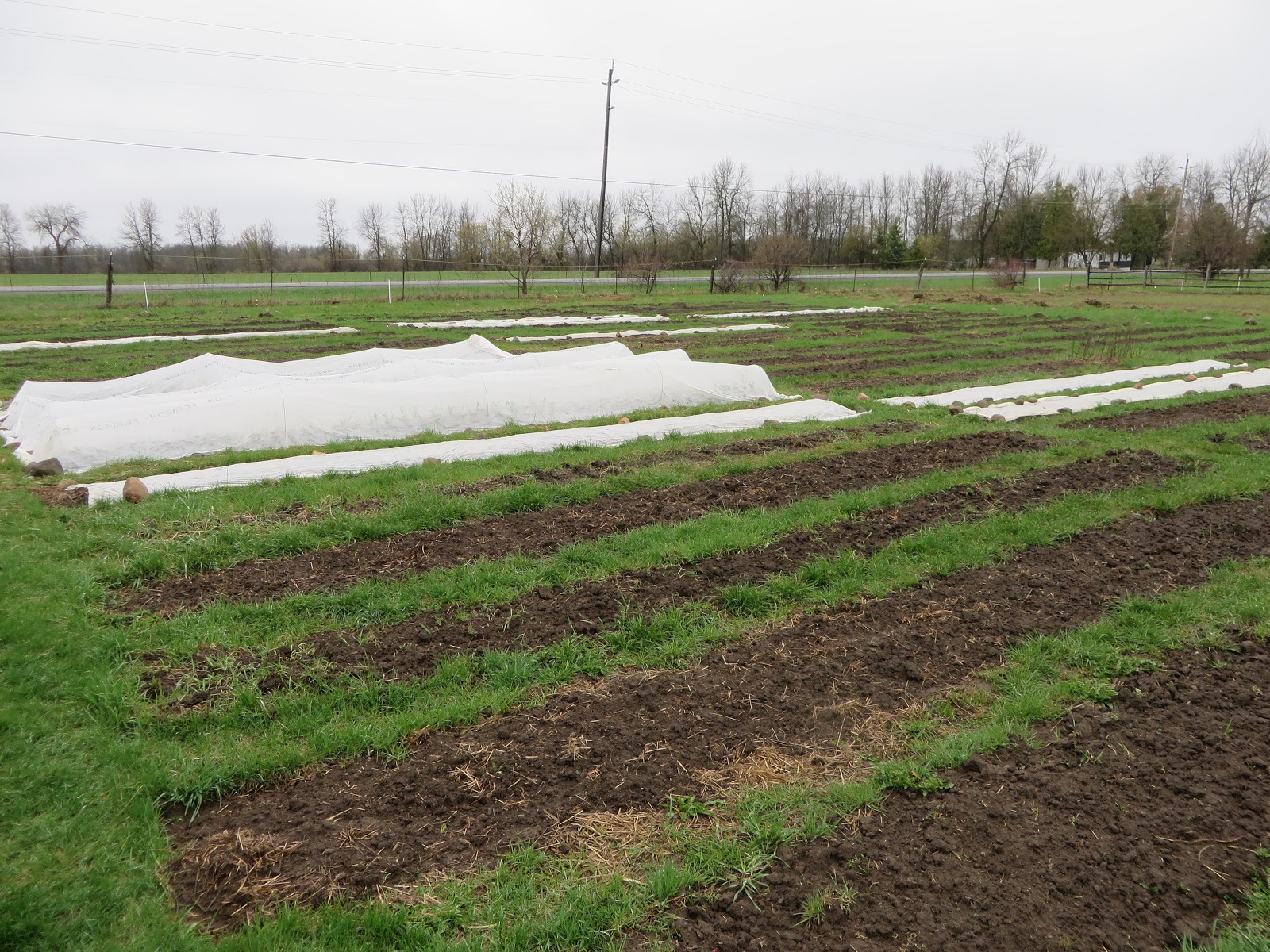
Unfortuneatly, the weather is still unsettled enough to require row covers.

The garlic needs to be kept covered at night as the leek moths are now coming out, the seeded beds need some protection from having the seeds exposed by rain, and the arugula is at a stage where it is very suceptible to flea beatles.

So all we see is a field of nylon.


A couple of posts back, I wrote that I would elaborate on the nursery techniques for starting crops from seed.


The seeds were started in trays, and shortly after germinating, promoted to cell packs.  By doing it this way, I save space.  Example:  If need a minimum of 100 plants of a given crop, I plant about 150 to 175 seeds, depending on the estimated germination rate. This will take up the space of one tray in the nursery.  If I were plant these in cell packs, they would take about two and a half trays.

When promoting, I take the best 120 sprouts, assuming that some might fail to thrive in the nursery.


These are bulb onions.  In the field, I grow these in clumps, aiming for three plants per clump in the field.

To make the transplanting more efficient, I grow the five onions in groups of five in the same cell pack.

I asume 1 will fail to thrive in the nursery, and 1 to fail during trasnsplant.

Sometimes four or even five will survive to harvest, but these are usually quite small, owing to competition with their nieghbours.


As these plants grow, I move them from the hot shelf to the warm shelf; and then eventually to the outdoor nursery.  This structure is not heated, so on cool nights, some trays return indoors.

As these crops approach their transplnat date, I start exposing them to direct sunlight and wind for lenghtening periods of time, until they are spending full days and nights in the hardening off shelter.  I aslo start reducing water at this time, to stimulate root growth.


Last year was the best yield I have had for onions.  I had hoped to double the amount this seaosn, but they take up a lot os \\f space, so I was only ablbe to increase the amount by fifty per cent.

The big challenge for improving is keeping the onions free from insect damage duirng the curing process.

Now that they are tranplanted, i have 80 days to come up with a solution...


Here is the hardening off shelter.  A smaller, less airtight version of the outdoor nursery.
Since taking thsi picture (about four years ago), I have added a few more shelves and a second "lid" that is covered with screen.

During the day, I raise the plastic lid, leaving the screen on to protect the plants from insects such as cabbage moth, which will lay their eggs in the cell packs at the base of brassica (cabbage family) plants.


Time to transplant:  First, we start with a clean bed.  The weeds have been alowed to sprout a couple of times (ideally three) and then ceared out with a small hoe (reffered to as cultivating).  This activity depletes the seed bank in the soil, and leaves the bed relativley weed free for the rest of the season unless the soil surface is greatly disturbed.


I then mark lines according to the plants spacing requirements.  In this case, I am planting baby pak choi in 1 row at 6 inch spacing.  (I'm interplanting with other crops in this instance, otherwise I would have about 4 rows -

I'm using a couple of 5" pieces of old garden hose attached to the tines of the bed rake to mark the lines.

Straight lines make later work much more efficient.


I then remove the plants from their cell packs.  In hot weather, I might water the bed first, to lessen the temperature shock to the plants.

Note the area where I have watered in arugula seed to the left; I have left space in the centre of the bed to transplant winter squash).


One hand pulls back some soil, the other places the plant into the hole, and so on.

After the plants are in, they are given a light watering to ensure the soil fills in around the roots.

Finally, the row cover is placed over the plants to give them a little protection from the elements while they reover from transplant shock and acclimatise to their new surroundings.


Transplanting is best done on cloudy days (again, to relieve some of the stress on the seedlings).  I can't wait on cloud cover all the time, so the row cover provides a bit of shade.

Heavy rain and wind can also take a toll on fresh transplants.

Many plants can outgrow insect damage, but young plants are quickly overwhelmed (happened once to my winter squashes).  The row cover reduces the number of insects getting into the bed.


I look forward to the day when we return to using row cover made of materials other than nylon.  Nylon, like plastic, breaks apart easily.

I recently learned that how a fibre behaves (how well it sheds water, holds or releases heat, allows in sunlight, etc) can be determined by the weave more so than the material it is made of.

With that in mind, all it will take are some entrepreneurs and an engineer or two to start using better materials for row covers, tarps, and many other objects useful around the farm and your home.


A few other notes:

Our first harvest is less than a month away, and I have at least one disapointment to relate.

The lettuce will not be ready for the first week.  Com[pletely my fault, I missed a nursery seeding date on April first.

There is plenty of lettuce ready for the second delivery on June 21st.

I sowed the radish early last week, and I am just seeing a couple of sprouts coming up as of today.  It is possible that I buried the seeds a little too deep, and they are just delayed by 48 hours or so.  If that is the case, then all is well.

Ususally, radish seeds sprout in about 5-7 days, so 10 days is a bit worriesome.  I planted about four different varieties, so it is not the seed lot.  The seeds are a little old - 2-3 years, but I overseeded to compensate (brassica seeds are usually viable for up to four years), and sometimes age is a factor in germination timing.  In either of these cases, we may still have radish for the first week.

However, if I do not see any radish in the next couple of days, I will wipe the bed and start with fresh seed to get the little roots to you on the third delivery on the 21st of June.

Other than the lettuce, not too disapointing, but missing both radish and lettuce for the first delivery will make it quite a small harvest.


The good news is that the spring garlic, arugula, pack choi, and spinach are growing well; assuming these grow well.  There is so much to worry aobut at this time of year...

One other note - due to timing and seasonal climate considerations, I opted to forgo the broccoli shoots for the spring, and reserved them for fall.  Instead, I will be growing kohlrabi for everyone, I assume it will be ready by late June or early July.

We'll know a lot more about how the season is shaping up by then.

Bob


Monday, 1 May 2017


Talk to you soon...


Hello Everyone:

The past two weeks have been a blur of activity.

Beds are getting prepared and the first seeds are gong into the ground.


A sure sign the season is opening is the first day I remove the straw from the garlic beds.

Always a bit of a breathe catcher doing this, as I never know what I will find.

This year, as every year before, almost 100 per cent emergence.

I was particularly nervous seeing mice trails under the straw.  However, they seem to have confined their activities to storing oat seeds under the straw.  I wonder if the owl found them?


Typically, most growers leave their garlic mulched by straw all season.  This keeps moisture in the ground around the shallow rooted garlic, and suppresses weeds to an extent.

However, I need my garlic beds to be clean enough to plant cabbage in within weeks of the garlic getting harvested, so I continue to maintain the beds while the garlic is still here.

Also, due to the Euopean Leek Moth, I have to use row covers on the garlic when the night temperature goes over 10 degrees.  The straw tends to damage the row covers, so another reason why I take the straw out.


The straw is set aside for later use in compost making and mulching crops such as celery, or in this case, rhubarb.


The rotation pattern I follow is important for many reasons.  By following it, I usually know where crops are going to be planted during the following season.

Knowing this, I can prioritise fall cleaning for the first crops that are seeded, such as spinach and peas.  The peas are just starting to germinate.


The biggest amount of labour goes into cleaning beds that became a bit messy last year.  I expect a few of these every season particyularly late season crops.

Quack grass is the biggest offender, though over th eyears I have reduced the amont in the beds considerably, partly by teasing out the long rhizomes (roots to the lay person), and by starving the rhizomes by clipping off the blades of grass that emerge.


This year, there are many of these beds, as our work flow was quite inturupted last spring.  Loosing time in the spring is

There won't be much effect for this year's crops, but it is delaying me from working on the new beds for next year - I might not have time to capitialize on what the pigs accomplished last year.


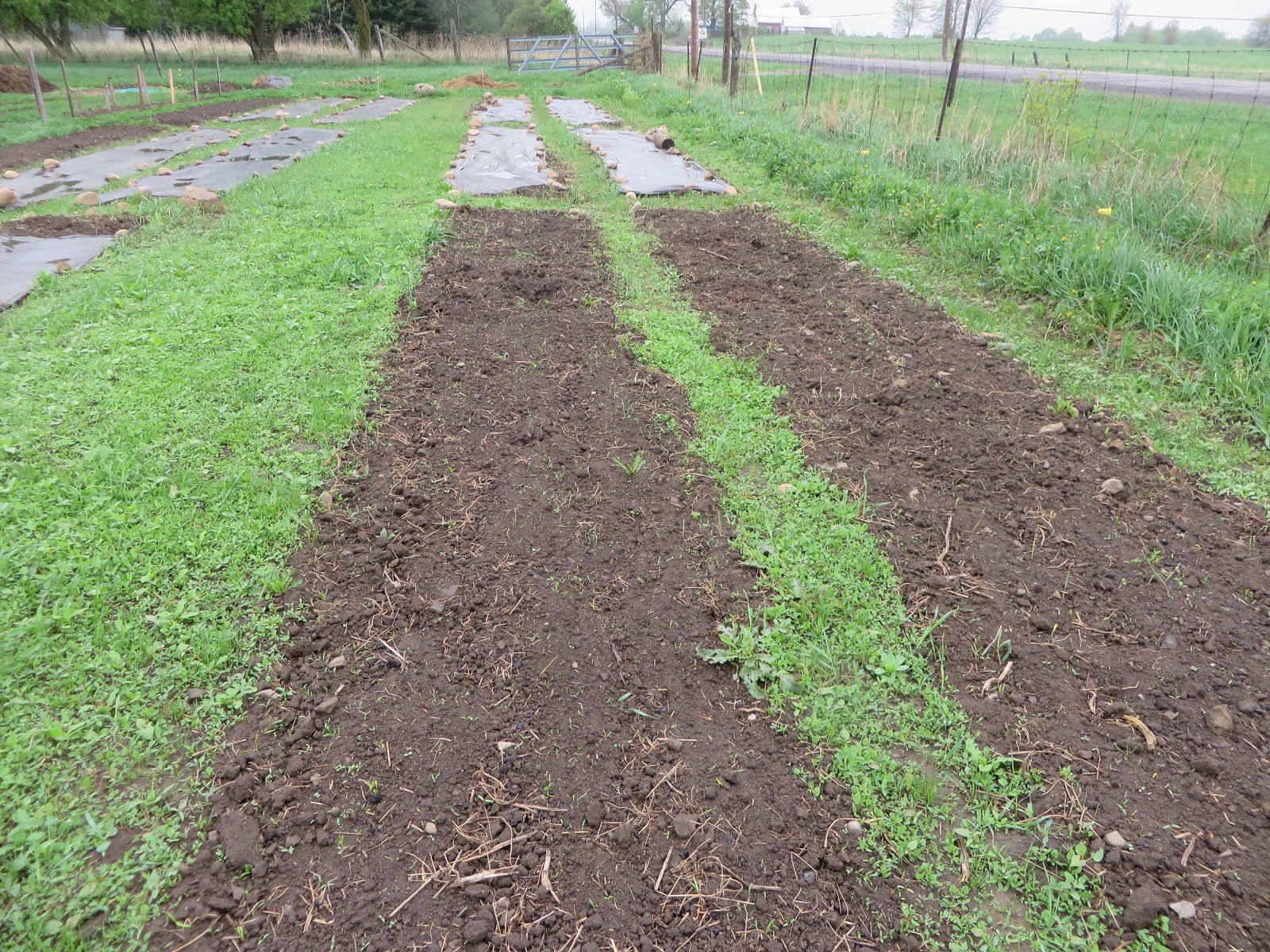
The beds developed last year (where we grew potatoes and squash) are looking quite good.  I have given them two cutivations this year to suppress weed growth before it starts, and hoped for one more.

Cultivating is best done with dry soil, so I used plastic mulch as a temporary cover for then next period of rain.

The wind had other plans, despite our attempt to pin down the mulch.  You don't win every game in this sport.


Many growers who use plastic mulch bury the edges of the plastic, but this stirs up the lower layers of soil and expose seeds in the "weed bank", which would negate the reason I use itin the first place.

By the way, cultivating is the process of disturbing the top inch or so of soil, just as weeds are starting to sprout.  Ususally, three passes with a hoe over a period of three weeks will deplete the germinating weeds and leave a relativley clean bed for the remainder of the season, provided the soil surface is not disturbed too deeply.

I can culivate twenty beds in about an hour; weeding mature weeds takes about three times as long; as well, the weed roots pull a considerable amount of soil (and compost and other amendments), and exposes more dormant seeds in the weed bank.

 For a detailed look as the type of hoe I use, check the posts dating back to this time of year, I think 2015 or 2014 has a considerable description of the use and benefits of a co-linear hoe.


Lots happening in the nursery as well.

Chard, Kale, Pak Choi, parsley, celeriac, celery, five types of tomatoes, four types of peppers, green and bulb onions...all of these need to be tended.

Primary concern is ensuring that the seed and seedling trays do not dry out.  It happened once this year, and the egplant was quite wilted looking when I found it.

Jus tin time, a quick soak brought them back to form.  A heart stopper for sure...


Here are the squash plants that germinated last week, now promoted to their cell packs.  As the weather warms, they will move out tot the outdoor nursery to get used to cooler temperatures, and then to the hardening off shelter to prepare for transplant.

Still a bit to write about, but all this writing and thinking about food reminds me that it is approaching 4:30 PM, and it is my turn to get supper started tonight....

Talk to you very soon

Bob