Sunday, 27 May 2018

Hello Everyone:

New post for May 27 below...


As of June 6th - I have sold 74% of the shares for this season.

Sales closed except for some returning customers who are still planning their summer.


New Post May 27:


 I saw a new bird for the farm yesterday...never seen one like this before.  If anyone has an idea as to what it might be, feel free to send me a note.

The size was about that of a jay.  There were three of them, mostly spending their time in and around the brush piles.

Their eyes are yellow, kind of like a pigeon.  Beak is slightly curved.  All three birds were fairly identical in marking and color.


(Update June 6 - It's a Brown Thrasher.  Great name.  Julia identified it and Mom, Dad, and Pam confirmed it).


I'll start this assessment of the field so far with a bit of pessimism, and then get on to the more optimistic news.

As I mentioned in the previous post, the late thaw has pushed back some of our crops.

The lettuce is quite small and I am not sure if it will be ready for the first harvest, even for a mini size head.

At this time of year, leaf growth increases exponentially, but I can't envision these being ready in time.

The first crops of lettuce I choose are typically romaines that may be grown as baby leaf crops or as full size heads.  With that in mind, I can hold these in the field an extra week or two if necessary to allow them to fill out without worrying about them going to seed.


I have similar reservations about the spinach, but at the very least, I am pleased with the germination results especially for the second round.


And now for the optimism...


The frisee endive is coming along nicely, I am anticipating having some of these for farm salads - another advantage of planting more than I need for the customer base.

These take a little longer and should be ready mid July.  I planted two rounds to ensure that anyone away for the first harvest can still have some when they return.

I anticipate doing another small round for the fall for those of you who really like it.


The garlic is doing quite well.

One unusual observation I made this year is the number of garlic's that have a delayed emergence.

Over eighty five per cent of the garlic's emerged a couple of weeks ago and are now about a foot in height, but about ten percent are just starting to emerge.

I have a couple of theories:  One is that some emerged under the straw back in late February when there was a temporary thaw (almost all of the field was snow free for about five days).  These plants may have emerged and then been nipped by the return of the cold a week later.  According to the resources I use, this will likely have a little effect on the bulb size, but otherwise should not pose any major difficulty.

Another theory is that mice have nibbled some of the bulbs and stunted them.  Only digging one of the late bulbs up will answer me that.

As for mice damage to the onions...so far only a few nibbles and a couple of missing plants.  Usually, the onions can take a snip off the top of the leaves without any noticeable impact - I do this in the nursery to keep the plants from falling over and getting caught on the neighboring trays when sliding the trays off the shelves.

However, at this young age and so soon after transplant, the mice sometimes pull the entire plant out.

I have been using the tomato stakes and some 3-4 inch logs to hold down the row covers to try and keep the mice out, and this seems to help (something I discovered last year).  Not perfect, and not enough stakes and logs to go around, but the results are better than in previous years.

In a couple of weeks, the plants will be mature enough (and tall enough) to be out of reach for the pesky critters.

By then, they will be on the hunt for my sprouting beans. 

I have heard recently that rodents can't stand the scent of castor oil.   One of the employees at 5-Span Feed and Seed in Packenham said this was a very old technique, and he uses it in his own garden.  So I am checking with my certifying agency to determine if I can use this on the organic crops.  I sure hope so as it would be satisfying to turn the tables on these pests...they have been an expensive and thankless visitor over the years!

Other crops that are arriving more or less on schedule and as expected are the fennel, celery, and radishes.


The past few days I have been transplanting as fast as I can, trying to make yup for the late transplanting due to the late ground freeze.


Last Sunday particularly, Julia was there to help by keeping a steady flow of seedling trays from the hardening off shelter tot he field, allowing me to work like a transplanting machine - left hand reach for the plant, right hand pull open the soil bed, left hand into the soil, right hand pat the root ball in...repeat...

Here are the kales coming out of the cell packs...


Meanwhile, Julia kept refilling the watering cans and placing them in the sun to warm up the well water, reducing some of the transplant shock for the crops; and making sure that the nursery was watered and fresh seed and seedling trays were prepared for the following rounds of lettuce, basil, etc...


Transplanting is best done on a cloudy day, giving the plants a little relief from the elements while they sort out their new surroundings.

I don't have time to wait for clouds, so I pull the row covers over them to offer a little protection.

These will come off in a few days and then it is up to the plants to do the rest.

These are the first green peppers to go intot he ground.


After transplanting, its time for more direct seeding.

(An old picture - I no longer grow Dakota Pearl variety potatoes, they were replaced by the fingerlings).

Another trick I use to save time with trasplnats and seed potatoes is to use a trowel to loosen the soil at at each planting point.  I then pour a little water in until the soil here is the consistency of a slurry, and then start inserting the plants or tubers.


After transplanting, I water the surface around the root ball to remove any air pockets around the roots.  This keeps the roots moist for several days longer than if I just watered in at the end of the process, affording me a little more time to get the irrigation tape in.


When that was done for the day, work immediately turned to maintaining what I have achieved so far.  Now that the first seed crops have been in for a week or more, it's time to start suppressing the weeds just as they start to germinate.

Look closely at the picture, you'll see the co-linear hoe, weed sprouts caught on the blade, and two lines in the soil surface indicating where the carrots were seeded.

The weeds have just started to sprout, and the weather is fairly dry, so I can drag the hoe blade along, disturbing the tender weed roots and exposing them to the dry air and sun.


Do this three times in a three week period (more often in rainy seasons) , and the seed beds remain fairly weed-free until I disturb the soil surface at harvest time.


It takes me about five minutes to clear a bed using this hoe, ten or more if their are seeds or freshly sprouting crops in the bed.

It takes about three times as much time to pull mature weeds, and the weeds root ball takes soil and nutrients away with each pull.


This is a great tool for those of you who love to garden but want to reduce your kneeling or squatting.  The hoe is available for the ridiculous price of fifty dollars (one five inch blade and an ash handle?) at a local gardening and tool supply store based here in Ottawa.  I have to admit that price has paid for itself over the years.


After surface cultivating beds with current crops and ready to receive crops, I turn to a few beds that will be needed in the coming weeks.

Here, I cultivate a little deeper, using either the curved tines or a stirrup  implement on my wheel hoe.

Another nifty tool that is very ergonomic and ingeniously engineered (the drawback being some of the components are cheaply made and tend to break - not what I would have expected of Swiss craftmanship.


Witht he curve tines on, I lean on the handles and let gravity do most of the work.

The tines pull out grass rhizomes under the soil (and stones, and deep tap roots, and the odd artifact).  They also break off clumps of grass from where the edge of the path has tried to grow into the bed.

This task also takes about five minutes per bed, maybe ten or fifteen if the bed has received very little attention in the past few weeks.


I mentioned deep tap roots above, though this season I have tended to leave these in the beds, opting instead to cut the heads off the plant repeatedly until the tap root starves - no green plant can live without sunlight.

This will eventually decay in the soil and thus add some more fertility and organic matter.

Once the root has shriveled up and decayed, the space becomes a reservoir for water, air, and hiding space for worms, toads, snake eggs, etc.


When all this is done, there is more work around the barn, tending the electric fence, and mowing or whipping the weeds along the main paths and around the work space...there are irrigation tapes to roll out, compost windrows to flip, and notes to take...no time to waste!

Bob


Saturday, 19 May 2018


Update May 12th:

Just returned from our annual seed potato trip.  If you have tried to contact us, we were well out of internet service for several periods of time and too preoccupied learning some of the finer details of potato growing (and sampling home grown pumpkin pe, raw milk sour cream, and of course potatoes...)

I worried myself to sleep Thursday night over the recently transplanted onions and leeks, the germinating peas and spinach, and all of the plants in the nursery, but Dick did a splendid job looking after my row covers and keeping the nursery watered and warm.  We lost a couple of kale seedlings but everything else appears to be fine.


I have increased the number of deliveries for the season to 15 from the previous 12 indicated on the 2018 Basket details page.  The amount of produce will not significantly change, but this will add a little flexibility for customers who are spending time away in the summer and even out some of the larger weekly harvests.  Two extra delivery dates will probably wind up in August and September.

I also added a June 13 delivery.  As I peek ahead at long-term weather models, there is increasing chance of a warmer than usual mid to late spring.  (In spite of the dusting of snow on the ground today).  This may have a negative impact on  spinach, a crop that prefers cool weather, and one that I am hoping to improve upon this season.  So I have moved it's sowing date ahead by one week in hopes of getting the most out of early spring temperatures.

Harvesting the green garlic a week early will probably improve its quality as well.

See "This Week's Harvest" page for the June 13 anticipated delivery.


And now for the May 19th post....


I have always thrived on the intensity of a short period of deeply focused work - in high school it was the fall running season; in my early twenties when our music group was preparing for a recording session or a series of shows.  Later on, I used the same planning and coping skills while volunteering and later working on the CKCU funding drive and other project management jobs.

Looking after my sleeping and eating habits have been my strong points, though I tend to fight against the flow more so than other folks who do similar types of jobs.  The fact that I am dealing with a living field, under a ceiling of ever changing weather helps keep my perspective.  I'm a perfectionist, detail oriented person so I have to step back once in a while and remind myself that no-one scores 100 per cent in this sport.

Having said that, the farm is starting to take shape for the season - it's been a very busy pair of weeks here with several 12 hour days of bed preparation, seeding, transplanting, and setting up the irrigation system.  The three day trip up to Coe Hill was a pleasant break despite worrying over the onions and leeks on the cold nights.


Several of yesterdays photos did not turn out, so I will fill out the post over the course of the week, but here are a few previews...


Spinach germination has been a real challenge the past few years.  Each time it failed to appear, I considered another potential reason and corrected it for the next time - only to have another failure.

Last fall, I drilled into my notes and set out a chart of every year I sowed spinach and looked for a pattern that might explain the difficulty.

I eventually figured out that there were multiple factors.


I used to use row covers on the beds to keep the soil moist after watering.  However, I later learned that leaf crops require lots of sunlight, and the row covers typically reduce sunlight by about 15 per cent.  So I ceased using those and relied on the irrigation system to keep the beds moist on warm, windy days.  That did not work either; I assume the cold water from the well was probably rotting the seeds.

The last time the spinach germinated well was in a bed not serviced by the irrigation system, so that was another clue.

This season, I have watered by hand, sometimes up to four times a day (the breeze dries off the soil surface quite quickly) and the results appear to have paid off.  The germination is not as good as I would like, but I think we may have enuogh plants to serve everyone - assuming they continue to grow.  We'll know better in mid June how this works out.


Pictured here is the second round of spinach just as it breaks the surface.


The peas have germinated well, as usual.

These are about two weeks old.  In another week or two, I will be pounding in the stakes to trellis the vines to.

One of my most anticipated crops of the spring...the first few will be taste tested in my lunch farm salad, just to make sure they are good enough to send on to all of you...


Here is a crop that I have not planted for several years - endive.  Very closely related to lettuce, used as a salad.

I tranplanted these yesterday.  PLants are best tranplanted on cloudy days (better yet, with a gentle rain) but I can't always count on the weather, so I water them in and then place older (tattered) row covers over them to provide the shade while they get over transplant shock and adjust to the full strength sun, temperature swings of outdoors, and the soil.


To prevent damaging the young plants, I usually place the irrigation tape in the beds before transplant.

Lettuces and endive are two of the very few crops that like wet leaves (most crops suffer when their leaves are exposed to too much moisture) and so I prefer to water these by hand - I think it helps the texture of the final product as well.  However, I won't always have time to water by hand, so they will get some added moisture from the well.


The potatoes have started to go into the ground.  As of this writing, I have most of the spring white and fingerling potatoes in the ground.  I'll do a supplemental sowing in a month or two to make up for any losses.

I expect to be posting a photo of the potatoes emerging in about a week or so.

Look closely, and you can see where I have drawn the sowing lines for a bed of carrots just to the right - these were sown about ten minutes after this picture was taken.


The next three days will be a flurry of activity as peppers, tomatoes, cucumbers, beans, kale, chard, radish, beets, turnips, etc are sown...its a little later than I would have hoped owing to the ground being frozen a week later than I anticipated this season.  So no time to waste...

Talk to you soon,

Bob

(more to follow for this post...)


New Post


Saturday, 28 April 2018


A few more updates from May 5th:

Yes, those little green shoots are the first leaves of garlic to emerge.

The bulbs were sown last November, and covered over with spelt straw to keep them from freezing through the winter.

Many gardeners leave the straw on until harvest, and allow the garlic to grow through it.  For a couple of reasons, I take much of it off and re-use it elsewhere.

More to follow...


Back in the indoor nursery, the delicata (winter)  squashes are also germinating.

The Butterscotch squash is due to be sown in about three weeks.  I have staggered the planting between the two in hopes of getting the delicata to flower and produce fruit first, so that the seed is not cross pollinated with our other variety, Butterscotch.


I have cleared some spare (unlit) shelves in the indoor nursery to make way for some plants from outside.

With a couple of cool nights on the way, I will have to bring in some plants such as tomato seedlings fro the unheated outdoor nursery.

At this time of year, there is very little nursery space.


The outdoor nursery is doing just fine, even with a predicted plus 6 tonight.

The temperature should remain about 10 degrees in there, not the best growing temperature but well within the plants tolerance level.

A few crops such as celery are intolerant to temperatures below 15 degrees, so even though they are more mature than the tomatoes and peppers, they remain within the indoor nursery.


Hello everyone:

Before getting onto the post, I have a couple of announcements:

I will be closing sales soon.  If you are interested in purchasing a share of the harvest, please contact me very soon.

If you have been in contact with me but are waiting to determine what your plans are for the summer, I can hold your place until a later date.

I will be sending out our first e-blast of the season within the next 48 hours.  If you do not see it, check your spam box.  If it is there, adjust your email settings accordingly.

If you do not have it at all, please contact me and I will check to see if I have you on this year's list.

!!!  VERY IMPORTANT  !!!

When communicating with me by email either for requests, notification of absences, sending in recipes, etc, PLEASE use a separate email with a specific heading (eg "absent for next delivery").

If you add your email to a chain of emails, it is possible I may not see it.  I want to spend my farm time doing farm work as much as possible - growing and tending your food and improving the farm and my farm skills as much as possible.


And now for the post for April 28:

It's been a very, very busy week here at Whitsend.  Monday to Kingston for a chainsaw safety certification course, Tuesday fieldwork until 4 pm and then off to Ferguson Falls for a National Farmers Union meeting, Wednesday out in the field all day and then raking the lawn after supper (A silly task, but while living off farm, I have to maintain the 'suburban standard' method of yard treatment), lot's of shopping and computer chores for Thursday, in the field all day Friday except a quick jaunt over to Farm Credit Canada Corp. to drop off an application package, and then off to Julia's birthday party Friday night.


And sowing more seeds...

And doing some engine maintenance on the tiller...

And repairing a leak in the outdoor nursery...

And electric fence maintenance...still unresolved, can't figure out where the short is occurring...

And sowing more seeds and promoting the ones I sowed last week...

And closing a sale...

This is what you pay me for.


Field work will continue Monday, the beds are getting cleaned up and prepared for the first direct sowing of peas and spinach and carrots...


Jen from Sysabee and I have trading documents all week, trying to figure out why her version was not functioning on my computer.  Now that that is fixed, I have started tweaking the request page.

Time is running short, so I will be distributing this very soon.  (one last test to run to make sure the glitch we had doesn't translate onto other customers computers).

Customers will receive a page detailing the season's crops they can expect in their baskets, and some options they have for choosing crops.

Please fill this out as much as you want to (there are three questions that must be entered - name, basket size, and a box to tick indicating you have read the document.  Even if you are ok with whatever you receive - many of you are - please send it to me anyway, I will be using the printed out version to track what you are receiving throughout the year.

After we have this system up and running, attention will turn to developing an online tool to accomplish this request system.  I expect this will take the better part of the year.  The goal is to try this out a couple of times during the season, and then have it up and running for next year.

This is new territory for me, so I have no idea how long it may take.


The past week I have been putting some of the hardier plants (onions, leeks, parsley) in the outdoor nursery for the day and then bringing them in for the night.  They get better light here than under the grow lights, and besides, the space under the lights is limited, and with so many other plants coming along, there just isn't enough room.

A couple nights back, I forgot to bring the onions in at the end of the day, and was greeted the next morning with some very sad onions - they were all limp and laying down.  The min/max thermometer indicated that the low reached plus one inside the outdoor nursery.


As onions have such a long lead time and must be planted within a certain window of time in order to bulb, I set about my scheduled tasks for the day wondering if that was it for the onions and leeks.  Green onions and parsley could be re-planted, but that would put a lot of pressure on the nursery with the squashes set to be planted soon.  I kept telling myself of the resilience of young plants and all of the fail safes I had in place for moderating the temperature change...


...three days later and almost all of the onions have stood back up and continued their leaf growing.  I lost a few (less than 2 per cent) and assume these ones were probably weaker in some way than the others, and may not have performed as well during the season anyway. Not everyone makes the team, as I sometimes say.


I mentioned in our last or second last post that the hotwax peppers (sometimes referred to as the "somewhat hot" peppers) had failed to sprout a week after the green  peppers.  I checked the package and found that the seeds were three years old.  I double checked my notes from previous years and found that three year old pepper seeds usually had a slightly lower germination rate, but certainly not zero per cent.  I recalled one of my mentors (Dick, I think) suggesting that field seed sometimes germinated slowly if it was old.  So I continued to tend the seedling tray and finally I have been rewarded.


Almost all of them emerged throughout the week, and I now have a decent compliment of mildly hot peppers to compliment our green peppers and super hot peppers.

Had I been less experienced, or not blessed with good mentors, or impatient, I might have given up!


The beds are finally dry enough to do a lot of work on.


Having permanent beds with grassed paths provide an advantage that they are ready for planting sooner than a bare field.  The grass turf can be trod upon much earlier than a soil path, which would get gouged up with deep footprints were I to be walking on it the day after a heavy rainfall.


For comparison, here is part of the new field.  The grass seed was sown late last fall and has yet to sprout.  The established beds pictured above are about the same elevation as the beds pictured to the right - you can see how saturated the soil is where the water is pooling along the fence.


Having permanent beds has many benefits; one of which is that they are ready to go as soon as they are thawed out.

(I have a couple of posts from the years 2012 to 2014 that go into this in more detail.)


Old weeds that survived the winter and some quack grass rhizomes that were missed last fall teased out of the soil.

Aerating beds to stimulate aerobic bacteria, which in turn work on turning simple nutrients into complex molecules that the plants can  use.

Cultivating beds to disturb any fresh weeds that may be trying to sprout, and breaks up clods of soil so there is more surface area exposed to the air.


Saw our first toad of the season while doing this work.


The list of tasks is seemingly endless.  It is exhilarating work, with a little foreboding on the horizon - what if I can't get it all done in time?  As I prepare the beds, I try not to think of the plants back in the nursery.  Once I sow seeds there, the clock is ticking.  Five weeks after sowing lettuce, the bed in the field has to be ready to receive them; four weeks for kale and pak choi.  And the sowing date for the squashes is soon upon me...


I made a mistake in the nursery last week while sowing the tomatoes.  I had been counting pepper sprouts to see if I had enough plus a few for my projected needs.

I then started sowing tomatoes, but I suppose my mind was still thinking peppers (12 plants per row, two rows per bed).

I was happily sowing tomato seeds at a rate of 12 plants per bed (only one row for toms) and didn't think much of it while marking off the number of seeds used in my production binder.


I realize many of you city folk may not know the difference between a pepper plant and a tomato plant, but there is a significant difference in size.

I planted twice as many tomatoes as needed.

So, I will have lots of plants to choose from (I'll take the healthiest and most vigorous growers); and then sell off as many of the sprouts as I can.  Customers can have a couple if they want to try their hand at growing these too.

I'm sure my mentors might be appalled at this waste of seed, but this is the sort of mistake I don't mind...far better too many than too little.  If this is all I have to fret over, then I must be in fairly good shape.


Bob


Sunday, 15 April 2018


April 15 2018

Hello Everyone:

Not much that can be done at the farm today.  Eastern Ontario is getting the freezing rain for the next twenty four hours and we are no different in that respect.


Pepper seedlings from a week ago
That isn’t to say that I have been away from the farm.  The green and very hot peppers are sprouting, the onions have surpassed my minimum needs for the season, and the rest of the plants are growing well (The moderately hot peppers appear to have lost their seed viability - the seed was somewhat old but I had presumed they had one season left in them.  I over seeded as one does in these situations, and have received just one sprout...more on this the next post).


I was out earlier to the nursery to ensure that the plants don’t dry out as I expect the roads will be treacherous at least for the early part of tomorrow.  With the heat on, the seedling trays require a water top-up once every 36 hours.  I can’t over water in advance (that would cause other problems) and so I have to make the forty minute round trip on days which one ought not to be driving. 

Ice storms are by far my biggest worry for weather at this time of year.  The nursery can probably take about 24 hours without power, and a typical power outage is usually no longer than a couple of hours. 

However, if a lot of lines go down across the city, our farm neighbourhood will likely be a low priority. 

Knowing that slowing down the rate of temperature change is the key to helping the seedlings through a period of time without heat, I place a few thermal masses in the nursery.  Water is an excellent thermal mass, and there are always several gallons stored in jugs.  Today, I placed several bags of soil that I thawed out in the outdoor nursery the past few days.  This soil is quite damp and will release it’s heat into the nursery should the temperature start to drop.

With all this down time from the farm, I can catch up on reading:


Free ranging poults at Elmtree Farm
Gene Lodsdon’s , “All Flesh is Grass” (Swallow Press, 2004) is one of the two current books I’m going through.  Gene works a cattle farm in Ohio and has successfully experimented (and continues to experiment) with small herds that are sustained by pasture farming, as opposed to strip grazing or other conventional methods.  Aside from his thoughtful observations on agriculture generally, I look at some of the techniques he uses to pasture cattle without resorting to planting amounts of corn or grain, silaging it for the winter, and spending money on feed and tractor fuel.


These are techniques that I can translate into pork and bird production when/if our farm moves to a permanent location.


I highly recommend this book to anyone considering free ranging livestock on any scale; it was one of the first I picked up when taking the first timid steps to buying a pair of pigs.


Another author I have returned to recently is Joel Salatin.  His books “Folks, This Ain’t Normal” and “You Can Farm Too” were inspirational when I started my farm journey.  Something had pricked my memory a while back when I was thinking about heating a pig hutch during the winter months, and I recalled some notes in one of his books how he buried silage corn under layers of straw in his barn.  Silage gives off heat due to the fermentation process, which moderates the temperature enough to keep the pigs warm.


Now I hope at least some of you are wondering about that buried corn with happy warm pigs nearby.  Joe states that all pigs have a sign on their foreheads that reads “Will Root for Corn” and they are quite happy doing this.  In fact, looking into the window of that barn on a minus twenty day in the Shenandoah valley and the pigs appear to be in a porcine heaven – sprawled asleep on the warm straw or alternately rooting up the tasty cobs.


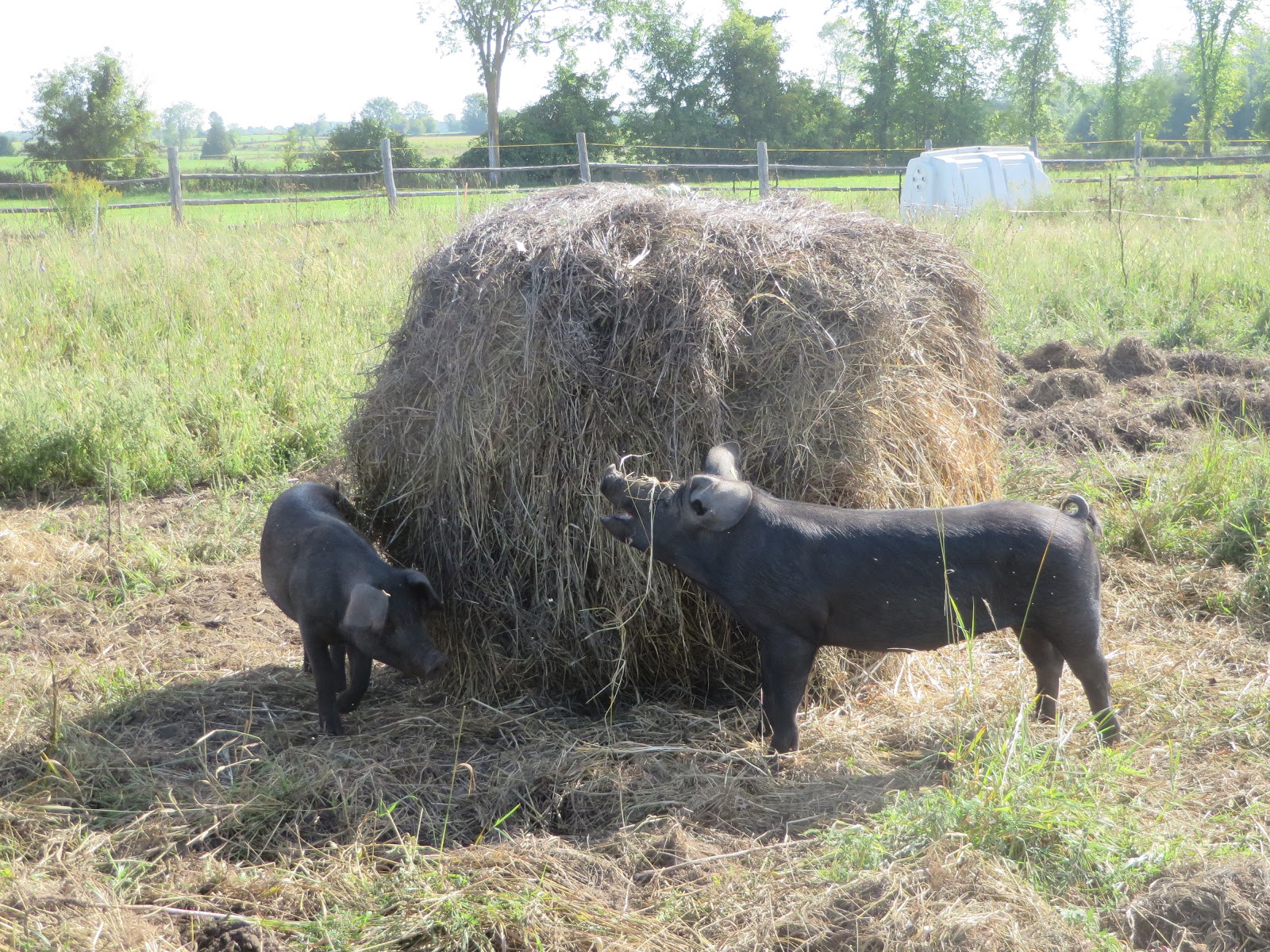
Side note about accompanying photo:

To keep my 2016 pigs pigs happy and curious (and to dismantle an old hay bale I wanted to incorporate into the soil), I would stuff apples into the edge of the bale after breakfast time.  They would finish their mash and then gallop over to find and tear the fruit out.  This had the added benefit of keeping them preoccupied so I could do a perimeter walk to inspect the electric fence or clean their water trough.


I have a few questions about this method (how is the corn replenished – I imagine bringing several hundred pounds of corn into a pig barn would cause a riot of excitement and a trampled farmer, and what state the pigs’ livers are in come springtime, not to mention what this might do for breeding sows. 

So I have to go through all of Salatin’s books to find the chapter that deals with this topic, and I get a refresher on his pasturing techniques and a lot of the other interesting innovations that I could adapt for my own uses whether for vegetables or animals.

I’ll recommend Joel’s books, but beware...I might compare him with the phrase “the Noam Chomsky of agriculture” – a relentlessly scathing whit and intelligent critique of the current food chain and it’s scientists, apologists, myth sustainers and snake oil peddlers.  I get a lot of my own ideas when reading about how he has DIY’d his way through a problem (be it reducing workload, expenses, or other farm challenges).  But like Noam Chomsky, a little too relentless for me to read in one sitting.


Farming: equal parts being, doing, and observing
My mentor Tom once referred to an old saying:  “It takes ten years to grow a farmer.”  He quickly added that after his tenth year, the only thing that changed were the nature of his questions, and he still wondered at the amount of knowledge he had yet to learn.

Well, we are just a couple of hours into this winter/spring freezing rain storm, so I might as well go back to the books for a little while – who knows, maybe Kanata will lose power and there won’t be light enough to read by later...


Progress report on the Whitsend customer request project...Jen from Sysabee and I are meeting this Tuesday to take a look at a potential draft.  Jen hosted a focus group of some of our customers last week and they had a strong preference for one of three possible formats that Jen was proposing.

I'm looking forward to see how this project is developing.

I wanted to be there for the focus group but wisely didn't ask to be included...best to get the unfiltered opinions from the folks who are going to use this.