Sunday, 5 June 2016


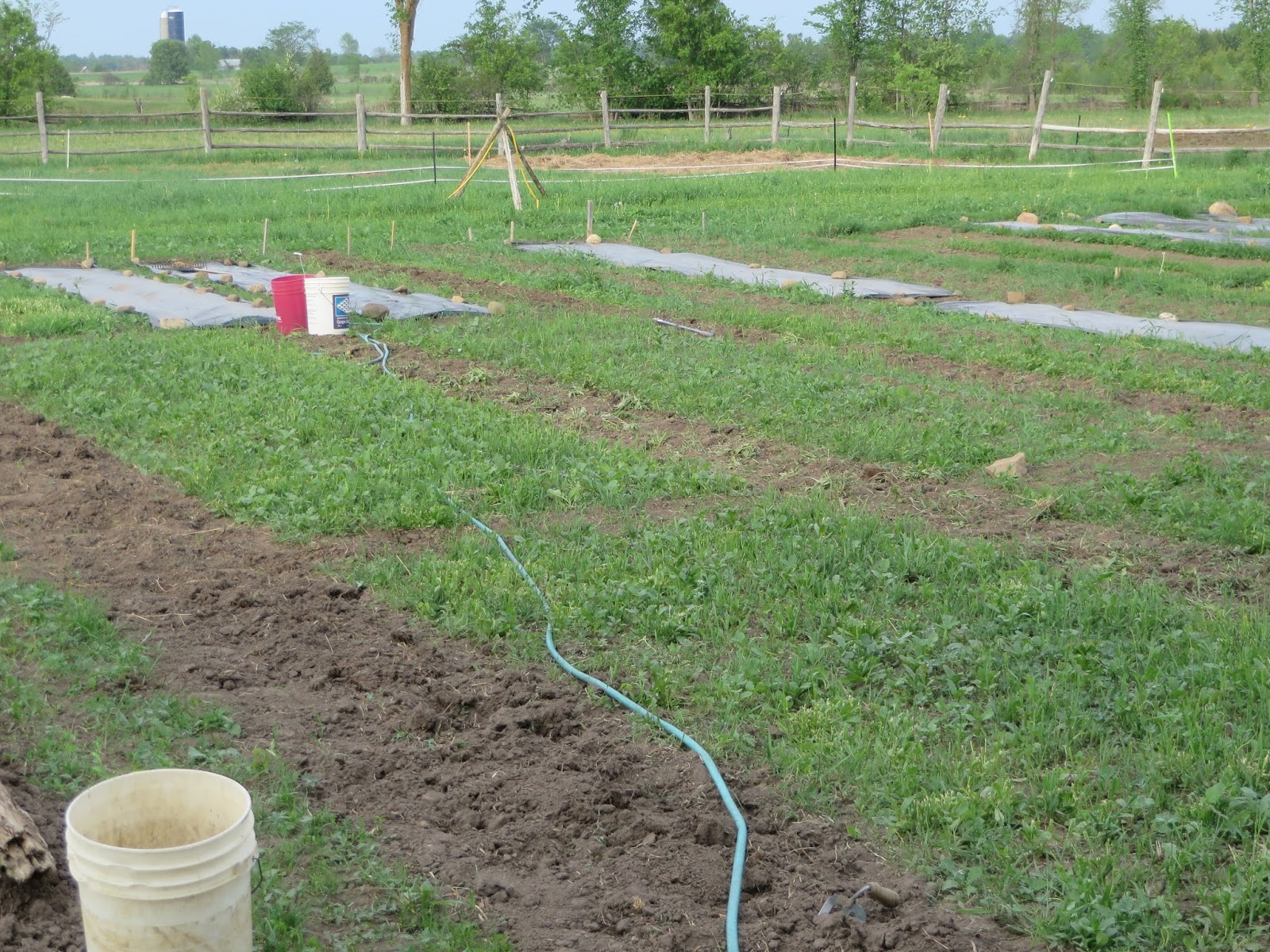
This is a photograph of staging a days worth of work.

Beans getting sown, beds getting cultivated of weeds, spot watering for transplants, rolling out new irrigation tape, and preparing beds for their sowing...all while weeds in new beds are suppressed by some plastic mulch.


 Another example of inter planting.  Celtuce and green onions in a tomato bed.

Tomatoes are the only crop I plant in the same bed year after year.

Typically, plants do best when rotated, but tomatoes are known to thrive when growing out of their own re-incorporated residues.

In order to complyu with organic rules (which stipulate that every bed must have legumes sown in them once every four years), and to follow the number one rule for building soil fertility, I rotate crops that are under sown in the tom beds.


Following the same pattern I use in the rest of the field (Legumes followed by leaves followed by fruits/bulbs/tubers followed by roots/cabbages), the  tomato bed pattern is dutch clover f/b green onions and celtuce f/b marigolds f/b radishes.  Clover fixes nitrogen, green onion and celtuce take up excess nitrogen, onions ward off various types of insects and condition the soil, and radishes thwart nematodes.


Lot's of food is growing in the field.  The first two rounds of potatoes are in, the first three rounds of carrots are sprouting, the peppers and eggplant are transplanted out, and even the parsnips are germinating despite the heat.

The peas are getting taller, they should be getting their first line of twine to cling to today.

However, the 'extra work' I have been awarded with dictates that the butternut squash must be planted out, and that cannot happen until the unplanned for beds are developed.


Last year's compost is ready to go into the leaf beds.  However little there is, some must now go to the unplanned for beds.

This is what someone else's mistakes do...now I have to decide weather to give my tomato plants that side dressing of compost in mid summer or give the weak soil in the unplanned for beds a boost.

The full story of developing these unplanned for beds will be documented open the page 'curious food'.


I start the season with fast growing Napoli carrots, then do a second round of Napoli a week later to ensure their is enough should the first round fail.

Two weeks after that, I plant a mixture of colored carrots.  I'll keep which colors I chose for this season under my cap for now...


And now some time to prepare the bean bed for late summer.  These are beds I started in my second year.  Owing to a number of mistakes (over a two year period), I have had to redevelop these beds a little at a time.

This season, they are ready for taking cleaning crops - potatoes and beans.

The rest of the beds in this block (reserved for fruits, roots, and cabbages) will need some fertility boosting, so I'll be planting filed peas and oats.


The peas will fix nitrogen in the soil, the oats will nurse the peas and build soil mass.  When these crops reach fruition, some will be cut off and fed to the pigs, and the rest re-incorporated back into the beds.  Then I'll plant buckwheat, a crop that has a deep tap root which brings up leached nutrients, particularly phosphorus.

The blackbirds know this is one of the two places I have been planting oats.  Whenever I start working in this block of beds, they watch.


The earliest lettuces are looking great despite the heat.  Some of the more recent transplants might not look so good at the same age, the heat has really been a challenge for them.

I started teh lettuces back in the cool of April.  Recalling last year when I started my summer lettuces too soon (they suffered in the cooler parts of May last year), I opted just to focus on the spring lettuces.

Next year I'll be planting both heat tolerant and cold tolerant lettuce next season.

By the way, this has been the driest May in sixty years.


This rock garden is getting a lot of use.  A few extra lettuces will provide me with some 'field salad' in a couple of weeks.


Each season has a different flavor; every day serves up a different accent.

Harvest starts next week...talk to you soon.

Friday, 27 May 2016


Spring is a time of hopefulness for most.

For me, a mix of hope and trepidation.  Can I pull off the juggling act again?

Because of the mice and other rodents in the barn, I use metal garbage cans for storing just about everything edible to rodents such as row covers, field crop seed bags, and anything else that can be chewed, gnawed, eaten, turned into nesting material or just plain sullied.


I had a free one available and used it initially as a rain barrel (I can't use rain barrels made of PVC plastic in the organic field).   Today, the can is being used as a very quick way to fill watering cans.

Although a lot of the watering of crops is done with irrigation, transplants need to be watered in by hand - the irrigation is too slow for this detail.  The metal can helps warm up the cold well water, which in turn reduces the shock the plants would experience.


Those of you who visited the farm in the previous two years might not recognize this picture - it is the section of field i have been rehabilitating from my "novice's mistake" back in the first season.

It is slowly taking shape and almost ready for the first round of potatoes and the mid summer green beans.


These crops help clean the beds of the weed material.  The beds are too fresh and full of weed seed to allow the growing of leaf or root crops.  So some beds will get a ground cover of either oats or buckwheat to suppress weeds and start the fertility building process.


To contrast, here are some of my best beds and a path with a rich ground cover of perennial rye.


I wrote a lot in the past couple of years about the co-linear hoe as indispensable for gardening and this style of farming.

This is the 'sister tool'.  I call it the bandit.

It does the same thing as the hoe, but used when a little more deftness is required.

For example, taking out weed sprouts around the base of plants or in between rows of closely spaced crops.


This chard bed will be cleaned using the hoe.

In a couple of weeks, the chard will be too big to hoe around, so that is when the bandit will be used.

If I leave the weeds much longer, they will have to be pulled individually, taking away soil and fertility from the bed.

When disturbed by the hoe or bandit, the weeds wither and die in the bed, decomposing and leaving the fertility available for the crop.


Weeding takes about three times longer than hoeing, and is much less ergonomic.


Inter planting - how to get two acres of food out of one acre of land.

These are celtuce, and green onions inter planted among tomatoes.

The smaller crops will be harvested before the tomato plants engulf the beds.

I like to scoop a little trench around the base of the water loving tom plants, just to conserve some of the moisture.


After the next round of hoeing/banditing, a layer of straw goes down at the base of the plant to hold moisture more and to foil the cut worms.


Speaking of trenches, here is another trick I am trying this year.

I am always struggling to get a decent 'hill' around my potatoes and beans.

So this season, I dug a small trench to place the kidney bean seeds in.   As the plants grow, the trench will get pushed in by the hoe and the plants will remain upright.

One can leave the beans un-hilled, but they will fall over and it will take much longer to harvest.


Also, they will not get much air circulation and may suffer some mold problems.  More work now means less work later!


Same goes for staking pea plants.  I use the method known as 'basket weave'.

The straw here is incidental, it escaped from a garlic bed next door..  Fine by me, the peas will appreciate the moisture retention and maybe the lighter colored straw will reflect some heat away from this crop that like to maintain it's cool.


Our garlic is doing great.

I thought I was the first to emerge garlic around here, but when I was at Fly Creek farm a couple of weeks back, I see that Brandy has me beat by about two weeks.

She either doesn't know why hers is so far ahead or she's not telling me!


These are the first two lettuces for this season - Winter Density and Outredgous.

Guess which one is which!

You might be interested to know that Outredgous is being grown on the international space station. Quite a feat for a humble little plant.

I never knew I liked lettuce until I started farming.  Then again, I'm not sure I ever ate lettuce until I started farming.


Leaves are where the plant handles single oxygen molecules.  For those of you with a passing knowledge of chemistry (or oxy-acetylene torches), handling oxygen is a tricky business.

Within a cell, oxygen can run amok and tear molecules apart in an effort to stabilize.

This would destroy the plants chromosomes, so plants create an array of chemicals called anti-oxidants to contain the oxygen before it does any damage.


Leaves are where the antioxidants are!

Here's more spinach.  I've had a splendid year of germinating spinach, makes the early start worth it.


More inter planting.  Arugula and pak choi.  The spaces in between clumps of choi are set aside for squash transplants.

Flea beetles will savage these young leaves, so any work in here must be done swiftly and the row cover replaced.


Closer to a long awaited goal.  Rhubarb in its second season.


When drafting my production plan last winter, I never dreamed of starting a new set of beds.

With such a thick growth of hay grass sod and some weeds, heavy horsepower is required.

The next step is to rake off the quack grass roots and start laying out the beds.

As I have to document the development of these new beds, I will use it as an instructional moment and display the step by step procedure in the "Curious Food" page in the coming days.


Preparing to hill beans.  First, a little trench is hoed in the centre of the bed.

Then the sharp edge is turned away from the plants and the soil is scooped up against the plant.

The co-linear hoe is my favorite tool on the farm, it is so versatile - hoing, hilling, edging beds.

Unlike the common "dutch hoe" which is more familiar to all of us, the co-linear hoe is very ergonomic to use.


These green beans are a variety called 'Provider'.

I plant them first as they are bred to germinate in cool soils, unlike a lot of green beans.

They are also the first beans to shut down from heat exhaustion, so are not very reliable in mid summer.

Another reason to hope that our temperature moderates a little over the next few weeks.


Did we get spring this year?


Here is a before and after shot of the bean beds.

To the left, hilled beans, to the right un-hilled.

The hilling of beans disturbs weed growth. Between that activitiy and the leafy canopy that the mature plants create, weeds have very little opportunity to establish themselves.

That is why some growers refer to beans as a cleaning crop.


One of the pleasures of organic farming is watching how the field you are working with  and seeing how it responds to your activity.

The rock garden has filled in the cracks in the paths with some kind of flowering mint, which was covered in honey and bumble bees today.

Another curious reaction in our field I have noticed is how the edging and mowing routine has controlled all grasses except for a grass that is 'hinged' on the stem.  When the mower rolls over it, it lays flat and does not get cut.


It does not seem to be a problematic grass, but it does ruin the nice uniform look of the rye grass paths.


Swiftly becoming enemy number three on this farm.

Eater of oat seeds, which are planted for the pigs forage crop.

I have tried sowing at night, raking the seeds under the soil, using a seeding disk, covering the forage area with expensive row cover.

Finally, out of desperation, I used the plastic IRT mulch, hoping that like peas, oats might germinate without sunlight.  They did.


But instead of running out to buy an acre of plastic, I purchased a big bale of straw from Dick, and covered the oat seeds that way.

By the way, I was attacked by one of these three years ago when a young male decided that the south end of my field looked like a cattail marsh and claimed it as a territory.  Very unnerving when an animal repeatedly tries to circle behind you and attack the back of your head.

The large numbers of territorial birds feeding in and around my field is a symptom of a lack of top predators.  So long as there are herbicides, etc moving up the food chain, herbivores will continue to dominate.  So I must get used to mice, moles, squirrels, rats, rabbits, and black birds.


Time to clean up and leave.  The shadows are long, the mourning dove is squawking, and I am tiring out.

Gather all the tools, replace the row covers, shut the barn, check the nursery for water levels, turn off the well, double check the electric fence, close the gates and get out...


...Because tomorrow is another day.


Tuesday, 26 April 2016

Sales update as of April 28:

We have room for 3 and a half full sized shares.

I need to know very soon if you are interested so I know how much to plant for our first delivery day on May 31.

I have added a limited area in Westboro to my Tuesday delivery route.  If you are in the vicinity of Princeton avenue, I can include your address.


Hey everyone:

Work has really picked up over the past week.  The field was soaked two weeks ago but has dried steadily and now I am well into preparing the beds for the season.

Today, I planted the first round of peas and spinach in the field.  The food is on the way!


I have yet to do a 'headcount', but the garlic seems to be emerging quite uniformly.

Around here, garlic is typically planted in the late fall and spends the winter dormant, protected by a layer of straw mulch.

As the days begin to warm, I start pulling the straw back for the day to warm up the beds.  This seems to encourage earlier growth.  I compared my results with a neighboring grower last year and found I was harvesting garlic two weeks earlier than they were, and the removal of the straw seems to be the differing factor.


If the straw were left on, the garlic would push up through, though the growth would be a bit slower.  I need that extra two weeks as late season cabbage typically follows the garlic.

The straw goes back onto the beds for the night.  This acts a s a blanket upon the bed, holding the days warmth inside.

Garlic can probably withstand the nightly lows of minus four to zero that we have been getting out here, but I would rather have it concentrate it's growth energy on thriving as opposed to surviving.


I need all the time I can get.  At this time of year, everything is gearing up to grow as quickly as possible.  So as I clean one bed, 128 other beds are starting to sprout weeds.

To give me some extra time, I place Infrared transmitting mulch (IRT mulch) on beds that are yet to be cleaned up, usually beds that are not required for the next couple of weeks.

IRT mulch allows the heat of the sun to pass through to the ground and then hold the heat in at night.  However, the mulch blocks the white light that allow plants to grow.


Some growers leave their mulch on all season, and plant their seedlings (typically peppers and tomatoes) right through the mulch.  They do this to prevent weed growth and supposedly this interferes with bugs as well.

My preference is to take the mulch off at planting time.  The mulch eventually degrades in sunlight and is expensive to replace.  (some non-organic growers allow it to break down into the soil!)

As well, I need all the frogs and toads I can get to eat flea beetles and aphids; trapping them under a layer of plastic won't help them at all.

I do have to check once in a while to ensure this is not happening...

Like row covers, one of the biggest drawbacks is that IRT mulch is ugly looking.


The outdoor nursery is half full, and doing a decent job of keeping the cold tolerant plants warm at night.

For lettuces, onions, parsley, and kale, plus five degrees is tolerable.

By day, all plants come out from the nursery and take a spot in the sun.  The nursery can get quite warm, but plenty of shade and indirect light is built in to protect the youngest plants from cooking.


Heat is augmented at night by a few large patio stones that are set in the sun all day.  These re-radiate the suns heat at night and moderate the interior temperature.

I hope to write more soon, though realistically, it may be another two weeks before I can write.  In the meantime, start swotting your cookbooks for recipes that include spinach, arugula, garlic greens, lettuce and peas!

Bob


Monday, 11 April 2016


Hey Folks:

Thanks to those of you who are visiting this site for the first time. We hope you enjoy our farm website as much as the real thing. 

Unfortunately, the electronic farm experience is not quite as tasty.  I hope it will whet your appetite for fresh, certified organic produce.

If you have any questions about the farm, feel free to contact me at the email address or phone number below.


Your advance payment will ensure a share of this year’s harvest.  Harvest deliveries start in June and run through to the end of October.  There are a couple of deliveries anticipated for November (cold hardy leaves and storage produce such as carrots and kidney beans).  

Why I use Flyers to find customers:

To keep our doorstep delivery cost efficient, I restrict my customer base to particular neighborhoods.  This renders print and electronic advertising somewhat ineffective.

I use very simple flyers (printed at home on standard print paper) to keep costs down. I realize most flyers will wind up being recycled, so I do not create extra expense with glossy, professionally cut flyers.

I do not leave flyers if I see a “no flyers please” sign on your mailbox. If I did not notice your request to this effect, please accept my apologies.


Still room for more customers...feel free to call the number at the bottom f the page, I am in most evenings.


Bob Whitmore


These are the first peppers to sprout.

In another week or so, they will be transferred to the outdoor nursery to start their cold treatment.

I am growing three types of sweet peppers this season:

Lipstick, an open pollinated sweet pepper that is cone shaped.

Olympus, a standard green pepper that did well for us last season.


And I am finishing off some seed from a bell pepper I used to grow called Yarden.  It takes about a week or two longer to develop fruit than the Lipstick,or Olympus, so I will be discontinuing it after our seed runs out.


Onions as far as the eye can see.  Looks like they are ready for their next haircut.

In another week or two, they will be gradually introduced to the outdoor nursery to prepare them for an early planting.

The sooner I can get the onions outside, the more opportunity they will have to grow without being bothered by the leek moths, which do not come out until nights are above ten degrees.


Onions are somewhat tolerant to cool weather. Some straw and row cover will keep them sheltered during the cool nights in May.


The parsley I grow is a flat leaf type.  Less cold tolerant than curly parsley but much easier to clean.

There is some debate I have heard about which type has the better flavor, but I (and others) have suggested that growing methods can have as much impact on the culinary performance as type does.

For myself, parsley is one of two crops I have to harvest after I have eaten my lunch.  This ensures everyone else gets their fair share.


For ideas on how to use this 'garnish' as a centrepiece flavour in your food, check out the 'Introducing Our 2016 Crops' page.


The first lettuces have been promoted, the second round is sown.

I have chosen four varieties of romaine to start the seasons lettuce.  My goal is to provide three to four mini romaines for the first two deliveries.

In early spring, leaves grow slowly due to the combination of cool temperature and short days.

I chose romaine lettuce as it can be planted in a much closer spacing than head lettuce varieties, allowing more plants per bed.


A full head of lettuce typically takes 48 to 58 days to reach harvest maturity.  To deliver this on June first would require planting the crop out in the second week of April - a bit too early for our climate.

The romaines I have chosen are suitable for mini lettuce production, meaning that there will be a decent amount of leaves in each plant  28 days after transplant.


The tomatoes, eggplant, and peppers continue to grow.

First disaster of the year occurred while watering the other day.  A tray of cherry tomato sprouts didn't quite balance on the shelf (always a lack of space at this time of year!) and took a tumble.

Most of the plants were salvaged, but a few were broken and a couple are not looking too healthy today.  I may have to start a few more plants to make up for these.  Fortunately, this variety has the shortest maturity date, so a few late plants will not make much difference.

It could have been worse....


Chard always seems to look so helpless after promoting - the stems are not rigid and so the plants flop over.

I transplant the chard at about 10"spacing for full sized plants.  It takes about 60 days to get the plants large enough to offer up a serving for everyone.

This year, i want an an early harvest, so I am doubling the amount of chard for transplant and transplant them at 5".  For the first harvest, I will harvest half of the plants which should give me enough to deliver to everyone.

As the 'rhubarb red' variety is most suitable for mini chard, I am concentrating on growing more of these than the white stemmed 'silverado' variety.


Still room for a few customers, let me know soon...time is almost running out for early season requests.