Saturday, 6 December 2025

 Hello Everyone:  Sorry for the delays in getting back to you with the year-end production review, updating the sale page (We still have a small amount of produce left) and anything else that has been away from my attention the past few weeks.  


After two weeks of fairly thorough rest (there was some fence work, accounting and a few other light weight tasks to do),we have been focussed on providing Cayley with the best comfort and care possible under the circumstances.


I'll have much more to say when the time is right...


Bob


Saturday, 27 September 2025


Hello Everyone.

I am a bit jealous of this picture.  It is the posture I would prefer to be in these days.


This post will focus on our entries in the MacDonald's Corners Agricultural Fair.  How such a small village can put on this big a show is quite impressive, and I have no doubt that the volunteers who make this happen are deserving of a big rest once the clean-up is finished.

One of the categories is the "Best Vegetable Basket".  I have considered doing this one for the past few years, and decided this season would be the year.  But I'm not very visually artistic and every combination I came up with seemed cluttered and disorganised.  So I just stuck to peppers and that earned us an honorable mention.

The winning entries had much more variety.


There were two pumpkin categories - largest pumpkin overall, and largest table pumpkin (one used for eating).  I entered two New England Pie squashes and took first place.

In hindsight, maybe I should have been disqualified, as High Mowing Seeds describes this as a 'dual purpose' pumpkin (jack-o-lanterns and eating).  

The other squash pictured next to my entry is an example of the unusual varieties of produce  that are on display in the competition.


There are three potato categories:  Early potatoes, late season potatoes and biggest potato.  I've seen some monsters in the big category, so I didn't try - nothing I had came close to past years winners.  

Size is not everything.  I selected my five largest "Onaway" tubers and they took 2nd place, likely due to the uneven shape in some of them.  (The dimples and grooves are typically caused by grass rhizomes or pebbles that the tuber grows around).

The first place entry was an early red variety called "Red Norland".  The tubers were smaller but had a much more uniform shape.  I grew that type for a couple of my first years in Stittsville.


Maybe size does count.  I entered five "French Fingerlings" in the late season and took first place.  I was surprised, given that some of the thin skin this variety is known for looked a bit flaky.  

However, the judges must have been impressed by the sheer size that these fingerlings are.  I know of at least one grower in the area who dismisses fingerlings as too small.  

Eat your heart out over these!  Fingerlings are regarded as the most flavourful of potato types, so you won't regret it.


Green with envy.  My three peppers placed 2nd in the sweet pepper category.  

The hot pepper entries were adjacent, and you can see that someone has diligently grown their jalapenos well enough for them to turn color.  

I'm struggling to get my green bell peppers to start turning to any color...I'm just hoping that I can get a bit of a tint into my last harvests of my own jalapenos.  The chemistry going on within the fruit changes the color and creates a richer, more complex flavour.


Muck soil is perfect for growing prize onions, so I am not surprised that we continue to dominate this category.  No-one else came close (in fact, no-one entered onions this year except me.  So first place was a fore-gone conclusion).  

Muck soil is all over the place up here, so I would expect that if anyone tried growing onions, the only real challenge would be European Leek Moths, lots of rain at the right time and the arm strength to pull these from the rock hard surface that is indicative of muck soil in dry conditions.


My only complaint about the onion category is there are subcategories for red and yellow.  So I could not display my white onions.

Most season's I place second or third for garlic.  In fact, most of my garlic varieties this season would have probably had "Thanks for Entering" judgment.  But our "Susan Delafield" porcelaine types were splendid - I new I had some potential winners as soon as I started to pull them from the ground last July.   


This year, the fair's theme was "Women in Agriculture".  Maybe that was on the judges mind when my garlic entry was considered.  Susan Delafield was the grower who brought this variety to the attention of the seed garlic farm who had the samples tested to confirm a unique variety.


There are no categories for lettuce at this fair.  So with a bit of trepidation, I entered a red boston lettuce "Alkindus" into the "unusual vegetable not covered in other categories".  I thought I might get kicked out for this sort of mischief, but no they rewarded me first place.  The prizes must be going to my head, as I see the ribbon is more prominent than the actual lettuce.

Runner up (also pictured) is a strange cross between a cucumber and a water melon. Apparently, there are several names for this crop, though Cucamelon was the name given by this entrant.


Here they are, the 2025 Whitsend Winners:


Finally, we are proudly the winners (again) for the best honey.  

The competition just did not have a chance.  Well that's one way of putting it.  With all of the bee keepers around here, it is surprising to us that no-one bothered to enter, leaving the ribbon free for us to claim.

On to the regional competition in Maberly, in November.


The frost in recent weeks destroyed most of Julia's sunflowers, and was particularly bad for the 15 foot tall specimens (there were some much smaller plants up by the house that were untouched).

I was thinking might have a chance in the "Tallest Sunflower" entry.  Last year's winner was probably taller, but I thought it was worth a try.  Transportation to the fair would likely have been a problem.


As it turned out, there were no entrants at all in that category this year, so we could have garnered another prize if we had entered the 4 foot tall plants that survived the frost.


So we have had some successes this season, though it was hard won and not without several setbacks, of which I will speak more of in future posts.

This mishap happened on a particularly trying day; it felt like so much salt in a wound...


After days of chasing turkeys from the new field.


Typically, I place row covers over the freshly seeded beds (in this case, a cover crop to prepare this bed for peppers next season).  This helps hold in moisture, but also keeps the crows and jays from eating the seeds.

Turkeys just rip the row cover to shreds and then tear up the soil eating everything edible - oats, peas and buckwheat.


The ground hog not only burrowed into a potato bed, it ate some of the tubers and got a drink by taking a bite out of the irrigation tape.  


Sometimes all you get in the end are the flowers and a few prizes...


Saturday, 28 June 2025

 Hello Everyone:

It has been a fortnight (archaic unit of measure equalling two weeks) of twos:

Two trips to the vet each week; two ticks removed from me, requiring two trips to the pharmacy, two swarms of bees from our two hives, two fifty foot rows of spinach bolting after producing two secondary leaves and attaining a height of less than 2 inches...

We carry on.


Deliveries for the season started with the usual collection of lettuce, mustard greens, green onions, pac choi etc.  The first round of lettuce (mini romaine and green leaf were ok, but these were noticeably tougher (to meat any rate) by the second week.  Seems I should be hand watering twice a day to help prevent this, though with the heat wave last week, even that might not have been helpful.

The third delivery commenced the start of our freckles variety mini romaine, which I always find dependable.  


Australe is a red boston/bibb type lettuce with soft leaves.  The leaves I tested from a stunted plant did not disappoint me.  I'm a stickler for soft lettuce leaves with a somewhat strong though not bitter taste and the ability of this variety to withstand the heatwave really impressed me.  

The goal now is to keep the mini romaines crunchy without being tough.  I've been hand watering the lettuce almost every evening but I am wondering if a mid day watering would help the plants cope.

After they reach a certain size, lettuce does not do well with the irrigation, it promotes rot in the leaf ribs.


Taking the sting out of the failed spinach (not enough compost?  Missing a micronutrient?  The temperatures were perfect for germination and remained cool for the first two weeks, so that clearly is not the problem).  

However, the peas rebounded from an average production last year and flowered a second flush.  The pods are not quite as full as I would hope but full enough to harvest and having decent flavour.

Looks like enough to add some to the store this week-end, something we were not able to do much of last season..


With the new sandy loam beds now coming into production this season, I was hopeful we would have a decent crop of carrots this year.  However, I needed to get a cover crop into the new beds to feed them after having grown potatoes there last autumn.  So, the July and August carrots had to go in the muck soil where they grow well if they germinate.  

Incorporating ash into the soil immediately before sowing seems to be the necessary step, though I was full of trepidation as I waited for these to germinate. 

Pictured here are the two beds in question, growing so well I'll have to thin them out a little.  Success breeds more work.


No sooner than those carrots started to grow, I cut down the cover crop in the loam beds, worked it into the soil, let it soak up some rain and then covered it with a black plastic tarp to raise the temperature, effectively turning the future carrot beds into a composter.  

After two and a half weeks (they say three weeks between turning in a cover crop and sowing seeds is necessary, but I did not have the time) I sowed yellow carrots, and then a week later white carrots.  These have just started germinating.  Next week, I'll be starting the orange carrots, which grow faster than the other colors I have.  All should be ready by September.


So far, the tomatoes are doing well.  The fish emulsion appears to be giving them what they need that the soil does not provide, and I am currently waiting for someone from the muck soil research station in Guelph to respond to my request for some information.  I would rather be feeding the soil than the plant, so I am hoping that my new contact will have some suggestions.  


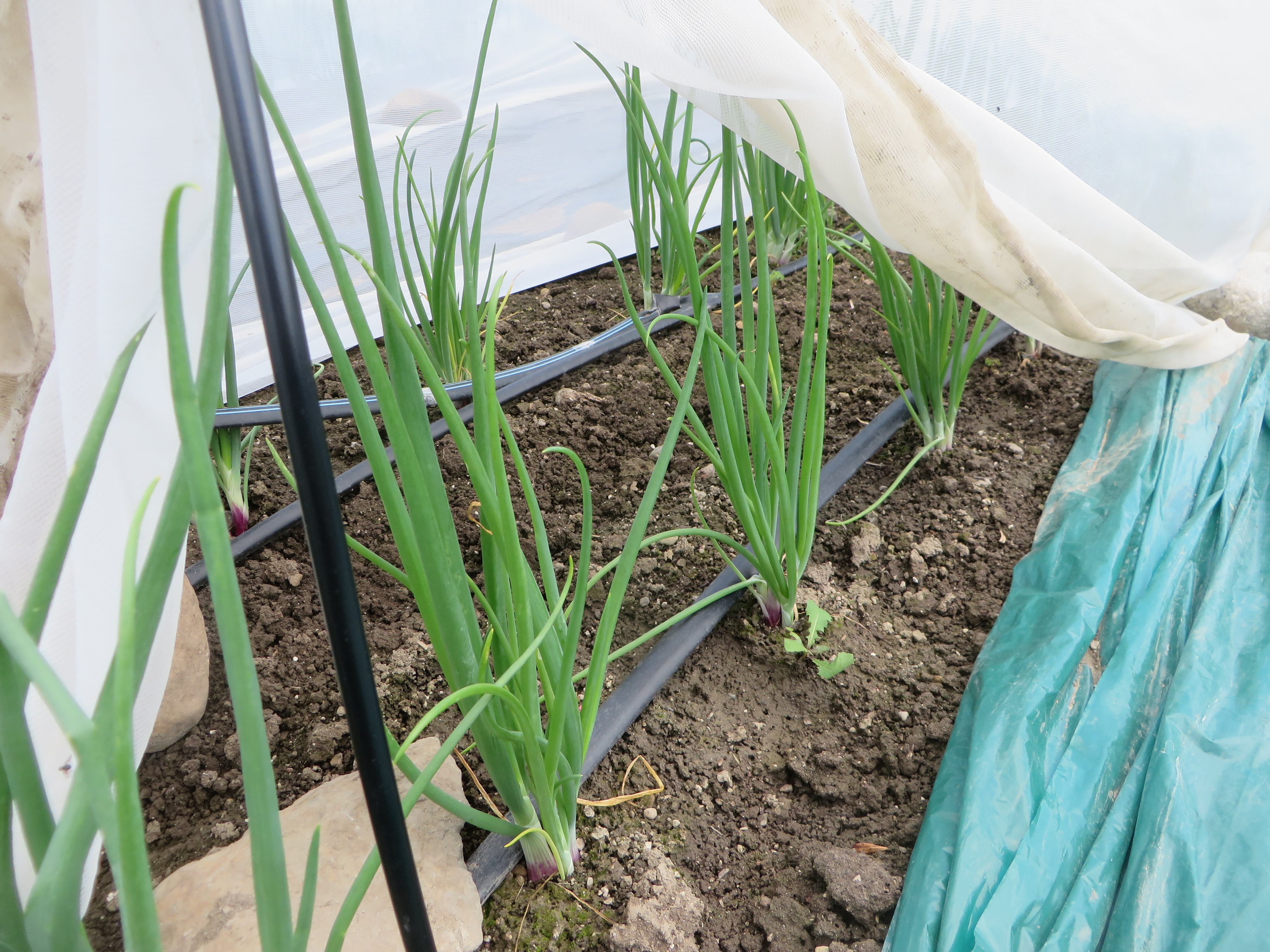
Now that the solstice has passed, our onions should start to grow their bulbs.  Our supply of frozen onion (from the imperfect or miniature bulbs rejected for customers) finally ran out last month and we had to trudge off to the store for their version of food.   

The cippolini onions should be ready for harvest in July though there will be a couple weeks of curing before we can use them.  

This year, I planted a long onion type that grows faster and is used while still fresh (no curing required).  So we might not have to wait as long as August...  Long Red of Tropea onions are an heirloom variety that I have planted a small amount of for the first time, so I have no idea what to expect.


One final note, I was informed that my hiring grant application was on a waiting list until/if new funds were released.  As our country is floating somewhere between a trade war and an economic war, I assume that there are greater needs elsewhere.

In spite of that, I hired one of our candidates that we interviewed back in the spring.  

We welcome Josee Michelle to our team (of two) at Whitsend and hope to spend as much time as possible keeping the farm fruitful and growing Josee's knowledge of agriculture and small scale farming - at least until my share of the hiring money runs out...


Help keep the money flowing in!

We still have room for a couple more shares.  I have reduced the price to reflect our first three harvests having already been delivered, and we still have pork to sell.

Contact us very soon as the number of remaining harvest shares are limited.


Thursday, 29 May 2025


We have only a few shares remaining, and sales will end very soon.  If you are interested in purchasing a share of our harvests this season, contact me very soon.

$340.00 for a full share: 11-13 deliveries from June through November.  
$164.00 for a half share:9-11 deliveries from June through November.

Pay in advance and insulate your self from food price inflation!


Hello Everyone:

The field work is moving along very quickly.  Ten hour days are the norm and six day weeks are typical.  This is one of the two times a season that determine the success of the farm, and there is no end of little details to tend to while keeping an eye on the big picture.  

Here is another big picture item, one of two false orange shrubs that we have planted near the house to provide more early season pollen and nectar for our bees and the other pollinators.  


The past few weeks have seen numerous additions to the growing field.  

Beans, lettuce, squashes, tomatoes, arugula, turnip, radish, peppers, pac choi, and as of today, the first round of potatoes.  The weather has been ranging between chilly and chillier and so the row covers have come off, gone back on again, off again, back on.  Environment Canada had a bad week and I started to use the row covers to protect the crops on nights which looked like extra warmth was not required, but why lay awake at night wondering if the forecast was wrong by 3 degrees?


As  for the rain, I won't have much concern about our aquifer going dry this season, at least for the next month or two.

Nonetheless, the irrigation is ready for the inevitable dry portion of the season.  Each year, anther drip tape starts to leak and so needs replacing.


These are the first two weeks of lettuce harvests.  Like everything else, they are benefitting from the rain but seem to be growing a little slow due to lack of sunlight.  Water alone will not do the trick.


Also plenty of seeding happening.  The first two rounds of carrots germinated well.  Reviewing my notes from previous years, it became apparent that the timing of ash application to the soil is a significant factor.  As stated elsewhere in this blog, our muck soil is low in manganese, essential for seed germination.  It appears that the ash must be applied immediately before the seeding takes place for best results.  

Spinach has been a notoriously difficult crop to germinate here, this is one of our better results.  However, they too are growing slowly despite the favourably cool weather.  


The other amendment I have been using this season is fish emulsion, which I have used sparingly in the past (particularly as I was starting out).  

I',m now using a little more and earlier than I used to, and seeing some encouraging results.  These tomatoes received an application a couple of days after transplant and unlike previous years when they seemed to do nothing for about a month, these plants are already showing fresh growth.  

The tomatoes and peppers will receive another application of fish and ash in a couple of weeks, and one final time as fruit is staring to set.


With the steady flow of transplants out the door and the clock ticking for each seeding and transplant schedule, it is easy to forget that these will be tasty food in a few weeks.  I am especially curious about the Red Long of Tropea, an elongated onion type that I have neither grown nor eaten before. 


Seeding potatoes in our new sandy loam field.  Here, I have furrowed two trenches to place the seed tubers.  This reduces moisture evaporation and gives me a head start on hilling


Finished.  The tubers are in the ground and the new tape laid out.  The white Onaway potatoes are in, and the red French Fingerlings are next in line.  

I'll have to start looking for another seed potato supplier soon.  When I was at Ellenberger's to pick up the seed potatoes, Henry inquired if I was interested in becoming Ontario's only organic seed potato supplier, as his knees were starting to give him some difficulty.

I'm not surprised he might say this, as he is of an age that is a couple decades beyond what most folks would consider retiring at.


With Henry talking abut retirement, Dick part way there and Tom and Alaine already living full time at their cottage, I suppose that means I am part of the next generation of farmers.  It's a thought that really hits hard.


Nothing is straightforward in farming.  A day after I planted the fingerlings, I was working in this area and noticed something amiss - a couple of tubers dug out of the ground.  

Careful examination of the surroundings revealed the culprit - racoons.  

I have two sprays that will be useful getting these of the property.  One is a mix of herb oils such as oregano and sage, and also contains hot pepper.  I can apply this to cover crops and areas near the food crops to act as a deterrent.  The other is coyote urine.  Small animals leave quite quickly when they sense this.  


For the most part, racoons are not too big of a problem  for food crops (except for corn, which we don't grow).  However, they are a threat for the chickens and their ability to damage and or disturb.  I suspect they dug up my trench compost I put in the chard bed, though at the time I could not find any foot prints clear enough to determine the culprit.


Transplanting and seeding and bed preparation are not the only things that have to be done here.  Compost growing is also essential, and as I use grass clippings as the main feedstock, I have to do a lot of that right now.  Ideally, there should be no grass seed in the clippings and the bluegrass (which is by far the worst weed here) and bluegrass - the dominant grass in most places here - sets its seed early.  SO most of my compost generating has to be done in the busiest time of the year as well.


Another source of fertility are our use of cover crops.  These are some f this years lettuce beds.

Last year they were seeded with snap peas, but ths did not germinate; and in turn, with no peas in those beds, there was no benefit of a nitrogen fixing plant.  So this spring, I planted field peas and some oats to cover the ed (to keep is weed free) and feed the soil with nitrogen.    


Now that I am getting close to the time when lettuce transplants are moved in, I have cut down the cover crops.  The next step is to work it in to the soil and let it decay for a couple of weeks.  


Speaking of peas, the snow peas are coming along and look like they ight be ready in two or three  weeks.  

The beds need a bit of cleaning, and the paths definitely need a mow, but otherwise I am pleased.


The work does not end.  If these plants get too much taller, the trellising will be more difficult to manage, so the stakes will have to get pounded in this week-end.  


When the work does end, I often find a surprise on my walk up to the house.  In this case, Julia's "b" garden has been spruced up and some alyssum transplanted into the bed, along with a fresh application of mulch.  .  

These are more food sources for our pollinators.  

Closer inspection revealed some of my amaranth flower transplants had been added.  I wasn't sure where I was going to put those anyway, and there was no guarantee I would have the time to plant them.


First harvest anticipated for June 12.  If your mouth is watering over the good food I have been taking about; or if you want to support local food growers, or if you want to pay for food once and not worry about price increases, now is a good time to call.

Bob