Wednesday, 1 August 2018

Hello Everyone:

Here are the details for farm visits.

If you are interested in seeing the place where your food is grown, then you are welcome to make an appointment to visit. 

Dates I am offering include August 4th, 19th, and September 1st or 2nd (TBD).

I offer two types of visits by appointment.  By knowing ahead of time, I can ensure that you have some food to go home with and ensure that there are not too many folks here at once. 

The short visit:

45 minutes to 1 hour.  A tour of the farm from seedlings in the nursery to the prep station where deliveries are packaged for distribution.  Visitors will find a few goodies to choose from before leaving.

The long visit:

1 to 2  hours or more if you are having fun.  A tour of the farm from seedlings to the prep station, and something edible to take home.  This is followed by some farm work geared to your interest and ability, such as

- Learning to use a co-linear hoe for weed suppression...no bending or kneeling.  Very translatable to a home garden setting.

- Compost turning...how to make high quality compost out of vegetable waste, grass clippings, and weeds.  A great way to burn off restless energy after a week of sitting at a desk.

- Tomato pruning...learn some of the finer points of getting the most out of your tomatoes, and introduction to the basket weave method of staking - a most economical way to stake tomato plants.

- Building a garden bed using hand tools - the broad fork, wheel hoe, and bed rake. 


Things to know to make your farm visit safe and enjoyable:


This is a working farm and a little rough and ready around the edges.  The following tips are important to consider.

Farming is a rain and shine sport so dress appropriately.  A brief downpour will simply move the tour into the barn, but lightening will cancel any visits immediately. 

There is a limited amount of shade from mid afternoon onward, again, be suitably prepared.

Toilet facilities are very limited so come prepared.  I may be able to open up the "rustic facility" for children's emergencies, but that will entail removing a lot of overgrowth - I'll see what can be done. 

The ground is uneven, so wear sturdy footwear. 

There are ticks and there may be some wild parsnip sprouting in the grass paths, so keep your ankles covered.  I have controlled the parsnip in most of the public areas, but these plants do sprout regularly so be vigilant (and point them out to me should you find any).  A portion of the field will be marked off limits due to some parsnip that is persisting.  Do not cross the barriers I have set.

Children are welcome though it is imperative they are kept close.  Everyone's food is in this field and a misstep or tumble could result in someone going short.


There will be opportunity for some carrot pulling for visitors aged somewhat young to growing older.

In September, there will be some radish pulling - ideal for those learning to grasp or slightly older. (good for photographs!)

If you are an avid birder, bring your binoculars, you might be in luck as the usual feathered friends have tamed up somewhat here and its easy to watch their behavior.  More unpredictable are visits from a heron and a bird of prey I can't identify (smaller than a red tailed hawk).  Most interesting are the sparrows patrolling for the potato beatles and horn worms.

Mosquitoes and deer flies are mostly absent.  If there is no breeze, the gnats may be a mild nuisance.  Rejoice, this is as good as it gets!


Directions to the farm:


Directions from Stittsville
:  

Travel south on Stittsville Main (This turns into Huntley Road as you leave Stittsville).

Pass Fernbank, Flewellen (Stanley Corners), and Fallowfield Road (Karter’s Corner). The next crossroads is Mansfield Road (turn right, or due west).

Drive approximately 4 minutes. It is on the left (or south) side of the road. You will see an old log barn about 200 feet off the road that has new cedar doors, turn into the lane way just before it.

If you arrive at 7070 Mansfield Road (also on the left, you have gone a bit too far. Turn around, and drive past the houses on the south side of the road; just past the last house you will see our lane way.


Directions from points west, or Hwy 417:  

Turn off Hwy 417 at Dwyer Hill Road, travel south.

Pass Golf Club Way, Crawford Road, Fernbank, and Flewellen.  Turn left or east onto Fallowfield Road. Pass Kolo, and Biltmore Cres., and turn right or south onto Munster Road.  Pass Biltmore Cres. and turn left or east onto Mansfield Rd.  Pass Conley Rd.

Watch for 7042 Mansfield Rd and turn into the next lane way on your right.

Directions from West end of Ottawa:

Drive west down Hunt Club until you get to the very end, then turn left.
Drive to Fallowfield, then turn right.
Drive to Huntly, then turn left.
Next right is Mansfield.

If you get to a cross road (Mansfield and Conley), you have gone a little too far, turn around and go to 7070 Mansfield.

When entering the lane way, drive slowly for everyone's safety.  Park under the trees to the right of the lane.  When exiting, there is ample space to turn around south of the barn.


Sunday, 29 July 2018

A month of ups and downs.  Both have been quite time consuming and I am either too tired or too busy with bigger farm priorities to get much writing in.

From so dry that pushing electric fence stakes into the ground was a two handed task to so wet that plants were falling over, compost was soaking wet and straw protecting the celery was matted down.

The garlic harvest went smoothly.  With plenty of time to do a careful and methodical job, there were no mix up of types and no damaged bulbs.  The bulbs were processed quickly and into the barn before any sun damage could occur, and strung up before the rodents could get a chance to sample them.

Also good was the quality of the bulbs.  The plants appear to be healthy and from the outside look to be virus free.  This is always a concern  - garlic is grown as clones from their parent and so tend to be susceptible to genetic accidents and viruses.  Viruses can shorten shelf life in the winter, and both viruses and mutations can compromise the bulbs reserved for seed.

Unfortunately, the bulbs have turned out very small.  This is disappointing and not a bit puzzling as well.

Fertility is not the issue - the garlic beds were amended the same as the bulb onions and leeks, and they appear to be growing very well.  An old farming adage is that one should reserve the best beds for onions.  I treat their close relations the leeks and garlic to the same care - double compost, greensand, calphos, and leaf mold.

It's possible that I did not strike the right balance of watering and dryness.  To much of either can be detrimental to garlic and after last year I was a bit spooked by loosing half the harvest due to too much moisture.

I'll let the garlic cure for another week and then do a final grading for seed qaulity.  After that, they will be cleaned and prepared for distribution.

Another up and down came from the carrots.  The carrot yield was a little smaller than I anticipated.  In my experience, spring carrots do not size up as most roots tend to take their growing cues from shortening days. 

The amount of tap root on the carrots indicate more growth potential, but to leave them in the ground for much longer would leave everyone all the hungrier. 

I tried to mitigate this this season by delaying the first sowing of carrots, but it did not seem to make a difference. 

I think next season I will try to mini "round" carrots.  These take a lot of space but if they are as good as folks say they are, might as well give them a try.  . 

Anyhow, at least the roots seem to be in good shape.

The day after delivery (Thursday) I arrived at he farm to find I had forgot the micro carrots (the teeny ones that we keep for ourselves) had been left in a bucket which had subsequently filled with rainwater.  .

I drained and threw these into a bag and went about my day and headed home, excited to clean and roast my first carrots of the season.

Not long after starting to wash these, I started to come across mushy spots on the roots.  More than 3/4 of the roots, to be more or less precise.  I sent out an email to the customer base, feeling terrible that not only was it a small yield, but a damaged one as well (how had I missed this on harvest day?!?!)

A few replies trickled in - everyone said the carrots were awesome.  Later that evening, while starting some items in the fridge, I found a bag of micro carrots I had forgotten about - what i had brought home Monday night after the carrots were harvested.  These were fine - no mush, no spots.

I suppose the second bag of carrots went bad due to sitting in that rain filled bucket in 30 degree heat.  At kleast these get a head start composting - these ones will be beyond palatability for the rodents who think that stealing my fertility is acceptable. 

Naturally, the biggest up also included the biggest down. The potato harvest was a fine success.  The worst that I saw was a bit if scab on the white potatoes.  There was very little worm and rodent damage, very little greening.  Overall, a bountiful harvest from each bed.  No record breaking yields, but a small increase per bed yield from last season, which I anticipated.  I use potato yields as one of my fertility measures.

We sampled some of the fingerlings this week and as usual, the taste was a good as ever.

When the first potato harvest is complete, it is time for the sowing of the fall potatoes.

One reason I do this is to disrupt the potato beatle cycle in the field.  Assuming there are beatle eggs on the early crop's leaves, by harvesting and composting these leaves early, an entire generation is wiped out.  Now these potential hatch-lings won't be around to infect the late season potatoes.

So I opened up the seed potato container and found 90 Lbs of rotten late season seed potato.

A big down.

I have had experience with somewhat rotten potatoes before (some of our saved seed from last year was in rough shape owing to the less than adequate year winter storage set up I had) but at least 2/3rds of these sprouted and that turned out to be enough.

So I planted thees ones and hoped for the best.  A week later, there was no sign of any emergence.  Another down.  I dug a few up and found that instead of any growth, the tubers were turning to mush.

I called our seed potato supplier, and not only did he have some left over ( a big up), Henry indicated that there were enough for our needs (another big up).

That meant a day trip to Coe Hill (a day lost to travel was a down, but I love the drive from Calabogie to Bancroft and will take it every chance I get - an up despite the added kilometers, time, and gas money).

Henry was there with his usual smile and well spring of potato knowledge, and I learned several facts about grading tubers as we sorted through his remaining inventory.  This, along with the fact that he announced that there was a half price special on for the day, was a very big up, though none of the red chieftains appeared suitable for planting.

This was a down as chieftains are one of the tubers I like to reserve for seed use each year - they have a dependable shelf life for the customers.  They are one of the varieties that I keep for seed.

Unfortunately, most of the seed potatoes that were available are licensed for seed production only, so I can't save many of them for next year.

After some gentle arguing over his outrageously low price, we packed up the Subaru and turned south toward hwy 7.  A relatively boring drive with much worse traffic, but a five minute detour took us past Elmtree Farm.

Elmtree was where I did my internship 10 years ago.  Tom and Allaine retired a couple of years back and sold the land for a very nice price - had they waited a year we could have bought the place.

It looks like a farm of some kind operates there now, so at least that beautiful place is being used appropriately - the sign indicated it was an organic farm, and I can at least rest assured that those little purple and blue salamanders are still happily living in the wood chip pile at the edge of the forest as they did when I was there.

On the way back to Ottawa, we managed to stay ahead of a violent storm following us out of the west.  Judging by the clouds ahead of us, we were following another storm system.  No need to speed or linger.

A quick stop a the farm to check on the nursery revealed several dead lettuces in an overheated outdoor nursery, but the kohlrabi showed no more signs of earwig damage in the indoor nursery - apparently the application of diatomaceaous earth did the necessary work.

We arrived home to find the planter hanger in the front yard had became so heavy with rainwater that the pole had bent to the pont that the planters were resting on the ground.  Is there any more downs to contend with?  At least the planters came to rest right side up...


As always, more to write and a few photos to add...we have a farm viewing to attend soon and I have some beans to clean up and put by....

Bob

Thursday, 28 June 2018

Hello Everyone:

Update July 20th:

The fingerling potatoes are harvested.  Looking very good.  Fingerlings are typically small tubers, but don't let that put you off.  They are considered to be the most flavorful of all potato types.  The skin is very thin, so don't waste your time peeling them.

The garlic is harvested.  The plants are healthy, but the bulbs are unusually small.

Important  - added delivery dates, confirmed farm visit dates:

As indicated on this site earlier this season, I have added two delivery dates.

August 29th.


September 26th.


I have reserved some time for scheduled  farm visits for the weeks of

August 1st

August 15th

More details regarding farm visits to be posted soon.


I hope that the last few deliveries have sufficiently whetted your appetites.  More crops are now coming in and we can expect larger deliveries from now until season's end.

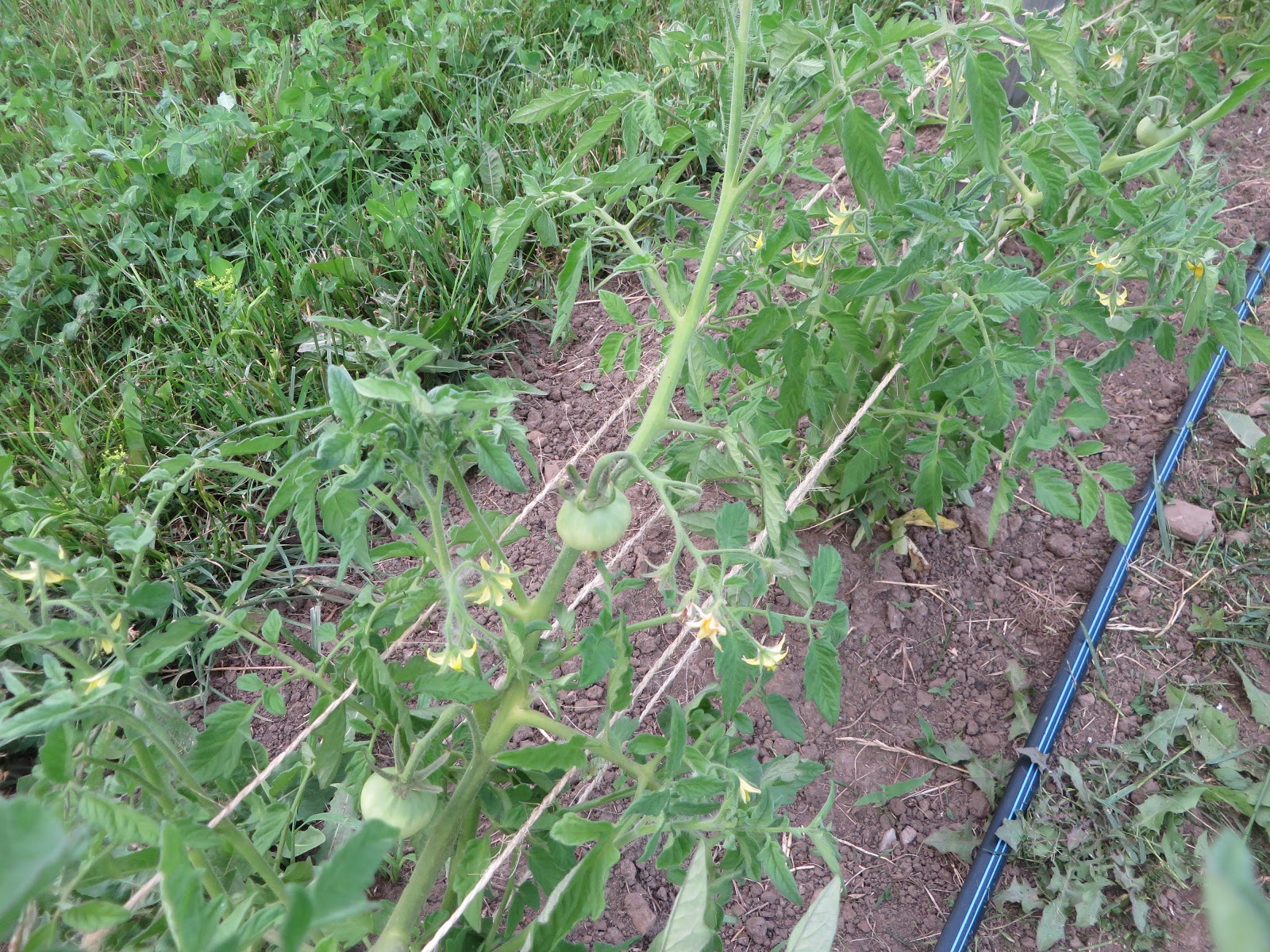
I am especially looking forward to the tomatoes and peppers - the plants are just starting to set their flowers.

Some plants have set their first fruits, these are candidates for seed saving.


Water saving techniques - I hoe a shallow trench around the squash plants to capture rainfall and mulch over it to reduce evaporation.

The irrigation system helps somewhat, though these deep rooted plants do best when planted in areas of the field with a shallower water table.

Until the irrigation system is extended to this new area of the field, I water by hand.

The straw also helps protect the fruits from rotting due to contact with the soil.


As I have written elsewhere, an irrigation system running for a week will not provide as much water to the crops as a twenty minute period of gentle rain.

Likewise, a trace amount of precipitation can soak into the ground a lot more thoroughly when the ground is already wet from the irrigation system.

A few notes about this week's lettuce:

I'll start by reserving my own judgment on the quality until the end of this post.


In previous years, I composted some lettuce that I felt was substandard.  The growth was there, but the leaf quality sometimes seemed a bit tough.

On one occasion, a pick-up customer noticed the basket of rejected heads set aside and inquired if that was extra.  I explained, she requested a sample, took a bite and declared there was nothing wrong with it.


I delivered some similar lettuce late last season (recall the weather was quite dry here in September?) and then referred to this in last years customer survey.  Most respondents claimed the lettuce was good; one noted that it was "...a bit bitter in salads but great for sandwiches."

Last Friday as I checked the crops for forthcoming harvest, I observed that the lettuce leaves seemed a bit tough, presumably due to lack of water.  With rain predicted for Saturday and or Sunday, I decided that the precipitation would give the plants enough moisture to soften up.

We were away on a farm search on Saturday; when we stopped at the farm that evening to close the hardening off shelter, I checked the rain gauge and found only a trace amount had fallen.  More rain appeared imminent (indeed, we drove through some on our way to Kanata) and I thought no more of it.


Sunday I was at the farm and it showered lightly a few times.  By the time I was closing up, a heavy cloud and rain curtain was a few kilometers north, and the wind was bowing from that direction.  I closed up and left, glad that finally there would be enough water to soak the ground.


Upon my return Monday, the rain gauge indicated less than half an inch had fallen all day Sunday and Sunday night - the heavy rain must have passed the farm (the photo here shows a similar event a few years ago).

By Tuesday morning, it was apparent that the rain had not penetrated very far; a quick finger test indicated that most beds were quite dry below the surface.


Had I turned on the irrigation the previous Friday evening and left it on for 48 hours, what little precipitation that fell would have soaked into the soil more thoroughly - soil saturates one layer at a time - and thus what we received would have penetrated deeper.

What does this have to do with the lettuce?

In my opinion, this week's lettuce is tough not crispy.  The flavor is strong, though typically (again, my opinion) lettuce ought to have a strong, slightly bitter flavor - hence my preference for red leaf lettuces and my disdain for iceberg.  Overall, I was disappointed.

However, I kept reminding myself about the pick-up customer and positive results from the survey and concluded that it was better to deliver this then to let it go to the compost to turn into next years food.

My thoughts were the same for the endive, I like the flavor, but think it is a little too strong and probably too tough.

It has been a few years since I have grown endive.  Shortly after transplant this season, I realized this variety is different than what I have grown in the past as well, so I don't have anything to reference it to (the endive I grew back in 2013 had much smaller leaves, with a tightly bunched and slightly blanched heart.

Should I have assume that the rain was not going to come?  I had every indication to believe it would...

Just to be absolutely certain, I got the irrigation on yesterday in spite of rain in the forecast; hopefully the lettuce growing now will be in better shape next harvest - July 11th.


Friday, 22 June 2018

Update June 24:

I have included lettuce and frissee endive in this weeks delivery - details to be found on this weeks harvest page.


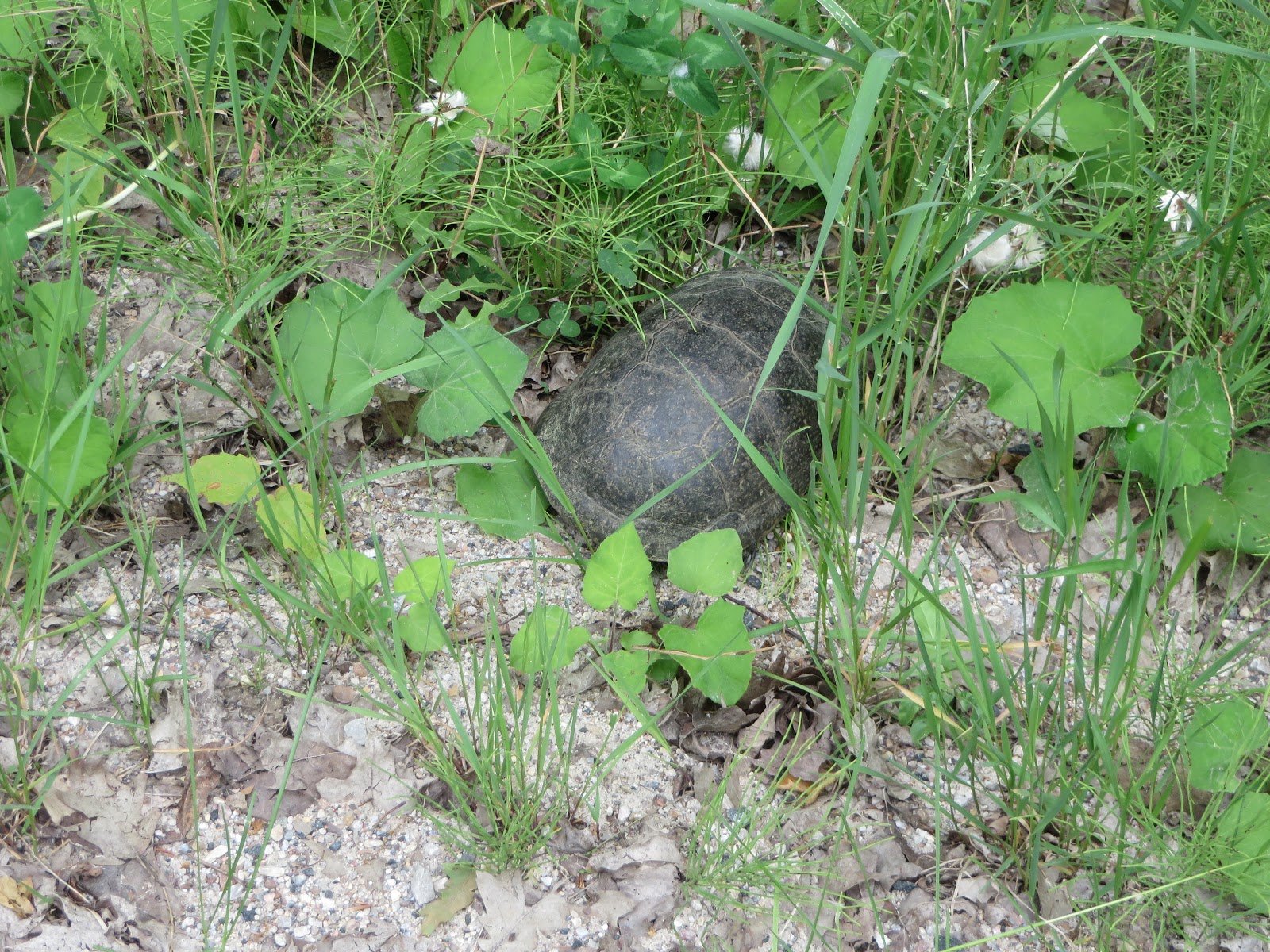
Blandings or Box turtle we helped across the road that day.

Hello Everyone:

Eastern ontario is so full of little corners and details that I think we can spend a lifetime of week-ends exploring it.

While on a trip to view another farm property, we found across a farm gate store and went in to visit (hoping to get some inside info on the neighborhood).

We got that, and an impromptu tour of an alpaca farm.


Could this be the place?

Seems to cover a lot of our needs, but the soil appears a bit weak - too much sand, not enough silt and clay.

We'll need a more detailed look at the back pastures to see what the ground has in it.


Finally the peas have brought forth their bounty.

I set my plans last fall based on a worst case scenario of a "ground still frozen" date, and nature exceeded that by one week.

That delayed  my pea planting by four days.

Our first harvest this week yielded enough for about half the customers; the rest of the pods required four days to mature.

Eight years of farming and still being reminded that I am not the one writing the rules.


The field is so full of food - I wish it were a ready now!

Here is one of two kale beds.  I had hoped for three beds but brassica crops are tricky to place due to their negative impact on crops which follow them (beans and peas are less affected, and potatoes and squash seem to be not affected too much).  There is more space in the autumn so I tend to plant more of them then.


Planting two kale beds makes it a bit trickier when trying to alternate with chard as the chard is easy to place in the field.  Here is one of three chard beds.

As such, customers generally receive more chard than kale over the season.


The lettuce is finally starting to size up - the heavy rain of a week ago made a huge difference.

An hour of gentle, steady rainfall will provide the what a hi tech irrigation system requires a week to deliver to the crops.

(My irrigation system is definitely lo tech).

I try to do some of the lettuce watering by hand as I have found that the leaf quality improves immensely, especially in the heat.


Like it's close relation lettuce, the celtuce also prefers the hand watering.

Beds not serviced by the irrigation become natural choices for fitting this limited crop in - in this case, it is transplanted under a tomato bed.


Another example of under-sowing - radish under the cucumbers.


This is one of the ways that I can fit the brassica crops into the rotation without having too much impact on following crops.

Once the radish is out, the edges of the beds are cultivated and a light sowing of dutch clover is planted to replenish the soil.

When the cucumbers are finished, the entire bed is cleaned and then either cover cropped for the rest of the season, or perhaps reserved for extra fall potatoes if needed.

Look carefully, the first cucumber flowers are just starting.


I mentioned lo tech irrigation earlier.  These irrigation tapes have the annoying ability to move on their own.  Each time the system is turned off, the tapes warm up, expand, and twist about.

Part of the routine of turning the system on involves straitening each of them out.

Here's an example among the first carrot crop of the season.

The plastic mulch in the adjacent bed is suppressing weeds until I can get the bed cleaned up.

I don't care for the plastic mulch too much.  There have been a few times when I have lifted it up to find dead frogs trapped underneath, particularly in the spring.

And inevitably, the mulch needs to be thrown out as it begins to break down.  Neither the organic standard or my conscience will allow this to disintegrate into the soil.


Celeriac transplanted a couple of weeks ago.

I expect it won't look much different for another two weeks or so - I refer again to the posts back in early march when these pants were the size of a pencil tip.

This part of the field has a shallow water table so some of the heavy drinkers are planted here.


One of this season's development projects - spelt.

Spelt straw has hollow stems which make it a great insulator for overwintering crops or winter bedding for animals.

I am trying my hand at it as we hope to have year round pigs and ducks at our new farm.

As this si a small scale experiment, I am also including buckwheat within the spelt.


My theory is that buckwheat grows much quicker than the spelt, so I can scythe it's tops and allow that to fall back to the ground, providing nutrient for the soil and some additional weed suppression.

Unfortunately, I do not have a hammer mill to harvest the grain.  Unlike other grains, spelt grain cannot be threshed by wacking it on the ground.


The east field is finally planted - here are some of this years kidney beans.

ate season potatoes and mini winter squash are soon to be planted in this plot as well.

Two years ago, our pigs were hard at work here eating a lot of the persistent weeds such as quack grass, dandelion, and wild parsnip.


The romano beans should be flowering soon, with beans to appear about two weeks after that...

So much promise, so much waiting, and so much to do in the meantime...