Hello Everyone:
 A little later a post than I had anticipated...plenty
to do and though I enjoy writing about the farm, it is easy to get outside and
stay there once the weather starts hinting of all the work needing to be done. April and May is the busiest part of my
season.
A little later a post than I had anticipated...plenty
to do and though I enjoy writing about the farm, it is easy to get outside and
stay there once the weather starts hinting of all the work needing to be done. April and May is the busiest part of my
season.
Our search for interns is just about wound up, and down
to the most probable candidates. From
what I have seen so far, the final cut will be a difficult choice.
 We have another six shares left to sell. If you know of anyone who might be interested
this season, please let me know and or forward my contact info to them.
We have another six shares left to sell. If you know of anyone who might be interested
this season, please let me know and or forward my contact info to them.
This season is a tough sell due to the reduction
in deliveries, a lot of short term pain for long term gain. This phrase keeps going through my
mind as I struggle to pull together the threads that consist of this season’s
efforts.
The new farm is improving incrementally, slower than I
would prefer but at a steady pace. I’ve
built a set of stairs (replacing a ladder) for the ‘hexagon’ – the two storey
shed that will house the future nursery and production office. It’s providing space to store tools until the
tool shed at the old farm is dismantled and brought here.
The A-frame shed is getting its collection of junk
cleaned out to make space for the chicks due to arrive in May. Overgrowth
around the electric fence is getting g cut back and the fence itself being
re-configured to meet our needs.
Just about every tire that came with the farm needs
patching...
The Stittsville farm is quickly losing its snow cover,
and nursery work is going mostly ok there.
Mostly as in everything is ok except the bulb onions,
which have succumbed to a considerable amount of damping off, probably due to
running the nursery a little too cool – in an effort to keep the seedlings from
drying out.
The other crops parsley, celery, celeriac, cutting
celery, green and extremely hot peppers are growing alright. The moderately hot peppers failed to
germinate. I can start these again after
ordering more seed though their first delivery will be a little late as a
result.
The biggest challenges are limited income (smaller
customer base this season) and keeping my spirits up.
 There are certainly moments when the task ahead is
frighteningly daunting. I constantly
remind myself to ignore the big picture much of the time and focus on the
priority task before me. As I move about
the farm, the details are in plain view and difficult to ignore. The receding snow adds to the sense of time
ruining short...chickens arriving in May, repairs to see to on the fence,
preparing for the bee-keeping, getting the new interns up to speed, signage for
the farm gate store, dismantling sheds at the old farm and having them trucked
up here...all this in addition to the usual work.
There are certainly moments when the task ahead is
frighteningly daunting. I constantly
remind myself to ignore the big picture much of the time and focus on the
priority task before me. As I move about
the farm, the details are in plain view and difficult to ignore. The receding snow adds to the sense of time
ruining short...chickens arriving in May, repairs to see to on the fence,
preparing for the bee-keeping, getting the new interns up to speed, signage for
the farm gate store, dismantling sheds at the old farm and having them trucked
up here...all this in addition to the usual work.
Despite the lower income this season, I am
glad we are only serving about a third of the customer base from previous
seasons.
I spoke during the previous post about investments for
the future of the farm. My activities of earlier this week are a good
example. I was preparing the shitake
mushroom nursery...
Shitake mushrooms have long been a favourite of mine
since discovering them in my early twenties.
My favourite means of preparation are sautéed in a sauce of honey,
garlic, and ginger, though I have been treated on more than one birthday with
“mushroom stroganoff” that includes shitakes and as many other varieties as
Julia can find in the store. Shitake is pronounced
Shay-Tawk-Eh, translated from Japanese as “Oak Mushroom”.
During my internship, our CRAFT farm group gathered at
Desert Lake Farm for a half day workshop on shitake growing. The spores of inspiration were inoculated in
my mind that morning.
 During our property search , one desired
criteria was access to a woodlot with hardwood trees. We were elated when we found that the sellers
were willing to share the resources of their adjacent woodlot.
During our property search , one desired
criteria was access to a woodlot with hardwood trees. We were elated when we found that the sellers
were willing to share the resources of their adjacent woodlot.
These mushrooms grow on hardwood. Fruiting trees such as apple or
cherry are notoriously poor. The seller of our property offered us the opportunity
to harvest ironwood trees from their woodlot, so this is the type we are
using.
The traditional method for growing shitakes involves inoculating
logs and leaving them in a forest for a season.
The trees need to be cut during the winter, after leaf
fall and before the trees start budding.
This ensures that most carbohydrates remain in the wood for the mycelium
to consume.
The trees are cut into four to five foot logs, ranging
in diameter of about five to eight inches.
The remaining portion of the trees can be cut into logs for firewood, as
ironwood makes great fuel – it burns slowly with a fairly hot flame.
Off to the woodlot to start harvesting trees. Tools of the trade:
 Not your average gardening tool. Chainsaws require some specialized training
and safety gear. As I am using one on
someone else’s land for commercial gain, I am obliged to have certified
training and top of the line safety gear, what’s known as “class A” chainsaw pants,
and CSA approved boots and helmet.
Not your average gardening tool. Chainsaws require some specialized training
and safety gear. As I am using one on
someone else’s land for commercial gain, I am obliged to have certified
training and top of the line safety gear, what’s known as “class A” chainsaw pants,
and CSA approved boots and helmet.
The most important piece of safety equipment is stored between
the ear protectors...
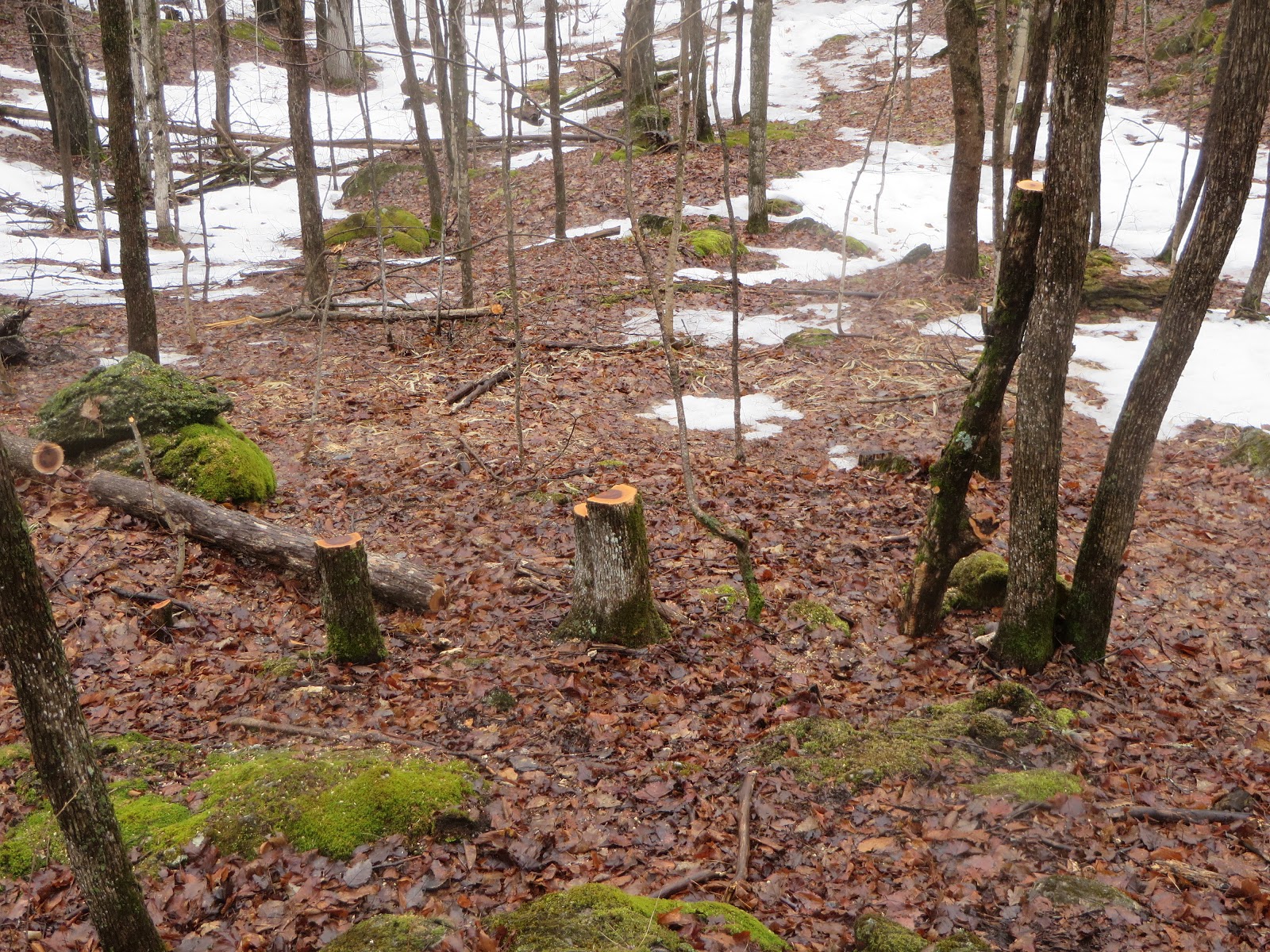
 After selecting suitable trees, they are felled.
My twenty year old self might be a little horrified at
the idea of felling live trees for mushroom growing. After all, mushrooms can be grown in a
“mushroom house” on sawdust – kind of like a greenhouse except dark, damp, and
cool. There are too many structures I need to build for other purposes and
the quantity of mushrooms I hope to produce don’t warrant it. Besides; my somewhat older self likes the
traditional techniques when they are more practical.
As well, I have learned a few things about forestry
over the years.
Managing a woodlot is like maintaining a self seeding
perennial garden. The idea is to
maintain a steady production of desired crops, with a little pruning or culling
to influence the character and productivity of the ‘garden’.
In this case, the landowner wants to promote more oak,
cherry, walnut and maple in the woodlot.
To make more space for these species, the less desired ironwood is
thinned out. Some folks around here
regard Ironwood as a weed. It certainly
is prolific.
Trees that are not quite big enough are left for future
mushroom logs.
The logs will finish producing mushrooms in about four
to five years, depending on size. Full
of mycelium, these will decay fairly quickly and return their nutrients and
carbon to the forest floor and regenerate the soil. In a rocky region such as this, more soil is
especially beneficial.
Another way I look at is that the forest contains a
certain amount of nutrient mass.
Removing the fruiting bodies of the mycelium is all I am taking from the
forest, the rest returns albeit in an altered state. Less cellulose, cambium, and leaf matter,
more mycelium. Less sun life, more soil
life. Is there any death here, or just a
change of state? Mushrooms are profound
creatures indeed...
 After a day of cutting (thanks for spotting me Dean) we
have a lot of down trees. The logs are
bucked and it’s getting late and starting to get chilly. This is good, for the snow will be firm for
the work ahead tomorrow...
After a day of cutting (thanks for spotting me Dean) we
have a lot of down trees. The logs are
bucked and it’s getting late and starting to get chilly. This is good, for the snow will be firm for
the work ahead tomorrow...
As I walk back to the car, I pass the first trees that
were felled earlier in the day. I think
of my grandfather. He used to cut trees
in the bush for a living. His name was
also Bob.
Next morning...
 Now that the logs are cut, they need to be taken to the
location I have chosen for the mushroom nursery. As the logs require periodic soaking in cold
water, I have chosen a spot where a year round creek runs from a springline a
few hundred feet away. As it is near to
source and fast moving, this water should remain quite cold even on the hottest
days of the year.
Now that the logs are cut, they need to be taken to the
location I have chosen for the mushroom nursery. As the logs require periodic soaking in cold
water, I have chosen a spot where a year round creek runs from a springline a
few hundred feet away. As it is near to
source and fast moving, this water should remain quite cold even on the hottest
days of the year.
Another criteria mushrooms require is shade. Shitakes grow in forests, where the
temperature is moderated throughout the season and direct sunlight reduced to a
minimum.
The lingering snow in the forest can be put to work,
along with an old children’s sled I found stashed on one of the sheds here. With a bit of twine and some clever knots, I
start the process of getting these re-located.
Why do most of the ironwoods grow on the opposite side
of the woodlot from the nursery? At
least most of this trip is downhill.
Now that the logs are gathered, they need to be propped up off the ground, to prevent contamination from other mycelia in the ground.
 At this point, I have reached the limit of what I can
do for now. The mycelium is being ordered,
and should arrive in a few weeks. At
that time, I will add more to this post, detailing the inoculating process.
At this point, I have reached the limit of what I can
do for now. The mycelium is being ordered,
and should arrive in a few weeks. At
that time, I will add more to this post, detailing the inoculating process.
After inoculation, logs are left for a season while
the mycelium colonizes the wood. During the
colonization period, the logs need to be soaked periodically so as to remain
moist. For this purpose, immersing the
logs in the creek will suffice. In our
climate, the colonization process takes about a year.
If all goes according to plan, the mycelium
will fruit, producing the final product for harvest, for spring 2020.
 During the mushroom harvest, care needs to be taken to
protect the fruits from predation – rodents of all types will eat these, as
will slugs.
During the mushroom harvest, care needs to be taken to
protect the fruits from predation – rodents of all types will eat these, as
will slugs.
Hardware cloth will keep out the rodents, and some ash
and eggshells scattered around the base of the logs for the slugs.
Usually, logs will produce fruits twice each year, in
the spring and fall. However, a
technique known as “shocking” the logs is said to encourage a more even
growth.
Traditionally, Japanese growers used mallets to strike
the logs. I presume this opens up minute
cracks to encourage mycelium growth and fruiting, but that is just a guess.
A more recent shocking technique is to re-immerse the
logs during the fruiting season in cold water.
Now that the logs are pre-positioned for their inoculating,
I take a much needed break and think of the relatively easy work ahead of
me. The hardest part to do now will be
the waiting to see (and taste) the fruits of my labours.

Waiting is worth it!
Here are the fruits of my labours from last season.
Months after harvest, the last of our butterscotch
squashes are starting to look like their shelf life is nearing it’s best before
date.
Even the ugly looking one is as rich and orange inside.

Roasted up...there is no time to make soup today, so we roast them, let them cool, and get them into the fridge.
Post script: we did make the soup a few days later. Now that I am watering your mouth, I suppose I'll have to get the recipe from Julia and get it posted here. Just in case some of our last season customers are looking at their squashes and wondering what to do with them...

 Another update as of this afternoon...they're here...


 The seedlings are still quite young, so a little added protection is provided by the row covers for the first week or so. It helps break the wind, reduces the fll strength of the sunlight, and hods in the heat for the cool nights.